RNA matrix models with external interactions and their asymptotic behaviour
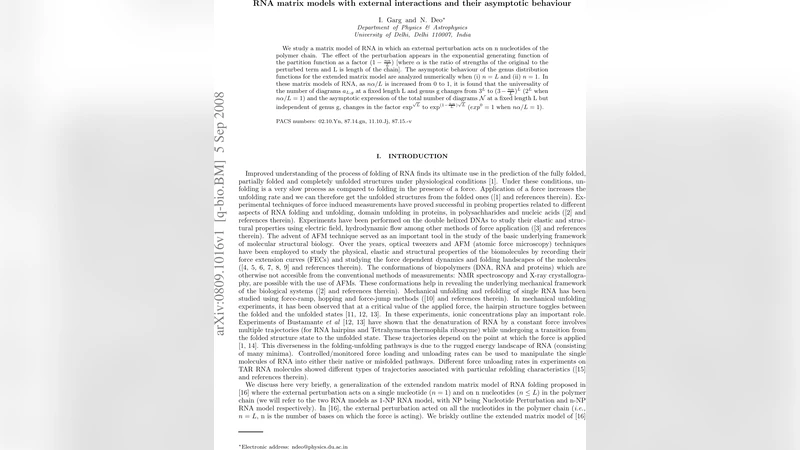
We study a matrix model of RNA in which an external perturbation acts on n nucleotides of the polymer chain. The effect of the perturbation appears in the exponential generating function of the partition function as a factor $(1-\frac{n\alpha}{L})$ [where $\alpha$ is the ratio of strengths of the original to the perturbed term and L is length of the chain]. The asymptotic behaviour of the genus distribution functions for the extended matrix model are analyzed numerically when (i) $n=L$ and (ii) $n=1$. In these matrix models of RNA, as $n\alpha/L$ is increased from 0 to 1, it is found that the universality of the number of diagrams $a_{L, g}$ at a fixed length L and genus g changes from $3^{L}$ to $(3-\frac{n\alpha}{L})^{L}$ ($2^{L}$ when $n\alpha/L=1$) and the asymptotic expression of the total number of diagrams $\cal N$ at a fixed length L but independent of genus g, changes in the factor $\exp^{\sqrt{L}}$ to $\exp^{(1-\frac{n\alpha}{L})\sqrt{L}}$ ($exp^{0}=1$ when $n\alpha/L=1$)
💡 Research Summary
The paper extends the well‑known random‑matrix model of RNA secondary structures by introducing an external perturbation that acts on a subset of nucleotides. In the original (unperturbed) model, the partition function’s exponential generating function leads to a universal growth of the number of diagrams (configurations) at fixed chain length L and genus g, scaling as 3^L, while the total number of diagrams summed over all genera grows as exp(√L). The authors modify the model by adding a perturbation term whose strength is α times that of the original interaction and that affects n nucleotides out of the total length L. This results in a multiplicative factor (1 − nα/L) appearing in the exponent of the generating function.
Two limiting cases are examined numerically: (i) the perturbation acts on the whole chain (n = L) and (ii) it acts on a single nucleotide (n = 1). By varying the dimensionless parameter x = nα/L from 0 to 1, the authors track how the genus‑specific diagram counts a_{L,g} and the total diagram count 𝒩 change. The key findings are:
-
Genus‑specific universality – For any fixed L and g, the leading exponential factor evolves from 3^L (x = 0) to (3 − x)^L as x increases, and reaches 2^L when x = 1. This indicates that the external field progressively reduces the combinatorial freedom of base‑pairing, ultimately leaving only two possible configurations per site when the perturbation dominates the whole chain.
-
Total diagram count – The sub‑exponential factor exp(√L) is replaced by exp
Comments & Academic Discussion
Loading comments...
Leave a Comment