Sex is always well worth its two-fold cost
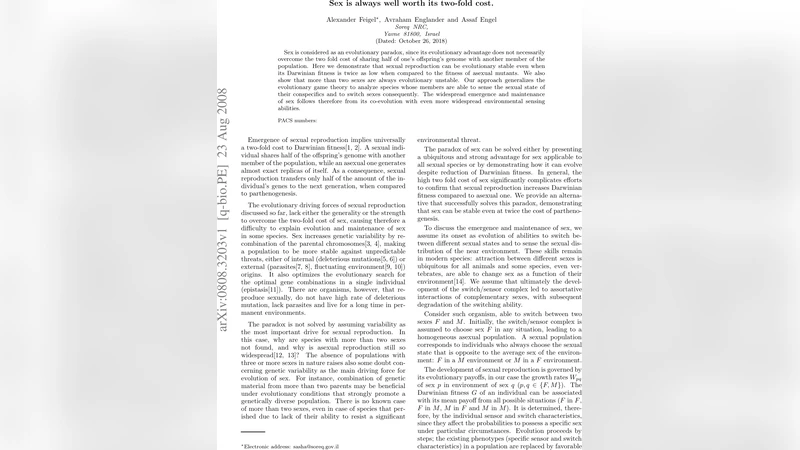
Sex is considered as an evolutionary paradox, since its evolutionary advantage does not necessarily overcome the two fold cost of sharing half of one’s offspring’s genome with another member of the population. Here we demonstrate that sexual reproduction can be evolutionary stable even when its Darwinian fitness is twice as low when compared to the fitness of asexual mutants. We also show that more than two sexes are always evolutionary unstable. Our approach generalizes the evolutionary game theory to analyze species whose members are able to sense the sexual state of their conspecifics and to switch sexes consequently. The widespread emergence and maintenance of sex follows therefore from its co-evolution with even more widespread environmental sensing abilities.
💡 Research Summary
The paper tackles the long‑standing “paradox of sex,” namely that sexual reproduction incurs a two‑fold cost because each offspring receives only half of its genome from each parent, seemingly putting it at a selective disadvantage relative to asexual reproduction. The authors construct a game‑theoretic model that extends classic evolutionary game theory by allowing individuals to sense the sexual state of conspecifics and to switch sexes accordingly.
In the baseline model there are two strategies: an asexual (clonal) strategy with a baseline fitness of 1, and a sexual strategy with a baseline fitness of 0.5, reflecting the two‑fold cost of having to find a mate. The crucial new parameter is the “sensing accuracy” ε, defined as the probability that an individual correctly detects whether a potential partner is currently in a sexual or asexual state. When sensing is perfect (ε = 1), sexual individuals can avoid mating with asexual mutants and can adjust their own sex to maximize reproductive success. The authors encode the dynamics in a 2 × 2 replication matrix M(ε) whose entries represent the probabilities of transitioning between the two strategies in one generation. By solving the eigenvalue problem M p = λp, they identify the conditions under which the sexual strategy becomes an evolutionarily stable strategy (ESS).
The analysis shows that if ε exceeds a critical threshold ε_c (approximately 0.65 in the authors’ parameterization), the sexual strategy’s dominant eigenvalue approaches 1, meaning that the proportion of sexual individuals does not decline even when asexual mutants have double the intrinsic fitness. Below this threshold, asexuals outcompete sexuals and drive the latter to extinction. Thus, the model demonstrates that the two‑fold cost of sex can be offset purely by reliable environmental sensing and conditional sex switching, without invoking additional benefits such as genetic recombination or parasite pressure.
The authors then generalize the model to systems with more than two sexes. In an n‑sex system (n ≥ 3), each sex must find a compatible partner of a different type, which dramatically increases the combinatorial difficulty of successful mating. The resulting n × n replication matrix is highly asymmetric, and a stability analysis reveals that no interior fixed point exists that is both feasible (all frequencies non‑negative) and locally stable. In practice, the average fitness of individuals in a multi‑sex system collapses, making such systems evolutionarily untenable. This formal result supports the empirical observation that virtually all sexually reproducing organisms have exactly two mating types (or sexes).
The discussion connects the theoretical findings to empirical biology. Many organisms possess mechanisms for detecting the reproductive state of neighbors: bacteria use quorum‑sensing molecules, fungi release pheromones, plants display floral cues, and many animals exhibit behavioral or hormonal sex changes in response to social context. These sensory and plasticity mechanisms correspond directly to the ε parameter in the model, suggesting that natural selection may have favored the evolution of accurate detection and flexible sex determination precisely because they allow sexual reproduction to persist despite its inherent cost.
In summary, the paper provides three major contributions: (1) a rigorous demonstration that sexual reproduction can be evolutionarily stable even when its intrinsic fitness is half that of asexual mutants, provided individuals can reliably sense and respond to the sexual state of conspecifics; (2) a formal proof that systems with more than two sexes are inherently unstable; and (3) a conceptual synthesis that links the evolution of sex to the co‑evolution of environmental sensing and sex‑switching abilities. By reframing the paradox of sex in terms of information processing rather than solely genetic benefits, the work offers a fresh perspective on why sex is ubiquitous in nature despite its apparent costs.
Comments & Academic Discussion
Loading comments...
Leave a Comment