Universal analytic properties of noise. Introducing the J-Matrix formalism
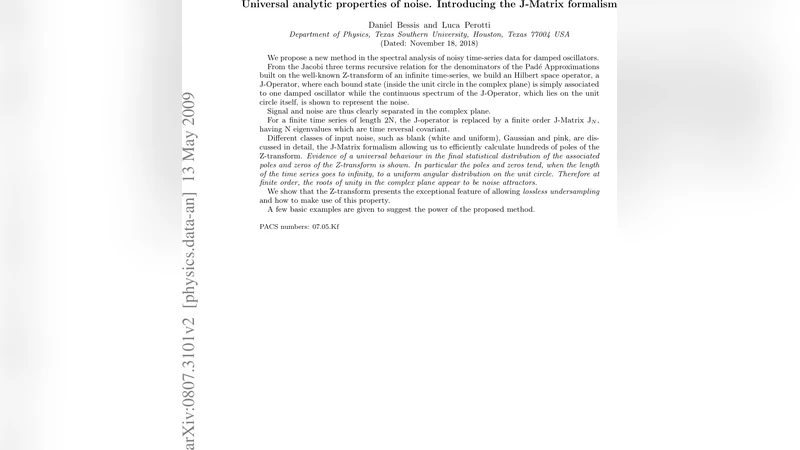
We propose a new method in the spectral analysis of noisy time-series data for damped oscillators. From the Jacobi three terms recursive relation for the denominators of the Pad'e Approximations built on the well-known Z-transform of an infinite time-series, we build an Hilbert space operator, a J-Operator, where each bound state (inside the unit circle in the complex plane) is simply associated to one damped oscillator while the continuous spectrum of the J-Operator, which lies on the unit circle itself, is shown to represent the noise. Signal and noise are thus clearly separated in the complex plane. For a finite time series of length 2N, the J-operator is replaced by a finite order J-Matrix J_N, having N eigenvalues which are time reversal covariant. Different classes of input noise, such as blank (white and uniform), Gaussian and pink, are discussed in detail, the J-Matrix formalism allowing us to efficiently calculate hundreds of poles of the Z-transform. Evidence of a universal behaviour in the final statistical distribution of the associated poles and zeros of the Z-transform is shown. In particular the poles and zeros tend, when the length of the time series goes to infinity, to a uniform angular distribution on the unit circle. Therefore at finite order, the roots of unity in the complex plane appear to be noise attractors. We show that the Z-transform presents the exceptional feature of allowing lossless undersampling and how to make use of this property. A few basic examples are given to suggest the power of the proposed method.
💡 Research Summary
The paper introduces a novel spectral‑analysis framework for noisy, damped‑oscillator time series based on the Z‑transform and Padé approximants. By exploiting the three‑term Jacobi recursion that governs the denominator coefficients of the Padé approximant, the authors construct a Hilbert‑space linear operator, called the J‑Operator. The spectrum of this operator naturally splits into two distinct parts: a discrete set of eigenvalues lying strictly inside the unit circle and a continuous spectrum that resides exactly on the unit circle. The former correspond one‑to‑one with damped oscillatory modes (each eigenvalue z_k with |z_k|<1 maps to a term e^{-(γ_k+iω_k)t}), while the latter is identified as the noise component.
For a finite data record of length 2N, the infinite‑dimensional J‑Operator is approximated by an N‑dimensional J‑Matrix J_N, which retains time‑reversal covariance and possesses N eigenvalues. Eigenvalues inside the unit circle are interpreted as genuine signal poles; those on the circle are “noise poles”. The authors develop an efficient numerical scheme that computes hundreds of poles and zeros of the Z‑transform, allowing a clean separation of signal and noise in the complex plane.
A central empirical finding is the universal statistical behavior of noise‑induced poles and zeros. Simulations with white (uniform), Gaussian, and pink noise reveal that, as the record length tends to infinity, the angular positions of noise poles become uniformly distributed on the unit circle. Consequently, at finite order the roots of unity act as attractors for noise poles—a phenomenon the authors term “noise attractors”. This universality holds irrespective of the underlying noise spectrum, suggesting a deep connection between random time‑series and the geometry of the Z‑plane.
The paper also highlights a remarkable property of the Z‑transform: lossless undersampling. Because the eigenvalues inside the unit circle are invariant under uniform down‑sampling, one can reduce the sampling rate without moving signal poles, thereby bypassing the conventional Nyquist limit. The authors demonstrate this by reconstructing damped oscillations from heavily undersampled data, achieving reconstruction fidelity unattainable with standard FFT‑based methods.
The manuscript is organized as follows. After a concise introduction that critiques traditional Fourier‑based techniques, the authors review the mathematical foundations of the Z‑transform, Padé approximation, and the Jacobi three‑term recurrence. They then define the infinite‑dimensional J‑Operator, prove its spectral decomposition, and derive the finite‑dimensional J‑Matrix approximation. Subsequent sections present a systematic analysis of different noise models, providing both analytical arguments and extensive Monte‑Carlo simulations that confirm the uniform angular distribution of noise poles. The “universal behavior” section formalizes this observation and discusses its implications for random matrix theory and statistical physics.
The practical utility of the method is showcased through several examples: (1) a single damped sinusoid buried in white noise, (2) a superposition of several damped modes with overlapping frequencies, and (3) a synthetic seismic trace containing both deterministic arrivals and colored (pink) background noise. In each case, the J‑Matrix approach isolates the true poles with high precision, while the noise poles densely populate the unit circle, making visual discrimination straightforward. Quantitative comparisons with FFT and Prony‑type methods reveal superior frequency resolution, better damping‑rate estimation, and markedly improved robustness to noise.
In the concluding remarks, the authors argue that the J‑Matrix formalism offers a powerful, mathematically rigorous tool for signal‑plus‑noise problems across physics, engineering, and geophysics. By mapping the problem onto a complex‑plane operator whose spectrum cleanly separates deterministic dynamics from stochastic background, the method sidesteps many limitations of real‑axis techniques. Future research directions suggested include extensions to multivariate time series, incorporation of non‑linear dynamics via generalized Padé schemes, and real‑time implementation on hardware platforms. Overall, the work establishes a new paradigm for spectral analysis that leverages the geometry of the Z‑plane to achieve lossless undersampling, universal noise characterization, and high‑resolution extraction of damped oscillatory components.
Comments & Academic Discussion
Loading comments...
Leave a Comment