Localized and periodic exact solutions to the nonlinear Schrodinger equation with spatially modulated parameters: Linear and nonlinear lattices
Using similarity transformations we construct explicit solutions of the nonlinear Schrodinger equation with linear and nonlinear periodic potentials. We present explicit forms of spatially localized and periodic solutions, and study their properties.…
Authors: Juan Belmonte Beitia, Vladimir V. Konotop, Victor M. Perez Garcia
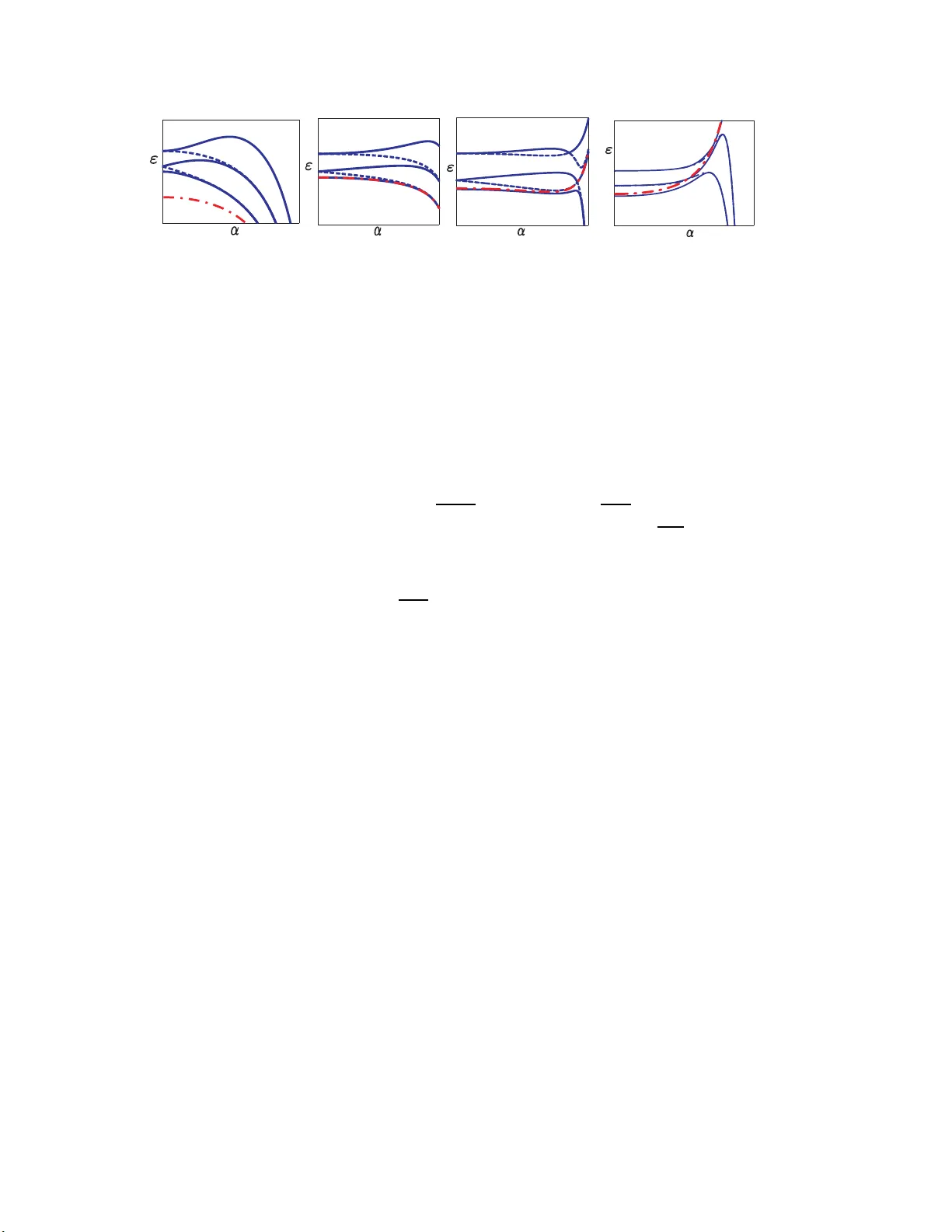
Lo calized and p erio dic exact solutions to the nonline ar Sc hr¨ odinger equatio n with spatially mo du lated p arameters: Lin ear and nonl inear lattices. Juan Belmonte-Beitia a , Vladimi r V. Konotop b , V ´ ıctor M. P ´ erez-Garc ´ ı a a V adym E. V ekslerc hi k a a Dep arta mento de Matem´ atic as, E . T. S. de Ingenier os Industriales and Instituto de Matem´ atic a A plic ada a la Ciencia y la Ingenier ´ ıa (IMACI), Universidad de Castil la-L a M ancha 13071 Ciudad R e al, Sp ain. b Dep artamento de F ´ ısic a, F aculdade de Ciˆ encias, Universidade de Lisb o a, Camp o Gr ande, Ed. C8, Piso 6, Lisb o a 1749-016, Portugal and Centr o de F ´ ısic a T e´ oric a e Computaciona l, Universidade de Lisb o a, Complexo Inter disciplinar, Avenida Pr ofessor Gama Pinto 2, Lisb o a 1649-003, Portugal. Abstract Using similarit y transf ormations we construct explicit solutions of the n on lin ear Sc hr¨ od in ger e qu ation with li n ear and nonlinear p erio dic p oten tials. W e present ex- plicit forms o f spatially lo calized and p erio dic solutions, and study their prop erties. W e pu t ou r results in the framework of the exp loited p ertur bation tec hniques and discuss their implications on the prop erties of asso ciated linear p erio dic p oten tials and on the p ossibilities of stabilizatio n of gap solitons using p olyc hromatic lattices. Key wor ds: Nonlinear lattices, nonlinear Sc hr ¨ od in ger equation, similarit y transformation, localized mo des, Bloch functions. 1 In tro duction The significan t increase of the interes ting prop erties of the solutions of the nonlinear Sc hr¨ odinger (NLS) equation with a p erio dic p oten tial during the last decade w as strongly stim ulated b y the application of that mo del in the theory o f Bose-Einstein condensates (BECs) (see e.g. [1,2]), where the mo del is kno wn also a s the Gross-Pitaevskii equation. The ma jor a dv antage of the use of o pt ical lattices, which constitute the ph ysical origin of the p erio dic Preprint submitted to Elsevier 12 Nov ember 2018 p oten tial, is the p ossibility of c hange o f their c haracteristics in space what stim ulated studies of manag ing soliton dynamics by spatially inhomogeneous lattices [3], b y lo w-dimensional lattices [4], b y lattices with defects [5,6,7], etc. Indep enden tly recen tly the re has b een in terest on t he systematic study of nonlinear lattices [8,9,10] in a more general contex t, including not only the BEC mean-field theory but also electromagnetic w av e pro pagation in la ye red Kerr media. Subseq uent studies of the in terplay b etw een linear and no nlinear lattices [11,12 ] ha ve revealed more p eculiarities o f lo calized mo des in suc h structures and un usual stabilit y prop erties of plane w av e solutions. Searc h of the lo calized mo des in a ll the studies men tio ned ab ov e w as carried out within the framew ork of approximate and n umerical metho ds, as the mo d- els, in general case, do no w allo w for exact solutions. Ho we ve r, r ecen tly it w as realized that for a n um b er of NLS mo dels including sp ecific ty p e of p erio dic p oten tials, exact p erio dic solutions can b e constructed [1 3 ,14], what can b e done in a systematic manner, using a kind of inv erse engineering a nd start- ing with a give n p erio dic field distribution [1]. W e wan t also to men tion the Refs. [15,16,17,18], where differen t metho ds to find exact solutions to nonlinear Sc hr¨ odinger equations were studied. Ev en greater prog ress w as ac hiev ed in constructing exact solutio ns, and in particular of in tegrable mo dels, of the NLS equation with time dep enden t co efficien ts (see e.g. [19,20,21,22,23,24,25] for the work dev oted to equations of the NLS-type), and f o r the stationary GP equation with a p oten tial and v arying nonlinearit y [26,27]. How ev er, a ll men tioned mo dels allo wing f o r ex- act solutions lo ok sometimes rather artificial, for example mo dels with exact p erio dic solutions mu st b e infinite or sub ject to cyclic b oundary conditions and mo dels with trap p otentials require sp ecific la ws of time v aria tions of the co efficien ts. D espite those difficulties, they hav e tw o imp orta nt adv an tages the first b eing that they are still exp erimen tally feasible, and the second b eing that they allow for exact solutions, thus ruling out an y am biguit y in in terpretation of the phys ical phenomena. Returning to the NLS mo dels with spatially p erio dic co efficien ts, we observ e that no exact lo c a lize d solutions hav e b een rep orted, so f a r (the only w ork to our kno wledge is the a na lytical approac h for constructing sufficien tly narrow pulses, recen tly elab or ated in [28 ]) . This is the main goal of t his presen t pap er to presen t for the first t ime suc h solutions, whic h can b e obtained for sp ecific t yp es of linear and no nlinear lattices. Moreo v er, simple analysis of the pre- sen ted mo dels and their solutions will allo w us to mak e sev eral conclusions ab out prop erties of the underlying linear la t t ices and ab out stabilization of lo calized mo des b y p olyc hromatic lattices. The results presen ted in this work, represen t the extension of t he ideas elab ora ted in earlier publications [26,27] to the case of p erio dic nonlinearities. 2 The pap er is orga nized as follows . In Section 2, we dev elop the theory of similarit y tra nsformations for our mo del problem: the nonlinear Schr¨ odinger equation with a spatially inhomogeneous nonlinearit y . In Section 3, we study the stationary lo calized mo des of the inhomogeneous nonlinear Sc hr¨ odinger equation (INLSE). In Section 4, w e presen t a study o f the stability of suc h solutions. Finally , in Section 5, w e construct explicit p erio dic solutions of the INLSE and study their stabilit y . 2 Similarit y transformations W e consider the one-dimensional spatially inhomogeneous NLS equation iψ t = − ψ xx + v ( x ) ψ + g ( x ) | ψ | 2 ψ , (1) with x ∈ R , v ( x ) and g ( x ) b eing resp ectiv ely linear and nonlinear p erio dic p oten tials, whose p erio ds will b e required to b e equal. More sp ecifically , with- out loss of generality w e imp ose the p erio d to b e π : i.e. v ( x + π ) = v ( x ) and g ( x + π ) = g ( x ), what can b e alw ays achie ve d b y prop er rescaling of v a riables. (It is worth to men tion here that in the BEC theory t he choice of the p erio d π corresp o nds to the scaling where the energy is measured in the units of the recoil energy). In order to eliminate p ossible unessen t ia l constan t energy shifts and bring the stat ement of the problem closer to the standar d one w e imp o se the requiremen t for the p erio dic p ot ential to hav e a zero mean v alue, i.e. h v ( x ) i ≡ 1 π Z π 0 v ( x ) dx = 0 . (2) The complex field ψ ( t, x ) will b e referred to as a (macroscopic) w av e function, where again w e b ear in mind BEC applications. In this paper, w e fo cus on stationary solutions of Eq. (1), which are o f the form ψ ( t, x ) = φ ( x ) e − iµt , (3) where φ ( x ) is a function of x only and µ is a constant b elo w referred to as a c hemical p oten tial. As it is clear − φ xx + ( v ( x ) − µ ) φ + g ( x ) φ 3 = 0 . (4) No w, follo wing the ideas of [26,27], w e lo o k for a tra nsfor mat ion reducing Eq. (4) to the solv able stationary NLS equation E Φ = − Φ ′′ + G | Φ | 2 Φ , (5) 3 where Φ ≡ Φ( X ), a prime stands for the deriv ativ e with resp ect to X , E and G are constants, and X ≡ X ( x ) is a new spatial v ariable. T o this end, w e use the ansatz φ ( x ) = ρ ( x )Φ( X ) , (6) where Φ( X ) is a solution of the statio na ry equation (5) and b oth ρ ( x ) and X ( x ) are functions whic h must b e found from the condition that ψ ( x ) solv es Eq. (4). Substituting ( 6) in to (4) we obtain the link: ρ 2 X x x = 0 , (7) as w ell as expressions for g ( x ) a nd v ( x ) through ρ ( x ) and X ( x ): g ( x ) = G X 2 x ρ 2 , a nd v ( x ) = ρ xx ρ + µ − E X 2 x . (8) F rom the expres sion for g ( x ) w e find the first constrain t of the theory: the metho d is applicable to mo dels with sign definite nonlinearities, and one mus t c ho ose G =sign ( g ( x )). Next, b eing in terested in s olutio ns existing on the whole real axis and excluding singular p ot entials w e ha ve to restrict the anal- ysis to functions ρ ( x ) in C 2 ( R ) whic h do not acquire zero v alues a nd th us are sign definite. Moreo v er since neither (8 ) nor (7) c hange as ρ ( x ) c hanges the sign (what simply reflects the phase inv ariance of the mo del (4)), in what follo ws we restrict the consideration to the case ρ ( x ) > 0 . The solution of (7) is immediate: X ( x ) = Z x 0 ds ρ 2 ( s ) . (9) Here w e ha ve take n in to accoun t that the constan t of the first inte gra tion with resp ect to x can b e c hosen 1 , as fa r as ρ ( x ) is still left undefined, and the second integration constan t con v enien tly fixes the origin. Thus w e hav e X (0) = 0 , and lim x →±∞ X ( x ) = ±∞ . (10) No w the co efficien ts in Eq. (4) can b e rewritten in the for m v ( x ) = ρ xx ρ − E ρ 4 + µ, g ( x ) = G ρ 6 . (11) 4 Th us, (6 ) with (9) giv es a solution of Eq. (4), whic h dep ends on the the p ositiv e definite function ρ ( x ), which m ust b e c hosen π -p erio dic. This choice is naturally v ery rich. T o b e sp ecific w e in v estigate in detail the simplest case where ρ ( t, x ) = 1 + α cos(2 x ) , (12) with α b eing a real constant, suc h that | α | < 1, and resp ectiv ely v ( x ) = − 4 α cos(2 x ) 1 + α cos(2 x ) − E (1 + α cos(2 x )) 4 + µ, (13) g ( x ) = G (1 + α cos(2 x )) 6 , (14) where µ is c hosen to ensure (2) and reads µ = 4 − 4 √ 1 − α 2 + E 2 + 3 α 2 2(1 − α 2 ) 7 / 2 . (15) Some direct generalizations of this mo del are presen ted in the App endix. The introduced linear p erio dic p oten tial v ( x ) has a num b er of p eculiar prop- erties, some o f whic h are: (i) It allows for some par t icular explicit forms of the Blo c h function (see e.g. expressions ( 1 8) and (2 7), b elo w), what is a ra t her p eculiar situation since in a general situation explicit for ms of solutions of a Hill equation in terms of the elemen tary fucntions are not a v ailable. (ii) α app ears to b e the para meter allowing one to con trol the band sp ectrum (as this is illustrated in each of the panels in Fig. 1 b elo w) and, in particular, allo wing for smo oth tra nsition b etw een con tinuum sp ectrum (at α = 0 where the p erio dic p otential do es not exist and the discrete sp ectrum (at | α | = 1 where the p erio dic p o ten tial is represen ted b y a sequence of p oten tial wells of infinite depths). In Fig . 1 these tw o situations are express ed by the f a ct that all gaps are collapsed at α = 0, one the one hand, and one of the bands acquire an infinite width at α = 1, on t he other hand. (iii) By v arying the par ameter E one can transform the p otential from a general for m with no in terv als of c o existenc e ( E < 0) to a form with c o ex is- tenc e ( E > 0) . Hereafter, follow ing [31] under the co existence phenomenon w e understand the o ccurrence when an inte rv al of instability (i.e. a gap) dis- app ears due t o collapsing of tw o gap edges. This prop ert y is also illustrated in Fig. 1, where panels (a) and (b) corresp ond to the general situation while in the pa nes (c) and ( d) one o bserv es in tersection of a dashed-doted (red) line with the gap edges precisely in the co-existence p oin ts. It is remark a ble that these prop erties b ecome more clear departing from the 5 solution of the resp ectiv e nonlinear problem. W e consider them in the next sections. 3 Stationary lo calized mo des W e start with the analysis o f the lo calized mo des. T o this end w e imp o se the b oundar y conditions lim x →±∞ φ ( x ) = 0 and taking in to accoun t (6) and (10) w e conclude that Φ( X ) m ust satisfy the zero b o undary conditions, as w ell: lim X →±∞ Φ( X ) = 0. This is the case where G = − 1 and Φ( X ) = √ − 2 E / cosh( √ − E X ) i.e. Φ( X ) is the standar d stationary NLS soliton. The resp ectiv e solution o f Eq. (4) reads φ s ( x ) = √ − 2 E 1 + α cos(2 x ) cosh( √ − E X ( x )) , X ( x ) = Z x 0 ds (1 + α cos(2 s )) 2 . (16) Let us no w consider in more detail t he obtained solution. First of all w e recall that the che mical p oten tial of a n y stationary solution of the NLS equation with a p erio dic p oten tial, whic h tends to zero or acquires a zero v alue m ust b elong to a forbidden g a p of the resp ectiv e p o ten tial and suc h solutions ha ve a space- indep enden t phase, a nd th us can b e c hosen real ( see e.g. [1,29]). The o btained solution (16) has che mical p oten tial µ , giv en by Eq. (15), and hence it m ust b elong to a ga p of the sp ectrum of the p oten tia l v ( x ), which is determined by the Hill eigen v alue problem: − ϕ xx + v ( x ) ϕ = E ϕ . (17) Moreo v er, since the obtained solution (16) exists for arbitrar y negative E , including the limit where E → −∞ and conseq uently µ < v ( x ) one concludes that E = µ b elongs to the semi-infinite gap ( −∞ , E ( − ) 1 ) of the band sp ectrum of v ( x ), i.e. E ( − ) 1 > µ , where w e use the notations E ( − ) n and E (+) n for the lo we r and upp er edges of the n -t h band, i.e. stabilit y region, pro vided that α = 1 designates the low est band. Indeed, a ssuming the opp osite, i.e. assuming that at some negativ e energy the solution b elongs to one of the finite gap and taking into accoun t the con tinuous dep endence o n E o ne concludes tha t at some negative E , the c hemical p oten tia l (15) crosses the stability region, what con tradicts to the existence of t he solution with zero b oundary conditions. Alternativ ely , t he ab ov e conclusion follows f o rm the facts that at α = 0 the solution (16) is in the semi-infinite ga p and that the dep endence of µ and v ( x ) on the parameter α ∈ ( − 1 , 1) is contin uous. The describ ed phenomenon is illustrated in Fig . 1 (sp ecifically in the panel (a)) where w e sho w the edges of the lo w est bands vs the para meter α for four t ypical situations E < 0 (panel (a)); E = 0 (panel (b)); E ∈ (0 , E 0 ) with 6 0 0.6 -8 0 4 8 (a) -8 8 0 0 4 0.9 (b) -4 0 4 8 (c) 0 0.8 -8 4 32 16 (d) 0 0.8 Fig. 1. Boundaries of the lo w est band edges (5 firs t b and edges) of the sp ectrum of Eq. (17) as fun ctions of α f or (a) E = − 5 (b) E = 0, (c) E = 0 . 1, and (d) E = 1. Solid and dash ed lines corresp ond to E ( − ) n and to E (+) n . The (red ) dashed-dot lines represent th e c h emical p oten tial µ . E 0 = max α { E m ( α ) } = 2 / 5 and E m ( α ) = 8(1 − α 2 ) 3 / (20 + 15 α 2 ) b eing the p oin t of the lo cal minim um of the c hemical p oten tial ∂ µ/∂ E | E = E 0 = 0 for a giv en α , (panel (c)), a nd E > E 0 (panel (d)). Lea ving the discussion of the situations depicted in Fig. 1 (c), (d) for Sec. 5, no w we turn to the limiting cases of the solution ( 16). At E → −∞ it ap- proac hes the NLS soliton: φ s ( x ) ∼ √ − 2 E (1 + α ) / cosh( √ − E (1 + α ) x ), what reflects the f a ct that the lo calization region, determined by 1 / q | E | , is m uc h smaller than the p erio d of the p oten tial. Th us ( 1 6) is an example of an exact solution, whose approximate form can b e obta ined as suggested in [28] (after the scaling o ut the amplitude √ − E ). An ev en more in teresting situation corresp onds to small | E | . When | E | → 0 the c hemical p oten tial approach es the band edge, what is illustrated in F ig . 1 (b), where E = µ coincides with the edge o f the semi-infinite band (in other w ords, here we are dealing with a situation where a for m ula for dep endence of the low est band edge on the parameters of the problem is giv en explicitly b y (15)). As it is w ell kno wn (see e.g. [1,29] and references therein) in this case the solution is accurately describ ed b y the m ultiple-scale approxim at io n and represen t s an en v elop e of the Blo ch state corr esp o nding to the gap edge. The structure of (16) implies that Φ( X ) is the en v elop e while ϕ ( x ) = 1 + α cos(2 x ) , (18) is the exact Blo c h function of the p oten tial v ( x, 0), give n b y (13), whic h cor- resp onds to the lo w est edge of the first band. In other w ords, in the limit | E | → 0 , (16) is an ex act envelop e soliton s olution bifurcating from the edge of the linear sp ectrum (to the b est of authors kno wledge (16) is the first kno wn solution of suc h a t yp e). In Fig. 2 w e illustrate the t wo opp osite limits of (16 ) corresp onding to an en v elop e (panel a) and to a narro w (panel b) NLS-type soliton. Finally w e observ e that b y changing the parameter α , one can scan the semi- 7 -80 80 0 -40 40 0 0.1 0.2 x (a) -10 10 0 0 3.5 x (b) Fig. 2. Solutions of Eq. (4), which are giv en b y (16), for (a) E = − 0 . 01 , α = 0 . 3 and (b) E = − 5, α = 0 . 1. infinite gap, obta ining the lo calized mo de with a priori giv en detuning t ow ards the gap. 4 Stabilit y of the solutions T o c hec k the linear stabilit y of the solution (16) w e study the ev olution of small p erturbations of the form ψ ( x, t ) = ( φ ( x ) + f ( x, t ) + ih ( x, t )), where f and h a r e real functions, whic h leads to the standard linearized Schr¨ odinger equation ∂ t f h = N f h , (19) with N = 0 L − − L + 0 , (20) and L − = − ∂ xx + v ( x ) + g ( x ) φ 2 ( x ) , (21) L + = − ∂ xx + v ( x ) + 3 g ( x ) φ 2 ( x ) , (22) F or p erturbations f , h ∝ e i Ω t , w e ha ve Ω 2 f = L − L + f . (23) The op erators L − and L + are self-adjoint. In the following, we will study some prop erties of t hese op erato rs. Using the fact that φ satisfies the Eq. (4 ), one 8 -0.1 -0.5 (a) Stable zone 0.4 -0.15 E -0.4 -0.3 -0.2 -0.2 -0.3 0.1 0 0.01 -0.4 -0.4 -2 -3 -4 -5 E Stable zone (b) -1 -0.1 -0.3 -0.2 0 Fig. 3. [Color onlin e] Stable zones of the solutions (16), for different v alues of the parameters α and E (a) − 0 . 5 ≤ E ≤ − 0 . 1 (b) − 5 ≤ E ≤ − 1. easily ch eck s t hat the op erator L − can b e rewritten a s L − = − 1 φ ∂ x φ 2 ∂ x 1 φ · !! . (24) As a conseque nce, R f L − f dx = R | ∂ x f φ | 2 φ 2 dx ≥ 0, and the op erat o r L − is nonnegativ e. Th us, the sp ectrum of the op erator L − is comp osed of: (i) A simple eigen v alue λ − = 0, with the corresp onding ev en eigenfunction, whic h is solution o f Eq. (4). (ii) A strictly p ositive con tin uous sp ectrum [ β , ∞ ). With regard to L + op erator, it satisfies the following relation L + = L − + 2 g ( x ) φ 2 ( x ). As g ( x ) is a negativ e function, the first eigenv alue of L + , λ + , satisfies λ + < 0. So, at least, an eigenv alue of L + is negativ e. Th us, as the L − op erator is nonnegativ e but the L + op erator is nonp ositiv e, the comp osition L − L + is indefinite. Th us, w e can no t say an ything analyt- ically of the sign of Ω 2 . Moreo v er, the fact that the p otential ( 1 3) can tak e b oth p ositiv e and negativ e v a lues complicates further the a na lytical study . Therefore, we ha v e to resort to nume rical metho ds to solv e Eq. (23). If some eigen v alue Ω 2 is negativ e, the asso ciat ed solution is unstable. Other- wise, the solutio n is stable. W e can calculate the eigenv alues of the op erat o r L − L + n umerically through a direct discretization of the L − L + op erator. In Figs. 3 (a ) and (b), we sho w the stable zones of the solutions (16), for differ- en t v alues of the parameters α and E . In Fig. 3 (a), we hav e studied the case − 0 . 5 ≤ E ≤ − 0 . 1. The zones of stabilit y for the case − 5 ≤ E ≤ − 1 are show n in Fig. 3(b). T o confirm this result, w e hav e studied n umerically the ev olution of the solutions (16) under finite amplitude p erturbations. W e ha ve confirmed that these obtained solutio ns are stable in the range giv en b y Figs. 3 (a) a nd (b). 9 5 Exact quasi-p erio dic solutions Let us no w turn to (quasi-) p erio dic solutions of Eq. (4). T o this end, first, w e hav e to recall the solutions o f the NLS equation (5) whic h are expressed in terms of the Jacobian elliptic functions, for whic h w e use the standard notations [30]. While doing this w e b ear in mind that differen t functions Φ( X ) whic h are obtained b y the shift of the arg umen t (lik e, for example, in (25a) and (25 d) b elow), and th us represen ting the same solutio n of the homogeneous NLS equation, now will give or igin to essen tially differen t solutions of Eq. (4) , b ecause the latter are comp osed of the t w o p erio dic p erio dic factors steaming from the structure of t he p erio dic p oten tial (they ar e describ ed b y the function ρ ( x )) and from the NLS solutions mentioned ab ov e, (see Eq. (6)). W e start with the simplest solutions of Eq. (4) for g ( x ) < 0 (i.e. G = − 1). They are φ (1) ( x ) = √ 2 k ν (1 + α cos(2 x )) cn( ν X , k ) , ν 2 = E 1 − 2 k 2 , (25a) φ (2) ( x ) = √ 2 ν (1 + α cos(2 x )) dn( ν X , k ) , ν 2 = E k 2 − 2 , (25b) φ (3) ( x ) = q 2(1 − k 2 ) ν (1 + α cos(2 x )) 1 dn( ν X , k ) , ν 2 = E k 2 − 2 , (25c) φ (4) ( x ) = q 2(1 − k 2 ) k ν (1 + α cos(2 x )) sn( ν X , k ) dn( ν X , k ) , ν 2 = E 1 − 2 k 2 , (25d) These are real functions, what determines the regions of the parameters where they are v alid. In particular, taking in to a ccoun t that the elliptic mo dulus k ∈ [0 , 1] w e ha ve that φ (2) ( x ) a nd φ (3) ( x ) a r e v alid only fo r E < 0, i.e. these are solutions b elonging to the semi-infinite gap, while φ (1) ( x ) a nd φ (4) ( x ) b elong to the g ap E < 0 and k > 1 / √ 2 (see Fig. 1(a)) or to the band E > 0 and k < 1 / √ 2 (see Figs. 1 (c) and (d)). All the solutions bifurcate from the linear Blo c h state (18 ) reco v ered at E = 0. The simplest solutions f o r g ( x ) > 0 ( G = 1) read φ (5) ( x ) = √ 2 k ν (1 + α cos(2 x )) sn( ν X , k ) , ν 2 = E 1 + k 2 , (26a) φ (6) ( x ) = √ 2 k ν (1 + α cos(2 x )) cn( ν X , k ) dn( ν X , k ) , ν 2 = E 1 + k 2 . (26b) As it is clear these solutions are v alid for E > 0. In the ab o v e fo rm ulas (25a) – ( 2 6b), X ( x ) is defined in (16 ), and ρ ( x ) is giv en b y (12). 10 Let us no w consider the pair of solitons (26a), (26b) (or alternative ly , the pair (25a), (25d)) in the ”linear” limit k → 0. They readily giv e t w o eigenstates of the p otential v ( x ) ϕ 1 = (1 + α cos(2 x )) s in √ E X , (27a) ϕ 2 = (1 + α cos(2 x )) c os √ E X . (27b) These are linearly indep enden t solutio ns. As it is kno wn (see [31] for the details) the co existence of suc h solutions o ccurs only if one of the gaps is closed. Th us, in α -dep endence of the sp ectrum of the p oten tial v ( x ) giv en b y (13), (15) at E > 0 there m ust exits p oin ts at whic h the first low est ga p is closes and through which the c hemical p otential µ g iven b y (15) passes. This is exactly what w e observ ed in panels (c) and (d) of Fig. 1. The existence of suc h po ints at sufficien tly la rge α steams from the fact that for E > 0 the c hemical po t ential infinitely grows with α while the minima of the p erio dic p oten tial tend to −∞ . Other exact eigenstates of the p oten tial v ( x ) giv en b y (13) can b e obtained b y considering the linear limit of the solutions solutions (25c) and (25d) whic h corresp onds to k → 1. In this w a y w e o bt a in a pair of t w o ”unstable” solutions ϕ 3 = (1 + α cos(2 x )) c osh √ − E X , (28a) ϕ 4 = (1 + α cos(2 x )) s inh √ − E X . (28b) As it is clear the com binations ϕ 3 ± ϕ 4 supplied b y the prop er constan t factor pro vide the asymptotics o f the solitary w av e φ s ( x ) giv en by ( 1 6) a t x → ∓∞ . T aking into accoun t that g ( x ) is sign definite, simple stability a na lysis of the presen ted solutions can b e p erformed following [14]: since φ (2) ( x ) > 0 and φ (3) ( x ) > 0 one verifies that they are linearly unstable, while the stabilit y of the solutions φ (1) ( x ), φ (4) ( x ), φ (5) ( x ) and φ (6) ( x ) is left undetermined. Finally , w e consider the limit k → 1 / √ 2 of the solutions (25a) and (25 d), whic h corresp onds to the limit o f large nonlinearity . F or this case, the p ot ential v ( x ) can b e view ed as a small and smo oth p erturbation o f the NLS equation, whose nonlinearit y is also a slo w function of the spatial v ariable. Th us the men tioned solutions can b e view ed as the p erio dic NLS solutions mo dulated b y the “env elop e” ϕ 0 ( x ). 11 6 Ph ysical applications and concluding remarks. Let us no w turn to the ph ysical applications of the obtained results. This problem arises natura lly since the perio dic structures we hav e used, Eqs. (13) and (14), b eing eve n express ed in elemen tary functions, are still not feasible for the most exp erimen tal settings, where only one or a few laser b eams are used (if one b ears in mind optical lattices for BEC applications). O ne th us can p ose the question as follo ws: do the obta ined solutions represen t satisfactory appro ximations to some realistic lo calized mo des ( lik e for example the o nes found nume rically in [11]) in the mo dels where the p erio dic co efficien ts are represen t ed by a few first F ourier harmonics of the p otential v ( x, E )? The presen t section aims to answ er this question. T o this end w e F ourier expand the functions v ( x ) and g ( x ), and in tro duce the truncated p o ten tials v N ( x ) and g N ( x ) generated by sup erp ositions of N harmonics: v N ( x ) = N X n =1 v n ( α, E ) cos(2 nx ) , g N ( x ) = N X n =0 g n ( α ) cos(2 nx ) , (29) where, for N = 2 v 1 ( α, E ) = − 8 1 − √ 1 − α 2 α √ 1 − α 2 + E α (4 + α 2 ) (1 − α 2 ) 7 / 2 , (30 a ) v 2 ( α, E ) = 8 (1 − √ 1 − α 2 ) 2 α 2 − E 5 α 2 (1 − α 2 ) 7 / 2 , (30b) and g 0 ( α ) = − 1 8 40 α 2 + 8 + 15 α 4 (1 − α 2 ) 11 / 2 , (31a) g 1 ( α ) = 3 α 4 8 + 12 α 2 + α 4 (1 − α 2 ) 11 / 2 , (31b) g 2 ( α ) = − 21 α 2 4 2 + α 2 (1 − α 2 ) 11 / 2 . (31c) Next w e use the Eqs. (29), (30a), (30b) and (31a), (31b), (31 c) to approximate the functions v ( x ) and g ( x ), giv en b y Eqs. (14) and (13), resp ectiv ely . Th us, for example, f o r α = − 0 . 1 and E = − 0 . 5, whic h are v alues where the solutions of Eq. (4) are stable, (see Fig. 3(a)), we obtain 12 x t x t Fig. 4. Ev olution of the solutions (16), with x ∈ [ − 40 , 40], t ∈ [0 , 1500], for E = − 0 . 5 and α = − 0 . 1 (a) using one harmonic (b) t w o harmonics. F or th e case (a), the solution is oscillatory . F or the case (b) the solution is stable. g = − 1 . 1099 − 0 . 6436 cos(2 x ) − 0 . 1115 cos(4 x ) , (32a) v = 0 . 610 7 cos (2 x ) + 0 . 0561 cos(4 x ) . (32b) Finally , w e ha v e sim ulated numeric ally the dynamics of the w av e pac k et with the initial profile giv en by the solutio n (16), and describ ed b y the ev olution equation (1) with the p o ten tials v N and g N with N = 1 , 2 instead of v and g , respectiv ely . Some t ypical results are shown in Fig. 4. One observ es that while the explicit analytical solution (16) is not a satisfactory approx imatio n for the harmonic p o t entials: in Fig. 4(a) o ne observ es oscillatory b eha vior of the mo de. Using a tw o- harmonic appro ximation for the p o ten tial results in a v ery stable b ehav ior o f the solution. It turns out, that for some sp ecific domains of the parameters the obta ined solutions represen t f airly go o d appro ximations ev en for the harmonic p oten- tials. An example of suc h a situation is sho wn in Fig. 5 where w e hav e c hoses E = − 0 . 1 and α = − 0 . 1: no visible difference exist in the dynamical regime for the mono c hromatic lattices (F ig. 5(a)) and the latt ices in a form of sup er- p osition o f the tw o harmonics (Fig. 5(b)) . Both Figs. 4 a nd 5 w ere obtained by direct nume rical sim ulations of Eq. (1 ), using as initia l data in the evolution in time the solution (16). T o conclude, in this pap er, b y using similarit y transfor mat ions we hav e con- structed explicit lo calized solutions o f the nonlinear Schr¨ odinger equation with linear p erio dic p oten tial and spatially p erio dic nonlinearities. W e hav e studied suc h solutions and t heir linear stabilit y . W e also hav e calculated p erio dic so- lutions of the inhomogeneous nonlinear Sc hr¨ odinger equation and ha v e sho wn that they rev eal some prop erties of the underline linear lattices, providing 13 x t x t Fig. 5. Ev olution of the solutions (16), with x ∈ [ − 40 , 40], t ∈ [0 , 1500], for E = − 0 . 1 and α = − 0 . 1 wh ere the linear and nonlinear lattices are appr o ximated by usin g only one harmonic (a) and tw o harmonics (b). F or b oth cases, th e solution is s table. exact analytical expressions fo r the resp ectiv e Blo c h w a ves . Ac knowled gemen ts W e would lik e to tha nk J. Cuev as fo r discussions. VVK ackn owledges supp ort from Ministerio de Educaci´ on y Ciencia (MEC, Spain) under gran t SAB2005- 0195 a nd PCI08-0093. This w or k has b een partially supp orted by grants FIS2006-04 190 ( MEC), POCI/FIS/56237 /2004 (F CT -P ort ugal- and Euro- p ean program FEDER) and PCI-08-0093 (Jun ta de Com unidades de Castilla- La Manc ha, Spain). A Examples of models allo wing exact solutions In this app endix, w e presen t tw o more general mo dels that we used in Eqs. (13) and (14). The first mo del corresp onds to the ch oice ρ ( x ) = (1 + α cos(2 x )) p , (A.1) with p ∈ R . So, it is clear that g ( x ) = G (1 + α cos (2 x )) 6 p , (A.2) 14 and the external p otential b ecomes v ( x ) = − 4 αp (1 + α cos(2 x )) − 2 h α (1 − p ) + cos(2 x ) + pα cos 2 (2 x ) i − E (1 + α cos (2 x )) 4 p + µ. (A.3) It is clear that when p = 1, w e reco v er the expressions (1 3) and (14). The second mo del corresp onds to g ( x ) = η (dn( ξ , k )) p , (A.4) with η a constant a nd dn the Jacobi elliptic function. W e can calculate the external p oten tial v ( x ) a nd obtain v ( x ) = p 6 h 1 − p 6 (dn( ξ , k )) 2 i + p 6 " k 2 − 1 1 + p 6 1 (dn( ξ , k )) 2 + p 1 3 − k 2 6 !# − E η G ) 2 / 3 (dn( ν ξ , k ) 2 p/ 3 + µ. (A.5) One can obtain the nonlinearit y g ( x ) and the pot en tial v ( x ), according to the v alue of p . References [1] V.A. Brazhnyi and V.V. Konotop, Theory of nonlinear matter w av es in optical lattice s, Mo d. Phys. Lett. B, 18 , 627 (2004). [2] O. Morsch, and M. Ob erthaler, Dynamics of Bose-Einstein condensates in optical latt ices, Rev. Mo d. Ph ys. 78 , 179 (2006) . [3] V. A. Brazhn yi, V. V. Konotop, and V. Kuzmiak, Dynamics of matter solitons in weakly m o dulated optica l lattices, Phys. Rev. A, 70 , 0436 04 (2004). [4] B. B. Baizak ov, B. A. Malomed, and M. Salerno, Multidimensional solitons in a low-dimensional p erio dic p oten tial, Phys. Rev. A, 70 , 053 613 (2004). [5] V. A. Brazhnyi, V. V. Konotop, and V. M. P´ erez-Garc ´ ıa, Drivin g defect mo des of Bose-Einstein condensates in optical latti ces, Phys.Rev. Lett., 96 , 060403 (2006 ). [6] V. A. Brazhnyi, V. V. Konotop, and V. M. P ´ erez-Garc ´ ıa, Defect mo des of a Bose-Einstein condensate in an optical lattice with a lo calized impur it y , Ph ys. Rev. A, 74 , 0236 14 (2006). [7] V. Ahufinger, A. Mebraht u , R. C orbal´ an, and A. Sanp era, Quantum switc hes and quan tum memories for matter-w a v e lattice solitons, New J. Phys., 9 , 4 (2007 ). 15 [8] H. Sak aguc hi and B. A. Malo med , Mat ter-wa ve solitons in n onlinear optical lattice s, Phys. Rev. E, 72 , 04661 0 (2005) . [9] G. Fibich, Y. Siv an, and M. I. W einstein, Bound states of NLS equ ations with a p erio dic nonlinear microstru ctur e, Ph ysica D, 217 , 31-5 7 (2006 ). [10] Y. Siv an, G. Fibic h, and M. I. W einstein, W a v es in nonlinear lattices - u ltrash ort optical pu lses an d Bose-Einstein condensates, Phys. Rev. Lett., 97 , 193902 (2006 ). [11] Y. Bludo v, and V. V. Konotop, Lo calized mod es in arra ys of b oson-fermion mixtures, Ph ys. Rev. A, 74 , 0436 16 (2006). [12] Z. Rapti, P .G. Kevrekidis, V.V. Konotop, C.K.R.T. Jones, Solitary wa ves under the comp etition of linear and nonlinear p erio dic p oten tials, arXiv:0707.1162 . [13] J.C. Bron s ki, L.D. Carr, B. Deconinc k, J.N. Kutz, and K . Promislo w, S tabilit y of repulsiv e Bose-Einstei n condensates in a p erio dic p oten tial, Phys. Rev. E, 63 , 036612 (2001). [14] J.C. Bronski, L.D. Carr, R. Carretero-Gonzalez, B. Deconinc k, J .N. Kutz, and K. Pr omislo w, Stabilit y of attractiv e Bose-Einstein condens ates in a p erio d ic p oten tial, Phys. Rev. E, 64 , 05661 5 (2001 ). [15] J. Belmonte -Beitia, V. M. P ´ erez-Garc ´ ıa and V. V ekslerc hik, Mo dulational instabilit y , solitons and p erio dic wa ves in mo dels of quantum degenerate Boson- F ermion mixtures, Chaos, Solitons and F r actals, 32 , (2007) 126 8-1277. [16] B. Li and Y. Chen, On exact solutions of th e nonlinear S c hr¨ odin ger equatio n s in optical fib er, C h aos, Solitons and F ractals, 21 , (2004) 241-2 47. [17] J-M. Zh u and Z -Y. Ma, Exact solutions for the cub ic-quin tic nonlinear Sc hr¨ od in ger equation, Chaos, Solitons and F r actals, 33 , (2007) 958 -964. [18] S-D Zhu, Exact solutions for the high-order d isp ersive cubic-quin tic nonlinear Sc hr¨ od in ger equation b y the extended hyp erb olic auxiliary equation metho d, Chaos, Solitons and F r actals, 34 (2007) 1608 -1612. [19] H.-H. Ch en and C .-S . Liu, Phys. Rev. Lett., Solitons in non unif orm media, 37 , 693 (19 76). [20] V. V. Konotop, O. A. Chub yk alo, and L. V´ azquez, Dynamics and int eractions of solitons on an in tegrable inhomogeneous latti ce, P hys. Rev. E, 48 , 564 (19 93). [21] V. N. Serkin and A. Hasega wa , No v el soliton solutions of the nonlinear Sc hr¨ od in ger equation mo d el, Ph ys. Rev. Lett., 85 , 4502 (2000). [22] Z. X. Liang, Z. D. Zh ang, W. M. Liu, Dynamics of a Brigh t Soliton in Bose- Einstein Condens ates with Time-Dep end en t Ato mic Scattering Length in an Expulsive P arab olic Pot entia l, Phys. Rev. Lett., 93 , 152301 (200 4). [23] S. Chen and L. Yi, Chirp ed self-simila r solutions of a generalize d nonlinear Sc hr¨ od in ger equation mo d el, Ph ys. Rev. E, 71 , 0166 06 (2005). 16 [24] V. M. P ´ erez-Garc ´ ıa, P . J. T orres, and V. V. Konotop, Similarit y transformations of nonlinear S c hr¨ odin ger equ ations with time v arying co efficients: Exact r esults, Ph ysica D, 221 , 31 (2006 ). [25] V. N. S erkin, A. Hasega w a, and T . L. Bely aev a, Nonautonomous solitons in external p oten tials, Phys. Rev. L ett., 98 , 0741 02 (2007). [26] J. Belmon te-Beit ia, V. M. P´ erez-Garcia, V. V ekslerchik, and P . J. T orres, Lie symmetries and solitons in nonlinear systems with spatially inhomogeneous nonlinearities, Ph ys. Rev. Lett., 98 , 0641 02 (2007). [27] J. Belmon te-Beit ia, V. M. P´ erez-Garcia, V. V ekslerchik, and P . J. T orres, Lie symmetries, qu alitativ e analysis and exact solutions of nonlinear S c hr¨ odinger equations with inhomogeneous nonlinearitie s, Discrete and Cont inuous Dynamical Systems B, 9 , 2 (2008). [28] Y. Siv an, G. Fibic h, N. K. Efremid is, S. Bar-Ad, An alytic theory of narrow lattice solito n s, arXiv:0707 .1589 . [29] G. L. Alfimo v, V. V. K onotop, and M. Salerno, Matter solitons in Bose-Einstein Condensates with optical lattices, Europhys. Lett., 58 , 7 (2002). [30] D.K. La wden, El liptic F unctions and applic ations , S pringer-V erlag, New Y ork Inc., (198 9). [31] W. Magn us and S . Winkler, Hil l’s E quation , Do ver Pu b lications, Inc. New Y ork, (1979 ). 17
Original Paper
Loading high-quality paper...
Comments & Academic Discussion
Loading comments...
Leave a Comment