Controlled impact of a disk on a water surface: Cavity dynamics
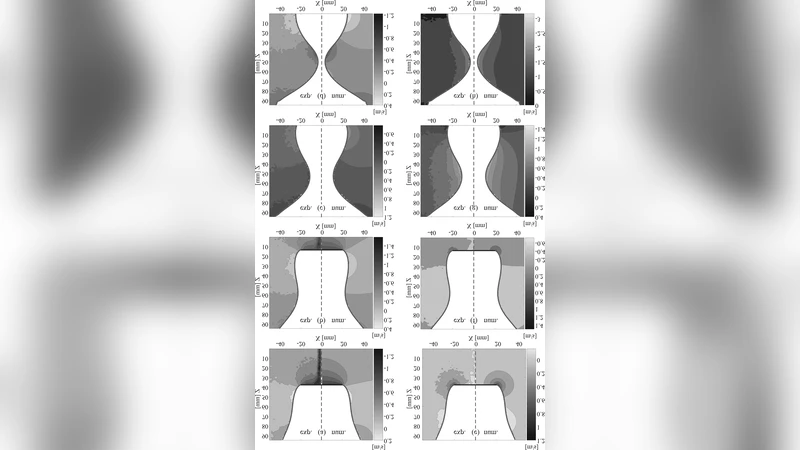
In this paper we study the transient surface cavity which is created by the controlled impact of a disk of radius h0 on a water surface at Froude numbers below 200. The dynamics of the transient free surface is recorded by high speed imaging and compared to boundary integral simulations. An excellent agreement is found between both. The flow surrounding the cavity is measured with high speed particle image velocimetry and is found to also agree perfectly with the flow field obtained from the simulations. We present a simple model for the radial dynamics of the cavity based on the collapse of an infinite cylinder. This model accounts for the observed asymmetry of the radial dynamics between the expansion and contraction phase of the cavity. It reproduces the scaling of the closure depth and total depth of the cavity which are both found to scale roughly proportional to Fr^{1/2} with a weakly Froude number dependent prefactor. In addition, the model accurately captures the dynamics of the minimal radius of the cavity, the scaling of the volume Vbubble of air entrained by the process, namely Vbubble/h0^3 proportional (1 + 0.26Fr^{1/2})Fr^{1/2}, and gives insight into the axial asymmetry of the pinch-off process.
💡 Research Summary
This paper presents a comprehensive investigation of the transient air cavity that forms when a circular disk impacts a water surface under precisely controlled conditions. By mounting the disk on a thin rod driven by a linear motor, the authors are able to prescribe the impact velocity V with high accuracy, thereby spanning a wide range of Froude numbers (Fr = V²/(g h₀)) from 0.6 up to 200 while keeping the disk radius h₀ between 10 mm and 40 mm. High‑speed imaging at 1000 fps captures the evolution of the cavity shape, depth, and minimum radius, and particle‑image velocimetry (PIV) provides the surrounding flow field.
Numerical simulations are performed with an axisymmetric boundary‑integral method that assumes inviscid, irrotational flow. The surface is discretized into adaptive nodes whose density follows local curvature, ensuring sufficient resolution near the pinch‑off singularity. Time integration uses a Crank‑Nicholson scheme with a safety‑factor‑controlled timestep, and a re‑gridding procedure maintains numerical stability. The simulations deliberately omit air dynamics, focusing solely on the pressure‑driven collapse of the cavity.
For Fr ≤ 13.6 the agreement between experiment and simulation is excellent: the cavity’s outer contour, its axial expansion, and the subsequent contraction match without any rescaling. The authors observe that the cavity’s radial dynamics can be described by a simple ordinary differential equation derived from the collapse of an infinite cylinder, R̈ = −g (R₀/R)², where R₀ is the initial radius at the start of the collapse. This model captures the pronounced asymmetry between the rapid expansion phase and the slower contraction phase.
Scaling analysis reveals that both the closure depth (z_c) and the total cavity depth (z_max) scale as h₀ Fr¹ᐟ², with a weak Fr‑dependent prefactor. The minimum neck radius follows the classic pinch‑off law R_min ∝ (t_c − t)^{2⁄3}, confirming the universal 2⁄3 exponent associated with inertial singularities. The volume of the entrained air bubble obeys V_bubble/h₀³ ≈ (1 + 0.26 Fr^{1⁄2}) Fr^{1⁄2}, a relationship that fits both experimental measurements and simulation data across the entire Fr range studied.
When Fr exceeds roughly 13.6, the experiments exhibit a surface‑seal phenomenon: the fast outward splash is drawn inward by the air rushing into the expanding cavity, causing the splash to close over the cavity axis and seal the top of the cavity. This effect shortens the cavity depth and introduces a discrepancy with the simulations, which do not include air and therefore do not display a seal. The authors discuss this discrepancy in the context of earlier observations by Wortington and later studies, emphasizing that air dynamics become non‑negligible at high impact speeds.
The paper concludes that (1) precise control of impact velocity via a linear motor is essential for systematic cavity studies; (2) boundary‑integral simulations accurately reproduce the cavity dynamics in the inertia‑dominated regime where Reynolds and Weber numbers are large; (3) a simple infinite‑cylinder collapse model successfully predicts the key scaling laws for cavity depth, neck radius, and entrained bubble volume; and (4) at high Froude numbers, air‑induced surface sealing dominates and must be incorporated in future models. The authors suggest extending the work to include full two‑phase CFD simulations and to explore non‑axisymmetric impacts, which would broaden the applicability of their findings to natural phenomena (e.g., raindrop impacts) and industrial processes (e.g., ink‑jet printing, metallurgical splashing).
Comments & Academic Discussion
Loading comments...
Leave a Comment