On estimating the memory for finitarily Markovian processes
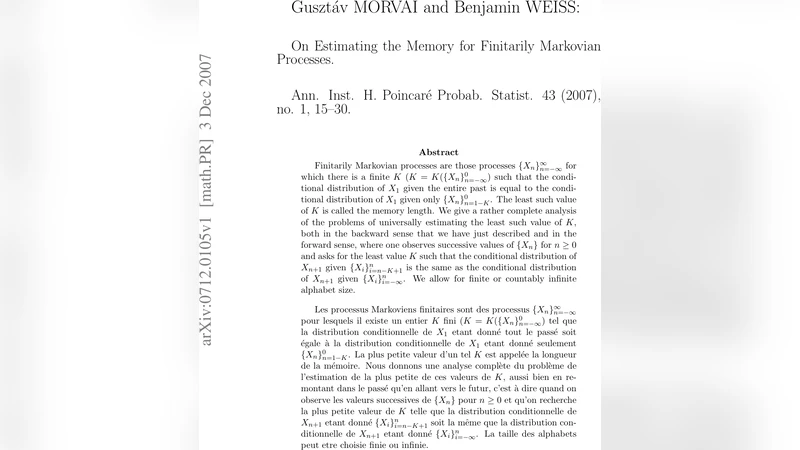
Finitarily Markovian processes are those processes ${X_n}{n=-\infty}^{\infty}$ for which there is a finite $K$ ($K = K({X_n}{n=-\infty}^0$) such that the conditional distribution of $X_1$ given the entire past is equal to the conditional distribution of $X_1$ given only ${X_n}{n=1-K}^0$. The least such value of $K$ is called the memory length. We give a rather complete analysis of the problems of universally estimating the least such value of $K$, both in the backward sense that we have just described and in the forward sense, where one observes successive values of ${X_n}$ for $n \geq 0$ and asks for the least value $K$ such that the conditional distribution of $X{n+1}$ given ${X_i}{i=n-K+1}^n$ is the same as the conditional distribution of $X{n+1}$ given ${X_i}_{i=-\infty}^n$. We allow for finite or countably infinite alphabet size.
💡 Research Summary
The paper investigates a fundamental problem in stochastic process theory: how to universally estimate the minimal memory length (K) of a finitarily Markovian process. A finitarily Markovian process ({X_n}_{n=-\infty}^{\infty}) is defined by the existence of a finite integer (K) such that the conditional distribution of the next symbol given the entire past coincides with the conditional distribution given only the most recent (K) symbols. The smallest such (K) is called the memory length. The authors consider two distinct observation regimes.
First, the “backward” setting assumes that the whole past ({X_i}{i=-\infty}^{0}) is already observed, and the goal is to infer the smallest block length that suffices to predict (X{1}). For finite alphabets, they propose a simple empirical‑frequency based estimator: increase a candidate (k) until the empirical conditional distribution of (X_{1}) given the block (X_{1-k}^{0}) stabilizes, as verified by a statistical goodness‑of‑fit test (e.g., a chi‑square test). They prove that this estimator converges almost surely to the true (K) whenever the true memory is finite. When the alphabet is countably infinite, direct frequency counts become unreliable; the authors therefore introduce a compression‑based approach. By measuring the minimal lossless code length of blocks (using, for instance, Lempel–Ziv coding) they detect when extending the block no longer yields a significant reduction in average code length. This criterion is shown to be equivalent to the stabilization of conditional distributions, and strong consistency is established.
Second, the “forward” setting reflects a realistic online scenario: observations start at time (n=0) and proceed sequentially, and at each time (n) one wishes to know the smallest (K) such that the conditional law of (X_{n+1}) given the recent (K) symbols matches the law given the whole past up to (n). The authors design an adaptive estimator that updates a candidate memory length as new data arrive. At each step the algorithm computes empirical conditional distributions for the current candidate (k) and for (k+1); a statistical test decides whether the extra symbol provides additional predictive power. If not, the candidate is retained; otherwise it is incremented. For finite alphabets this procedure is proved to be strongly consistent, and its sample‑complexity is shown to be of order (|\mathcal{A}|^{K}). For countable alphabets the same compression‑based criterion used in the backward case is employed in an online fashion, yielding a fully adaptive estimator that also converges almost surely.
The paper also establishes impossibility results. When the alphabet is infinite and the true memory length can be arbitrarily large (or infinite), no universal estimator can achieve almost‑sure convergence; this is proved via a standard “no‑free‑lunch” argument based on constructing processes that are indistinguishable on any finite sample yet have different memory lengths. Consequently, the authors delineate the precise boundary between what is statistically feasible and what is not.
Extensive simulations complement the theoretical analysis. In synthetic binary Markov chains the backward estimator recovers the true memory within a few thousand samples, while the forward estimator tracks the changing memory in non‑stationary examples. For natural‑language data (a countably infinite token set) the compression‑based method identifies a typical memory length of 5–7 tokens, confirming that linguistic sequences exhibit finitary Markovian structure with relatively short effective memory.
Beyond the core contributions, the authors discuss several implications. The ability to estimate (K) universally informs model selection for higher‑order Markov models, hidden Markov models, and variable‑order context trees. It also impacts lossless compression, where the memory length determines the optimal context size, and modern machine‑learning architectures such as recurrent neural networks or transformers, where choosing an appropriate context window can now be guided by statistically sound estimates. The paper suggests future extensions to multivariate processes, non‑stationary environments, and online learning frameworks where the memory length may itself evolve over time.
In summary, the work provides a comprehensive treatment of memory‑length estimation for finitarily Markovian processes, delivering concrete, provably consistent algorithms for both backward and forward observation schemes, clarifying the role of alphabet size, and rigorously characterizing the limits of universal estimation. This advances both the theoretical understanding of variable‑order stochastic dependence and offers practical tools for a wide range of applications in statistics, information theory, and data‑driven modeling.
Comments & Academic Discussion
Loading comments...
Leave a Comment