Coefficient Quantization for Frames in Banach Spaces
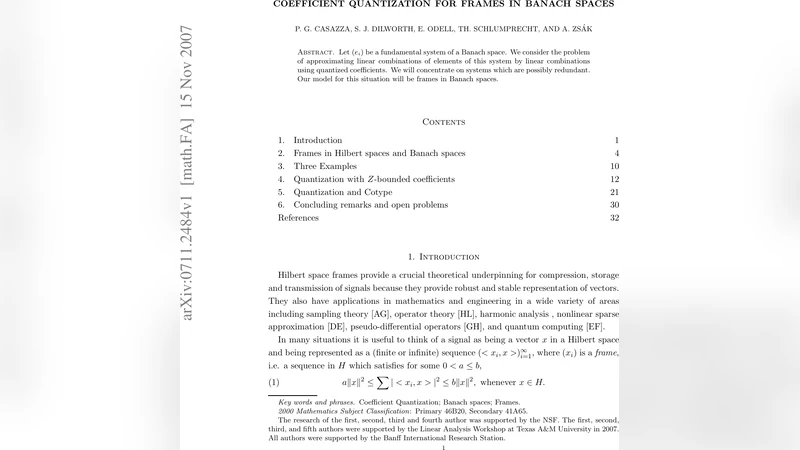
Let $(e_i)$ be a fundamental system of a Banach space. We consider the problem of approximating linear combinations of elements of this system by linear combinations using quantized coefficients. We will concentrate on systems which are possibly redundant. Our model for this situation will be frames in Banach spaces.
💡 Research Summary
The paper investigates the problem of approximating linear combinations of elements from a fundamental system in a Banach space when the coefficients are restricted to a finite, quantized set. Rather than limiting the analysis to bases, the authors adopt the more flexible notion of frames, which allow redundancy and thus provide robustness against noise and quantization errors. The central question is: given a frame ((e_i){i\in I}) for a Banach space (X) and a quantization alphabet (\mathcal{Q}\subset\mathbb{R}) with mesh size (\delta), under what conditions can any finite linear combination (x=\sum{i\in F}a_i e_i) be approximated by (\tilde x=\sum_{i\in F}\tilde a_i e_i) with (\tilde a_i\in\mathcal{Q}) such that (|x-\tilde x|\le\varepsilon)?
The authors begin by recalling the frame operator (T:X\to\ell_2(I)), (Tx=(f_i(x)){i\in I}), where ((f_i)\subset X^*) is a dual system satisfying the frame inequalities (A|x|\le|Tx|{\ell_2}\le B|x|). These inequalities guarantee that the analysis map (T) is bounded below and above, which is crucial for stability under coefficient perturbations. The quantization error is split into two components: (1) the direct error caused by replacing each coefficient (a_i) with its nearest quantized value (\tilde a_i), and (2) the indirect error arising from the redundancy of the frame, which can either amplify or mitigate the first component.
A key contribution is the introduction of a “redundancy constant” (C) that quantifies how the lower frame bound deteriorates when passing to sub‑frames. For frames that are (C)-stable (i.e., every sub‑frame retains a lower bound at least (A/C)), the authors prove that if the quantization mesh satisfies
\
Comments & Academic Discussion
Loading comments...
Leave a Comment