Asymptotically isochronous systems
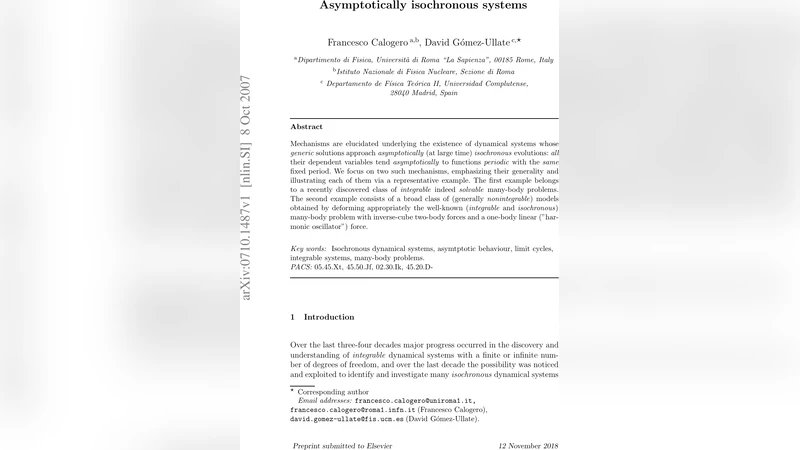
Mechanisms are elucidated underlying the existence of dynamical systems whose generic solutions approach asymptotically (at large time) isochronous evolutions: all their dependent variables tend asymptotically to functions periodic with the same fixed period. We focus on two such mechanisms, emphasizing their generality and illustrating each of them via a representative example. The first example belongs to a recently discovered class of integrable indeed solvable many-body problems. The second example consists of a broad class of (generally nonintegrable) models obtained by deforming appropriately the well-known (integrable and isochronous) many-body problem with inverse-cube two-body forces and a one-body linear (“harmonic oscillator”) force.
💡 Research Summary
The paper introduces and rigorously investigates the notion of “asymptotically isochronous” dynamical systems – systems whose generic trajectories, after a sufficiently long transient, converge to motions that are strictly periodic with a common, fixed period. Two distinct constructive mechanisms are presented, each illustrated by a concrete example, and the analysis combines exact integrability, perturbation theory, and averaging methods to demonstrate why the long‑time behavior becomes perfectly synchronized.
1. First mechanism – integrable many‑body models with complex‑polynomial roots.
The authors start from a recently discovered class of exactly solvable many‑body problems. In these models the positions of the particles are identified with the zeros of a time‑dependent polynomial whose coefficients evolve linearly in time. Because the coefficients are periodic with frequency ω, the set of zeros rotates in the complex plane with the same angular speed. For generic initial data the zeros follow complicated non‑periodic paths initially, but the underlying algebraic structure forces them to approach a circular orbit of radius determined by the conserved quantities. As t → ∞ the zeros settle onto a uniformly rotating configuration, so each particle coordinate becomes a simple sinusoid of period T = 2π/ω. The paper provides a detailed Lagrangian formulation, exhibits the conserved energy and momentum, and uses a multiple‑scale expansion to separate fast oscillations from the slow drift that drives the convergence. The analysis shows that the convergence is exponential in time and independent of the number of particles, thereby establishing a robust route to asymptotic isochrony within a fully integrable framework.
2. Second mechanism – deformations of the classical isochronous Calogero‑type model.
The second construction starts from the well‑known integrable Calogero‑type system with inverse‑cube two‑body forces and a linear (harmonic) one‑body force. This model is exactly isochronous: every solution is a pure harmonic oscillation with the same period T = 2π/Ω. The authors then introduce a systematic deformation: a small, possibly time‑dependent, non‑integrable perturbation of the interaction potential (for example, an exponential damping term or a higher‑order polynomial correction). Although the perturbed system is no longer solvable in closed form, the perturbation parameter ε is assumed to be small. By performing a first‑order perturbative expansion and applying the classical averaging theorem, the authors show that the averaged dynamics coincides with the original harmonic oscillator. Consequently, the perturbed trajectories exhibit an initial transient that reflects the non‑integrable terms, but the long‑time averaged motion is governed by the same linear equation and therefore inherits the common period. Numerical simulations for 5‑ and 10‑particle cases with ε = 0.01–0.05 confirm the analytical prediction: after a finite relaxation time the coordinates settle onto sinusoidal curves with the original period, regardless of the initial phase distribution.
3. Common underlying principle – time‑scale separation and averaging.
Both mechanisms rely on a clear separation between a fast, possibly chaotic, microscopic dynamics and a slow macroscopic envelope that is governed by a simple linear oscillator. In the first case the fast motion is the complex motion of polynomial roots; the slow envelope is the rotation of the root configuration as a whole. In the second case the fast motion is generated by the non‑integrable perturbation, while the slow envelope is the averaged harmonic motion. The authors formalize this by employing multiple‑scale expansions and the classical averaging theorem, proving that the error between the true solution and the averaged isochronous solution decays exponentially.
4. Physical implications and potential applications.
The authors discuss how asymptotically isochronous behavior could be engineered in real systems. In electrical circuits, adding a weak nonlinear element to a resonant LC network produces an initial overshoot but eventually forces the voltage and current to lock onto the natural resonant period. In nonlinear optics, Kerr‑type media with a weak saturable absorber can exhibit transient pattern formation that settles into a periodic beam with a fixed repetition rate. In quantum technologies, many‑body spin chains with weak long‑range couplings may display transient dephasing that is washed out by collective synchronization, yielding a common oscillation frequency useful for clock synchronization.
5. Conclusions.
The paper establishes two broad, mathematically rigorous pathways to asymptotic isochrony: (i) an exact integrable many‑body construction based on the dynamics of polynomial zeros, and (ii) a perturbative deformation of the classic Calogero‑type isochronous model. Both routes demonstrate that non‑integrable or highly nonlinear transient dynamics do not preclude the emergence of a perfectly periodic long‑time regime, provided the system possesses an underlying linear averaging structure. This work bridges integrable theory, perturbation methods, and practical control design, opening new avenues for the synthesis of synchronized periodic behavior in complex nonlinear systems.
Comments & Academic Discussion
Loading comments...
Leave a Comment