Superintegrable anharmonic oscillators on N-dimensional curved spaces
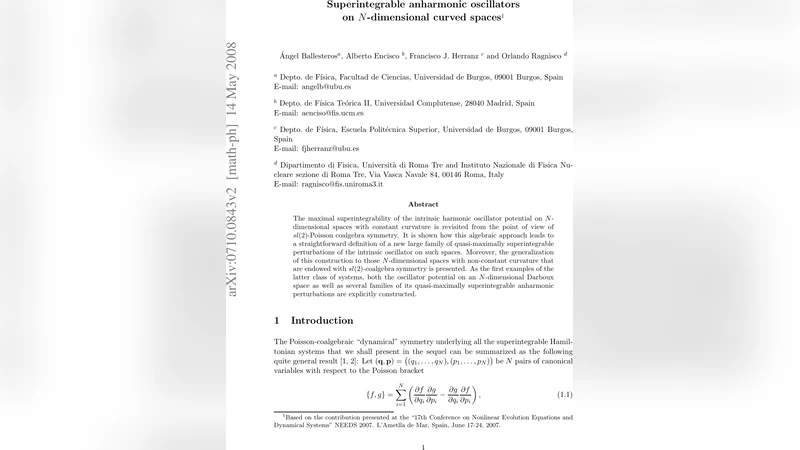
The maximal superintegrability of the intrinsic harmonic oscillator potential on N-dimensional spaces with constant curvature is revisited from the point of view of sl(2)-Poisson coalgebra symmetry. It is shown how this algebraic approach leads to a straightforward definition of a new large family of quasi-maximally superintegrable perturbations of the intrinsic oscillator on such spaces. Moreover, the generalization of this construction to those N-dimensional spaces with non-constant curvature that are endowed with sl(2)-coalgebra symmetry is presented. As the first examples of the latter class of systems, both the oscillator potential on an N-dimensional Darboux space as well as several families of its quasi-maximally superintegrable anharmonic perturbations are explicitly constructed.
💡 Research Summary
The paper investigates superintegrable systems on curved N‑dimensional manifolds by exploiting the sl(2) Poisson coalgebra symmetry. The authors first revisit the intrinsic harmonic oscillator – often called the Higgs oscillator – on spaces of constant curvature (the N‑sphere S^N and the N‑hyperbolic space H^N). By expressing the Hamiltonian in terms of the coalgebra generators J₊, J₋ and J₃, they show that the Casimir invariant C = J₊J₋ – J₃² together with the N‑fold coproduct yields N independent integrals of motion. Together with the Hamiltonian itself, this provides 2N‑2 functionally independent constants, confirming maximal superintegrability (MS) of the system.
The central contribution is the construction of a large family of quasi‑maximally superintegrable (QMS) perturbations of the intrinsic oscillator. The authors add polynomial potentials of the form a_k (J₊)^k (k ≥ 2) to the original Hamiltonian: H_QMS = ½ J₋ + ½ ω² J₊ + Σ_{k=2}^M a_k (J₊)^k . Because the added terms are functions solely of J₊, the sl(2) coalgebra symmetry remains intact. Consequently, the N universal integrals derived from the coalgebra survive, while the total number of independent integrals drops to 2N‑3, which is the defining property of a QMS system. The paper provides explicit examples for k = 2, 3, 4, discusses the curvature‑dependent coefficients, and analyses the resulting dynamics (periodicity, stability of trajectories).
A further novelty is the extension of the whole construction to non‑constant curvature manifolds that still admit an sl(2) coalgebra structure. The authors focus on N‑dimensional Darboux spaces, whose metric can be written as g_{ij}=f(x) δ_{ij} with a suitable conformal factor f(x). In such coordinates the same generators J₊, J₋, J₃ can be defined, preserving the coalgebra relations. The intrinsic oscillator on a Darboux space is then defined by a curvature‑dependent potential V₀ = ½ ω² F(J₊), where F encodes the specific conformal factor. By adding the same polynomial perturbations as before, they obtain explicit QMS Hamiltonians on Darboux I and III types, each possessing 2N‑3 independent integrals. The paper also sketches the quantization of these models and comments on the resulting energy spectra.
Overall, the work demonstrates that sl(2) Poisson coalgebra symmetry provides a unifying algebraic framework for constructing both maximally and quasi‑maximally superintegrable systems on a wide class of curved spaces, including those with variable curvature. The method automatically generates a set of universal integrals, simplifies the identification of admissible perturbations, and opens the door to systematic exploration of more intricate potentials (e.g., non‑polynomial interactions, external fields) on high‑dimensional curved manifolds.
Comments & Academic Discussion
Loading comments...
Leave a Comment