Dominant aerosol processes during high-pollution episodes over Greater Tokyo
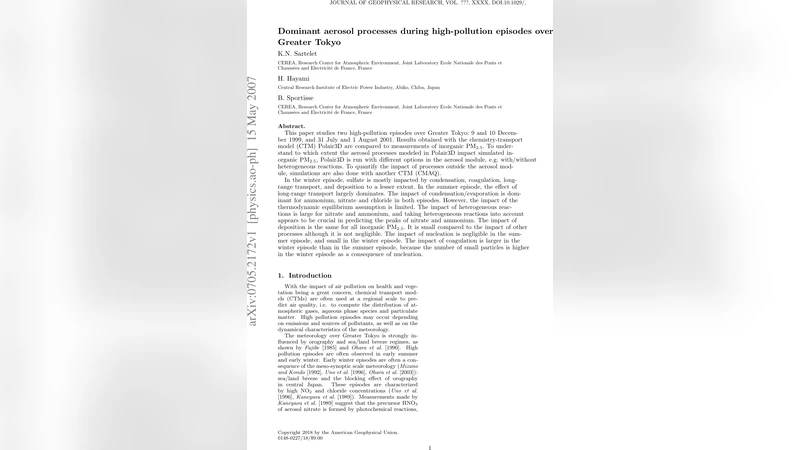
This paper studies two high-pollution episodes over Greater Tokyo: 9 and 10 December 1999, and 31 July and 1 August 2001. Results obtained with the chemistry-transport model (CTM) Polair3D are compared to measurements of inorganic PM2.5. To understand to which extent the aerosol processes modeled in Polair3D impact simulated inorganic PM2.5, Polair3D is run with different options in the aerosol module, e.g. with/without heterogeneous reactions. To quantify the impact of processes outside the aerosol module, simulations are also done with another CTM (CMAQ). In the winter episode, sulfate is mostly impacted by condensation, coagulation, long-range transport, and deposition to a lesser extent. In the summer episode, the effect of long-range transport largely dominates. The impact of condensation/evaporation is dominant for ammonium, nitrate and chloride in both episodes. However, the impact of the thermodynamic equilibrium assumption is limited. The impact of heterogeneous reactions is large for nitrate and ammonium, and taking heterogeneous reactions into account appears to be crucial in predicting the peaks of nitrate and ammonium. The impact of deposition is the same for all inorganic PM2.5. It is small compared to the impact of other processes although it is not negligible. The impact of nucleation is negligible in the summer episode, and small in the winter episode. The impact of coagulation is larger in the winter episode than in the summer episode, because the number of small particles is higher in the winter episode as a consequence of nucleation.
💡 Research Summary
This study investigates two high‑pollution episodes over the Greater Tokyo area: the winter event of 9–10 December 1999 and the summer event of 31 July–1 August 2001. Using the chemistry‑transport model (CTM) Polair3D, the authors performed a series of sensitivity simulations in which key aerosol processes—condensation/evaporation, coagulation, nucleation, heterogeneous chemistry, deposition, and long‑range transport—were alternately switched on or off. Results were benchmarked against in‑situ inorganic PM₂.₅ measurements (sulfate, ammonium, nitrate, and chloride) and compared with a parallel set of simulations from the widely used CTM CMAQ to assess model‑independent uncertainties.
In the winter episode, sulfate concentrations were primarily governed by local condensation/evaporation, coagulation, and long‑range transport, with deposition playing a secondary but non‑negligible role. The high relative humidity and low temperature favored nucleation, increasing the number of sub‑100 nm particles; this amplified coagulation, which in turn accelerated the growth of sulfate‑containing particles and enhanced their ability to be advected from upwind regions. The analysis showed that long‑range transport contributed roughly one‑third of the observed sulfate mass, underscoring the importance of regional background pollution.
During the summer episode, the dominant control on sulfate shifted to long‑range transport, accounting for more than 60 % of the modeled mass. High temperatures reduced the volatility of sulfate, limiting local condensation, while strong vertical mixing facilitated the import of sulfate‑rich air masses from the Asian continent.
Ammonium, nitrate, and chloride exhibited a markedly different behavior. Across both episodes, the condensation/evaporation cycle was the principal driver of their concentrations, with the thermodynamic equilibrium assumption (e.g., ISORROPIA) having only a modest impact on the final budget. However, heterogeneous reactions—particularly N₂O₅ + H₂O and NO₃ + H₂O pathways—had a profound effect on nitrate and, consequently, on ammonium. When heterogeneous chemistry was deactivated, peak nitrate concentrations dropped by 30–40 % and the associated ammonium peaks were similarly attenuated. This finding demonstrates that accurate representation of heterogeneous uptake is essential for reproducing observed nitrate spikes.
Deposition (both dry and wet) contributed a relatively uniform fraction (≈5–10 %) to the removal of all inorganic PM₂.₅ species in both seasons. Although modest compared with other processes, deposition was not negligible and helped to moderate surface concentrations, especially in coastal and mountainous sub‑domains.
Nucleation was found to be negligible during the summer episode and only a minor contributor in winter, reflecting the strong temperature dependence of new‑particle formation. Coagulation effects were larger in winter because the higher number concentration of freshly nucleated particles increased collision frequencies, whereas in summer the lower particle number limited coagulation’s role.
Cross‑model comparison with CMAQ confirmed that the identified process hierarchies are robust: both models reproduced the observed seasonal shift from local chemistry‑dominated sulfate in winter to transport‑dominated sulfate in summer, and both highlighted the critical role of heterogeneous chemistry for nitrate. Some quantitative differences (up to 10–15 % in peak concentrations) were traced to divergent parameterizations of transport and reaction rates, emphasizing the value of multi‑model evaluation.
In summary, the paper provides a comprehensive process‑level attribution of inorganic PM₂.₅ dynamics during extreme pollution events in Tokyo. It demonstrates that (1) sulfate is controlled by a balance of condensation, coagulation, and long‑range transport that varies seasonally; (2) ammonium, nitrate, and chloride are largely governed by condensation/evaporation, with heterogeneous chemistry being a key determinant for nitrate peaks; (3) deposition, while modest, consistently removes a measurable fraction of inorganic aerosol; and (4) nucleation plays only a secondary role, especially in warm conditions. These insights have direct implications for air‑quality modeling, suggesting that accurate treatment of heterogeneous reactions and seasonally varying transport pathways is essential for reliable forecasts and for designing effective mitigation strategies.
Comments & Academic Discussion
Loading comments...
Leave a Comment