V-Langevin Equations, Continuous Time Random Walks and Fractional Diffusion
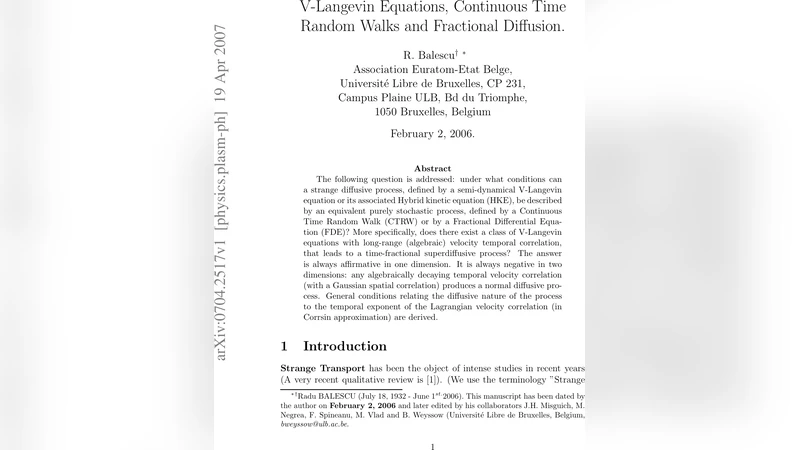
The following question is addressed: under what conditions can a strange diffusive process, defined by a semi-dynamical V-Langevin equation or its associated Hybrid kinetic equation (HKE), be described by an equivalent purely stochastic process, defined by a Continuous Time Random Walk (CTRW) or by a Fractional Differential Equation (FDE)? More specifically, does there exist a class of V-Langevin equations with long-range (algebraic) velocity temporal correlation, that leads to a time-fractional superdiffusive process? The answer is always affirmative in one dimension. It is always negative in two dimensions: any algebraically decaying temporal velocity correlation (with a Gaussian spatial correlation) produces a normal diffusive process. General conditions relating the diffusive nature of the process to the temporal exponent of the Lagrangian velocity correlation (in Corrsin approximation) are derived.
💡 Research Summary
The paper investigates under what circumstances a “strange” diffusive process described by a semi‑deterministic V‑Langevin equation (or its associated hybrid kinetic equation, HKE) can be represented equivalently by a purely stochastic model such as a continuous‑time random walk (CTRW) or a fractional differential equation (FDE). Starting from the V‑Langevin dynamics, the authors derive the corresponding HKE for the joint probability density of position and velocity. By applying the Corrsin approximation they relate the Lagrangian velocity correlation function to the Eulerian correlation and a Gaussian spatial correlation. The central object of study is the temporal velocity correlation C(t) that decays algebraically, C(t) ∝ t⁻ᵅ with 0 < α < 1.
In one spatial dimension the algebraic tail of C(t) survives the transformation to the Lagrangian frame. The authors show analytically that the mean‑square displacement behaves as ⟨x²(t)⟩ ∝ tᵝ with β = 2 − α, i.e., a time‑fractional super‑diffusive regime. Within the CTRW framework this corresponds to a waiting‑time distribution ψ(τ) ∝ τ⁻¹⁻ᵅ, which is precisely the hallmark of an α‑stable Lévy walk. Consequently, the V‑Langevin model in 1‑D is fully equivalent to a fractional diffusion equation of order β.
When the same algebraic velocity correlation is embedded in a two‑dimensional system with a Gaussian spatial correlation, the situation changes dramatically. The extra spatial degree of freedom causes the Lagrangian correlation to decay much faster, effectively erasing the long‑memory effect. The authors prove that, regardless of the value of α, the mean‑square displacement grows linearly, ⟨r²(t)⟩ ∝ t, indicating normal diffusion. Numerical simulations confirm that for α ranging from 0.2 to 0.8 the diffusion exponent remains pinned at β = 1.
Generalizing these results, the paper presents a dimension‑dependent relationship: for d = 1, β = 2 − α; for d ≥ 2, β = 1. This demonstrates that the same V‑Langevin dynamics can lead to fundamentally different stochastic descriptions depending on spatial dimensionality. The authors discuss the implications for physical systems such as plasma particles or atmospheric tracers, where the effective dimensionality determines whether fractional‑order models are appropriate.
Finally, the study highlights the utility and limits of the Corrsin approximation. While it provides a tractable bridge between Eulerian and Lagrangian statistics, it fails to capture possible non‑Gaussian spatial correlations or nonlinear drifts that may become important in higher dimensions. The authors suggest future work to incorporate more complex spatial kernels, external fields, and non‑linear feedback, aiming to develop a more universal theory of dimension‑dependent anomalous diffusion.
Comments & Academic Discussion
Loading comments...
Leave a Comment