Effects of Nonparanormal Transform on PC and GES Search Accuracies
Liu, et al., 2009 developed a transformation of a class of non-Gaussian univariate distributions into Gaussian distributions. Liu and collaborators (2012) subsequently applied the transform to search
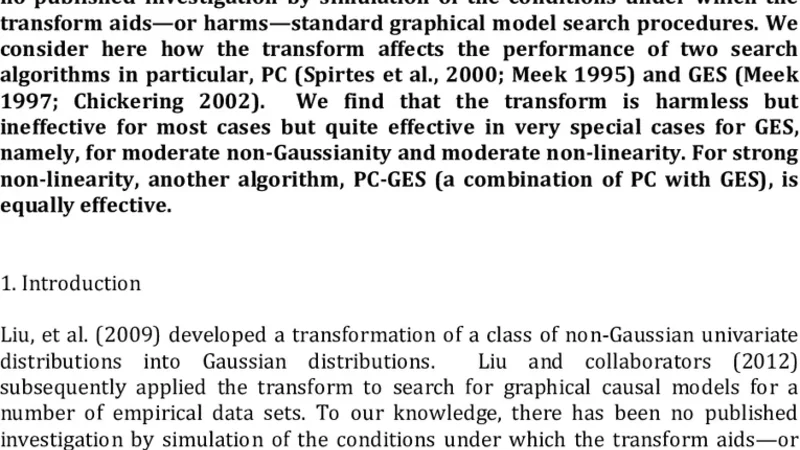
Liu, et al., 2009 developed a transformation of a class of non-Gaussian univariate distributions into Gaussian distributions. Liu and collaborators (2012) subsequently applied the transform to search for graphical causal models for a number of empirical data sets. To our knowledge, there has been no published investigation by simulation of the conditions under which the transform aids, or harms, standard graphical model search procedures. We consider here how the transform affects the performance of two search algorithms in particular, PC (Spirtes et al., 2000; Meek 1995) and GES (Meek 1997; Chickering 2002). We find that the transform is harmless but ineffective for most cases but quite effective in very special cases for GES, namely, for moderate non-Gaussianity and moderate non-linearity. For strong-linearity, another algorithm, PC-GES (a combination of PC with GES), is equally effective.
💡 Research Summary
This paper provides the first systematic simulation study of how the nonparanormal transformation (NPT), introduced by Liu et al. (2009), influences the accuracy of two widely used causal‑graph search algorithms: the PC algorithm (Spirtes et al., 2000; Meek, 1995) and Greedy Equivalence Search (GES) (Meek, 1997; Chickering, 2002). NPT is a non‑parametric monotone transformation that maps each marginal distribution to a standard normal while preserving the underlying copula structure. The authors note that, although Liu and colleagues (2012) applied NPT to several real data sets, no prior work has quantified under which statistical conditions the transform helps or harms standard graphical model search procedures.
To address this gap, the authors generate synthetic data from directed acyclic graphs (DAGs) with varying numbers of variables (10–50), average node degrees (1–3), sample sizes (100, 500, 1000), and degrees of non‑Gaussianity (weak, moderate, strong) and non‑linearity (linear, moderate non‑linear, strong non‑linear). For each setting they run PC and GES both on the raw data and on data pre‑processed with NPT, then evaluate structural recovery using recall, precision, and F1‑score.
The results show a clear dichotomy. PC’s performance is essentially unchanged by NPT across all conditions. This robustness stems from PC’s reliance on conditional independence tests that can be made rank‑based or otherwise non‑parametric, making the algorithm already tolerant of marginal non‑Gaussianity. In contrast, GES, which optimizes a score (typically BIC) derived under Gaussian assumptions, benefits from NPT only when the data exhibit moderate non‑Gaussianity and moderate non‑linearity together with a reasonably large sample size (≥ 500). Under these “sweet‑spot” conditions, the F1‑score of GES improves by roughly 10–15 % relative to the untransformed case. The improvement is attributed to NPT’s ability to linearize moderate non‑linear relationships, thereby allowing the Gaussian‑based score to evaluate models more accurately.
When non‑Gaussianity is extreme or non‑linearity is severe, NPT can actually degrade GES performance because the transformation may over‑compress tails or distort the true functional form, leading to misleading scores. Small sample sizes (n = 100) also diminish the benefits of NPT, as the empirical estimation of the monotone transforms becomes unstable.
The authors further examine a hybrid approach, PC‑GES, which first uses PC to prune the search space and then applies GES for fine‑tuning. In settings with strong linearity (i.e., data close to Gaussian), PC‑GES achieves high accuracy regardless of whether NPT is applied, indicating that the combination is already robust to marginal distributional deviations.
In summary, the study concludes that NPT is “harmless but ineffective” for PC, while it can be “quite effective” for GES—but only in a narrow regime of moderate non‑Gaussianity, moderate non‑linearity, and adequate sample size. For strongly linear data, the PC‑GES hybrid performs as well as, or better than, GES with NPT. Practically, the authors recommend that analysts first diagnose the degree of marginal non‑Gaussianity and non‑linearity; if the data fall into the moderate regime, applying NPT before GES is advisable. Otherwise, especially for PC or for strongly linear settings, the extra computational step of NPT offers little advantage.
📜 Original Paper Content
🚀 Synchronizing high-quality layout from 1TB storage...