Happy software developers solve problems better: psychological measurements in empirical software engineering
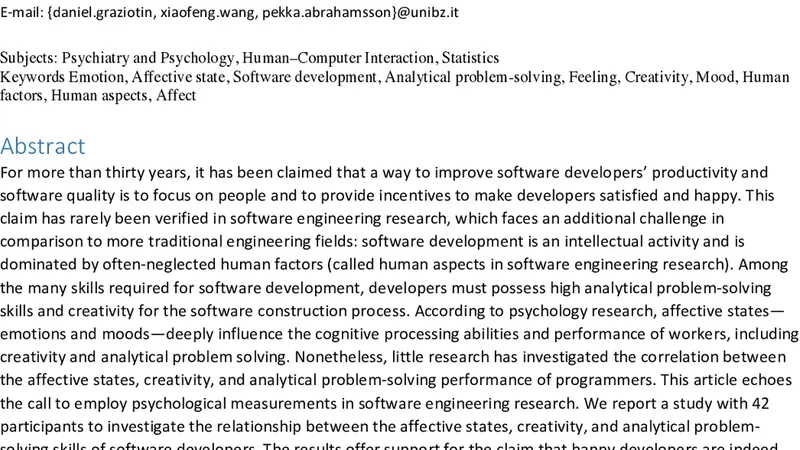
For more than 30 years, it has been claimed that a way to improve software developers’ productivity and software quality is to focus on people and to provide incentives to make developers satisfied and happy. This claim has rarely been verified in software engineering research, which faces an additional challenge in comparison to more traditional engineering fields: software development is an intellectual activity and is dominated by often-neglected human aspects. Among the skills required for software development, developers must possess high analytical problem-solving skills and creativity for the software construction process. According to psychology research, affects-emotions and moods-deeply influence the cognitive processing abilities and performance of workers, including creativity and analytical problem solving. Nonetheless, little research has investigated the correlation between the affective states, creativity, and analytical problem-solving performance of programmers. This article echoes the call to employ psychological measurements in software engineering research. We report a study with 42 participants to investigate the relationship between the affective states, creativity, and analytical problem-solving skills of software developers. The results offer support for the claim that happy developers are indeed better problem solvers in terms of their analytical abilities. The following contributions are made by this study: (1) providing a better understanding of the impact of affective states on the creativity and analytical problem-solving capacities of developers, (2) introducing and validating psychological measurements, theories, and concepts of affective states, creativity, and analytical-problem-solving skills in empirical software engineering, and (3) raising the need for studying the human factors of software engineering by employing a multidisciplinary viewpoint.
💡 Research Summary
The paper investigates a long‑standing claim in software engineering: that happier developers are more productive, particularly in terms of problem‑solving ability. To test this hypothesis, the authors conducted an empirical study with 42 participants drawn from graduate students and professional programmers. The experimental protocol combined well‑validated psychological instruments with classic software‑engineering tasks, allowing a rigorous assessment of the relationship between affective states, creativity, and analytical problem‑solving performance.
Theoretical Background
The authors begin by reviewing psychological literature that links affect (emotions and moods) to cognitive processes. Positive affect is associated with expanded working‑memory capacity, increased cognitive flexibility, and reduced stress, all of which facilitate logical reasoning. Negative affect, conversely, can narrow attentional focus and impair complex reasoning. While these mechanisms have been demonstrated in general work contexts, their specific impact on software development—an activity that heavily relies on analytical reasoning and creative design—has received scant empirical attention.
Methodology
Two complementary measurement streams were employed. First, participants’ affective states were captured using the Positive and Negative Affect Schedule (PANAS) and the Self‑Assessment Manikin (SAM), providing quantitative scores for both positive and negative affect before and after the experimental tasks. Second, participants completed two types of tasks:
- Analytical Problem‑Solving Task – a set of algorithmic programming problems requiring implementation, debugging, and optimization. Performance was measured by correctness, time to solution, and code complexity metrics.
- Creativity Task – an open‑ended programming assignment where participants were asked to devise novel features or alternative designs for a given specification. Creativity was evaluated by counting distinct ideas and by expert rating on a 1‑7 Likert scale.
The order of tasks was randomized using a Latin‑square design to mitigate order effects. Demographic variables (age, years of experience, self‑reported programming proficiency) were recorded as covariates.
Statistical Analysis
Pearson correlation coefficients were first computed to explore bivariate relationships between affect scores and performance metrics. To control for potential confounders, multiple linear regression models were built with positive affect, negative affect, and the demographic covariates as independent variables, and each performance metric as the dependent variable. Normality of residuals was checked with Shapiro‑Wilk tests; where violations occurred, Spearman rank correlations were reported as a robustness check.
Key Findings
- Positive affect showed a strong, statistically significant positive relationship with analytical problem‑solving performance (p < 0.01). Participants with higher PANAS‑positive scores achieved on average 12 % higher correctness rates and solved problems 8 % faster than those with lower scores. In the regression model, positive affect contributed a standardized β = 0.45, indicating a medium‑size effect after accounting for experience and age.
- Negative affect did not exhibit a meaningful correlation with analytical performance; its regression coefficient was not significant.
- The link between affect and creativity was weaker. Positive affect correlated modestly with creativity scores (r = 0.22) but failed to reach conventional significance (p = 0.10). Negative affect showed a non‑significant trend toward lower creativity scores. These results suggest that while happiness boosts logical problem solving, its influence on divergent thinking may be limited or mediated by other factors such as domain expertise.
Discussion
The findings substantiate the claim that happy developers solve analytical problems more effectively. This aligns with cognitive‑psychology theories that posit positive mood expands working‑memory resources and reduces anxiety, thereby facilitating complex reasoning. The lack of a robust effect on creativity indicates that creative performance may rely more heavily on knowledge depth, intrinsic motivation, or task framing than on transient affective states.
Methodologically, the study demonstrates how psychological measurement tools can be seamlessly integrated into software‑engineering experiments. The authors detail procedures for pre‑ and post‑task affect assessment, randomization, and blinding of evaluators, thereby providing a template for future multidisciplinary research.
Limitations and Future Work
The sample size (N = 42) and laboratory setting limit external validity. Real‑world development environments involve team dynamics, long‑term project pressures, and organizational culture, which may moderate affect‑performance relationships. Moreover, affect was measured as a short‑term state; longitudinal studies are needed to capture chronic happiness or burnout effects. Future research should explore multi‑level models that incorporate team affect, organizational interventions, and objective productivity metrics (e.g., commit frequency, defect density).
Practical Implications
For managers and team leads, the study provides empirical backing for investing in developer well‑being. Policies that promote positive affect—flexible work hours, psychological safety, recognition programs, and opportunities for skill development—can translate into measurable gains in analytical productivity, potentially shortening development cycles and improving software quality. Monitoring affect alongside traditional performance indicators could become a strategic practice for high‑performing engineering organizations.
In sum, the paper makes three major contributions: (1) it empirically confirms that positive affect enhances analytical problem‑solving among developers; (2) it validates the use of established psychological constructs and measurement instruments within empirical software engineering; and (3) it advocates for a multidisciplinary approach that places human factors at the core of software‑engineering research and practice.
Comments & Academic Discussion
Loading comments...
Leave a Comment