Green open access in computer science - an exploratory study on author-based self-archiving awareness, practice, and inhibitors
Access to the work of others is something that is too often taken for granted, yet problematic and difficult to be obtained unless someone pays for it. Green and gold open access are claimed to be a s
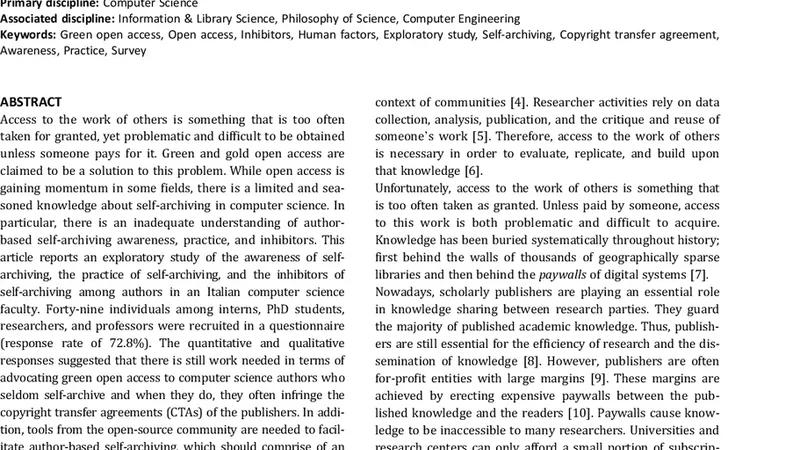
Access to the work of others is something that is too often taken for granted, yet problematic and difficult to be obtained unless someone pays for it. Green and gold open access are claimed to be a solution to this problem. While open access is gaining momentum in some fields, there is a limited and seasoned knowledge about self-archiving in computer science. In particular, there is an inadequate understanding of author-based self-archiving awareness, practice, and inhibitors. This article reports an exploratory study of the awareness of self-archiving, the practice of self-archiving, and the inhibitors of self-archiving among authors in an Italian computer science faculty. Forty-nine individuals among interns, PhD students, researchers, and professors were recruited in a questionnaire (response rate of 72.8%). The quantitative and qualitative responses suggested that there is still work needed in terms of advocating green open access to computer science authors who seldom self-archive and when they do, they often infringe the copyright transfer agreements (CTAs) of the publishers. In addition, tools from the open-source community are needed to facilitate author-based self-archiving, which should comprise of an automatic check of the CTAs. The study identified nine factors inhibiting the act of self-archiving among computer scientists. As a first step, this study proposes several propositions regarding author-based self-archiving in computer science that can be further investigated. Recommendations to foster self-archiving in computer science, based on the results, are provided.
💡 Research Summary
The paper investigates the state of green open access (Green OA) in computer science by focusing on author‑based self‑archiving—i.e., the practice of depositing a copy of a scholarly article in an institutional or subject repository. Although Green OA is widely promoted as a solution to the pay‑wall problem, little is known about how computer scientists perceive, enact, or are hindered from self‑archiving. To fill this gap, the authors conducted an exploratory survey among members of a single Italian university’s computer‑science faculty. A total of 49 participants—comprising interns, PhD candidates, researchers, and professors—responded, yielding a 72.8 % response rate. The questionnaire combined closed‑ended items (Likert scales, multiple‑choice) with open‑ended prompts to capture three dimensions: (1) awareness of self‑archiving concepts and policies, (2) actual self‑archiving behavior in the past two years, and (3) perceived inhibitors.
Quantitative findings reveal a striking lack of awareness: roughly two‑thirds of respondents could not accurately describe what self‑archiving entails or where it can be performed. Only 28 % reported having deposited any version of their work in a repository, and among those, more than half admitted to violating the publisher’s copyright transfer agreement (CTA) by uploading a version that was not permitted. The most frequently cited reasons for not self‑archiving were “lack of time,” “complexity of copyright contracts,” and “absence of clear institutional policy.”
Qualitative analysis identified nine distinct inhibitors, which the authors group into legal, technical, institutional, cultural, and personal categories:
- Unclear copyright contracts and perceived legal risk – authors are unsure which manuscript version they may share.
- Complexity of repository interfaces – uploading, metadata entry, and version selection are perceived as cumbersome.
- Missing or ambiguous institutional Green OA policies – no clear mandates or incentives exist.
- Lack of peer and supervisor support – colleagues do not encourage or model self‑archiving.
- Research evaluation systems that do not reward open‑access deposits – promotion criteria focus on journal impact rather than openness.
- Absence of technical tools for automatic metadata extraction and CTA compliance checking – authors must manually verify permissions.
- Fear of copyright infringement consequences – potential legal or reputational penalties deter action.
- Additional time and effort required – self‑archiving is seen as an extra administrative burden.
- General cultural resistance to open‑access norms – a belief that traditional subscription journals remain the gold standard.
The authors argue that inhibitors 1 and 6 are especially amenable to mitigation through open‑source software that automatically parses publisher policies, determines the permissible version (pre‑print, post‑print, or publisher’s PDF), and populates repository metadata. Such tools could lower the technical barrier and reduce legal uncertainty.
Based on the empirical results, the paper proposes a set of five propositions concerning the relationships among awareness, behavior, and inhibitors, intended as hypotheses for future confirmatory studies. It also offers concrete recommendations: (i) develop clear, faculty‑wide guidelines that translate CTAs into actionable self‑archiving permissions; (ii) create or adopt open‑source repository‑management tools with built‑in CTA‑checking modules; (iii) institutionalize Green OA policies that tie repository deposits to research‑assessment metrics; (iv) launch targeted training workshops and mentorship programs to shift cultural attitudes; and (v) incentivize self‑archiving through recognition in promotion dossiers.
In conclusion, the study demonstrates that computer‑science scholars in the examined Italian faculty are largely unaware of, and rarely practice, Green OA self‑archiving, often doing so in ways that breach publisher contracts. The nine identified inhibitors highlight a multifaceted problem that requires coordinated legal, technical, and cultural interventions. By addressing these barriers, the community can increase the openness of computer‑science literature, accelerate knowledge diffusion, and align with broader open‑science initiatives.
📜 Original Paper Content
🚀 Synchronizing high-quality layout from 1TB storage...