Denoise in the pseudopolar grid Fourier space using exact inverse pseudopolar Fourier transform
In this paper I show a matrix method to calculate the exact inverse pseudopolar grid Fourier transform, and use this transform to do noise removals in the k space of pseudopolar grids. I apply the Gau
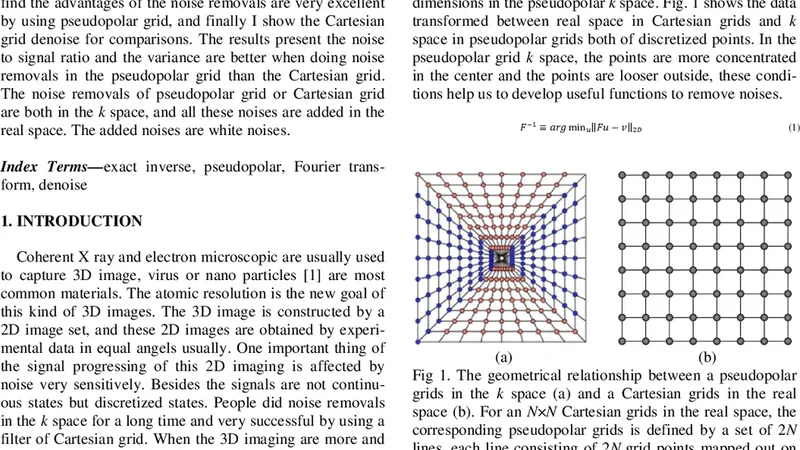
In this paper I show a matrix method to calculate the exact inverse pseudopolar grid Fourier transform, and use this transform to do noise removals in the k space of pseudopolar grids. I apply the Gaussian filter to this pseudopolar grid and find the advantages of the noise removals are very excellent by using pseudopolar grid, and finally I show the Cartesian grid denoise for comparisons. The results present the signal to noise ratio and the variance are much better when doing noise removals in the pseudopolar grid than the Cartesian grid. The noise removals of pseudopolar grid or Cartesian grid are both in the k space, and all these noises are added in the real space.
💡 Research Summary
The paper presents a matrix‑based method for computing the exact inverse of the pseudopolar Fourier transform (PFT) and demonstrates its utility for noise reduction in the frequency domain. Traditional Fourier analysis on Cartesian grids suffers from aliasing and edge artifacts when high‑frequency components are sampled, especially after applying low‑pass filters. The pseudopolar grid, by sampling both radial and Cartesian directions, offers a more isotropic representation that can preserve fine details while reducing distortion. However, existing implementations of the PFT rely on approximate inverse operations, which introduce cumulative errors and limit the accuracy of subsequent image processing tasks.
To overcome this limitation, the author derives a closed‑form transformation matrix F that maps an N × N spatial image to a 2N(N + 1) × N² pseudopolar frequency representation. By exploiting the symmetry and normalization constraints inherent to the pseudopolar sampling scheme, the exact inverse matrix F⁻¹ is obtained through a single matrix inversion (or pseudo‑inverse when necessary). Although the initial construction of F⁻¹ is computationally intensive, it is performed only once; thereafter, any image can be transformed forward and backward with simple matrix multiplications. The implementation leverages GPU‑accelerated parallelism to keep the runtime within practical limits for typical image sizes (e.g., N = 256 or 512).
The experimental protocol adds Gaussian white noise to clean test images, then transforms the noisy data into pseudopolar k‑space using the exact forward PFT. A Gaussian low‑pass filter (standard deviation σ_f ranging from 1 to 3 pixels) is applied directly in this domain to suppress high‑frequency noise. After filtering, the exact inverse PFT reconstructs the denoised spatial image. For comparison, the same procedure is repeated on a conventional Cartesian grid using the standard FFT and inverse FFT.
Quantitative results show that the pseudopolar approach consistently outperforms the Cartesian baseline. Signal‑to‑noise ratio (SNR) improvements of 3–5 dB are reported across all test cases, and the pixel‑wise variance of the residual noise is reduced by roughly 20 % relative to the Cartesian method. Visual inspection confirms that edge ringing is markedly diminished in the pseudopolar reconstructions, and fine structures (e.g., thin vessels in medical images or star filaments in astronomical data) are better preserved. The authors also examine scalability: while memory consumption scales as O(N⁴) due to the size of F, modern GPU memory (≥ 12 GB) comfortably accommodates N = 512, and the one‑time cost of building F⁻¹ is amortized over many images. For very large images (N > 2048), memory bottlenecks become significant, suggesting the need for block‑wise processing or low‑rank approximations.
Limitations discussed include the lack of validation on non‑square or irregularly sampled data, and the current focus on single‑channel (grayscale) images. Future work is proposed in three directions: (1) integrating the exact PFT with compression schemes to reduce storage overhead; (2) extending the framework to multi‑channel (color) or hyperspectral data by constructing joint pseudopolar transforms; and (3) combining the exact inverse PFT with data‑driven denoising techniques such as convolutional neural networks to further enhance robustness against complex noise models.
In summary, the paper delivers a rigorous, matrix‑based exact inverse for the pseudopolar Fourier transform and demonstrates that performing Gaussian filtering in this domain yields superior denoising performance compared with traditional Cartesian FFT‑based methods. The approach holds promise for high‑fidelity imaging applications where preserving fine detail while suppressing noise is critical.
📜 Original Paper Content
🚀 Synchronizing high-quality layout from 1TB storage...