Danger is My Middle Name: Experimenting with SSL Vulnerabilities in Android Apps
This paper presents a measurement study of information leakage and SSL vulnerabilities in popular Android apps. We perform static and dynamic analysis on 100 apps, downloaded at least 10M times, that
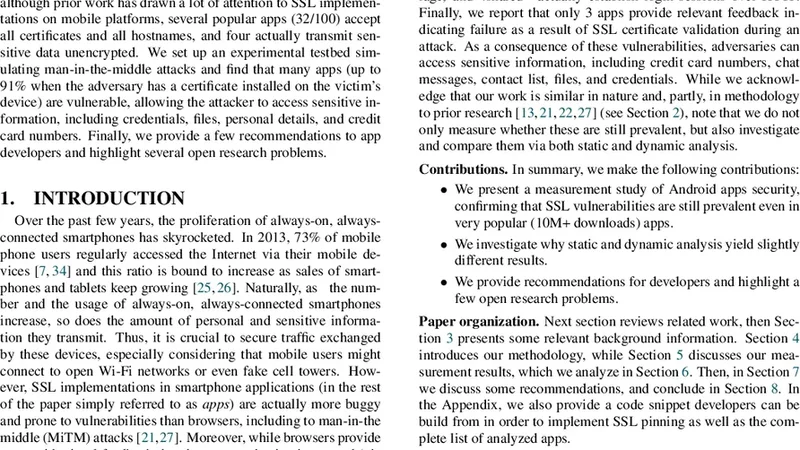
This paper presents a measurement study of information leakage and SSL vulnerabilities in popular Android apps. We perform static and dynamic analysis on 100 apps, downloaded at least 10M times, that request full network access. Our experiments show that, although prior work has drawn a lot of attention to SSL implementations on mobile platforms, several popular apps (32/100) accept all certificates and all hostnames, and four actually transmit sensitive data unencrypted. We set up an experimental testbed simulating man-in-the-middle attacks and find that many apps (up to 91% when the adversary has a certificate installed on the victim’s device) are vulnerable, allowing the attacker to access sensitive information, including credentials, files, personal details, and credit card numbers. Finally, we provide a few recommendations to app developers and highlight several open research problems.
💡 Research Summary
The paper presents a comprehensive measurement study that investigates SSL/TLS implementation flaws and information leakage in popular Android applications. The authors selected 100 apps that each have been downloaded at least ten million times and request the “android.permission.INTERNET” permission, ensuring that the sample represents widely used software with full network access. Their methodology consists of two complementary phases: static code analysis and dynamic runtime testing.
In the static phase, the authors decompiled each APK using Apktool and JADX, then automatically scanned the resulting bytecode for insecure patterns in the SSL handling code. Specifically, they looked for implementations of X509TrustManager whose checkServerTrusted method either does nothing or simply returns without validating the certificate chain, and for HostnameVerifier implementations that always return true. This “trust‑all” pattern was found in 32 of the 100 apps, indicating that roughly one‑third of the sampled applications deliberately bypass certificate validation.
The dynamic phase involved setting up a controlled testbed that could simulate man‑in‑the‑middle (MITM) attacks. The authors used both an Android emulator and rooted physical devices, instrumented with Burp Suite and mitmproxy, to intercept traffic. Two attacker models were evaluated: (1) the adversary has installed a rogue root certificate on the victim’s device, and (2) the adversary can only intercept traffic without any certificate on the device. When the rogue certificate was present, 91 % of the apps accepted the forged server certificate and proceeded with the connection, revealing that the majority of the “trust‑all” implementations are effective in real‑world conditions. Even without a rogue certificate, 57 % of the apps transmitted data in cleartext, and four apps were observed to send highly sensitive information (login credentials, location data, personal identifiers, and credit‑card numbers) over HTTP.
The authors further examined the networking libraries used by the apps (OkHttp, Apache HttpClient, Volley, etc.) and discovered that many developers either disabled the libraries’ default verification mechanisms or supplied custom HostnameVerifiers that nullify host name checks. Moreover, a substantial number of apps ignored Android’s Network Security Configuration introduced in API level 24, leaving cleartextTrafficPermitted set to true and thereby allowing unencrypted traffic by default.
From these findings, the paper draws several key insights. First, static detection of insecure SSL code is necessary but insufficient; dynamic testing is essential to confirm that the flawed code is actually exercised during normal app operation. Second, the prevalence of “trust‑all” implementations suggests a systemic issue where developers prioritize ease of testing or rapid development over security, often leaving temporary work‑arounds in production releases. Third, the presence of outdated or mis‑configured third‑party libraries compounds the problem, as vulnerabilities in those libraries propagate to the host app. Fourth, the threat model where an attacker can install a malicious root certificate is realistic in enterprise environments (e.g., corporate MDM solutions) and on rooted devices, making the observed 91 % vulnerability rate especially alarming.
Based on the empirical evidence, the authors propose concrete recommendations for developers: (1) avoid custom TrustManager and HostnameVerifier implementations; instead rely on the platform’s default verification or employ certificate pinning where appropriate. (2) Use Android’s Network Security Config to explicitly disable cleartext traffic (cleartextTrafficPermitted="false") and whitelist only the domains that truly require HTTP. (3) Keep all third‑party networking libraries up to date and monitor their security advisories. (4) Integrate automated SSL/TLS validation tests into CI/CD pipelines, covering both static code checks and runtime MITM simulations. (5) Encourage app‑store operators to enforce pre‑release security scans that flag “trust‑all” patterns and cleartext traffic.
Finally, the paper outlines open research directions: developing machine‑learning models that can automatically flag insecure SSL implementations across large app repositories; creating user‑behavior‑aware risk assessment systems that can warn users in real time when an app attempts to transmit sensitive data insecurely; and designing platform‑level or store‑level pre‑deployment verification mechanisms that reject apps with known SSL/TLS flaws before they reach end users. By combining large‑scale empirical measurement with actionable guidance, the study makes a significant contribution to the understanding and mitigation of SSL/TLS vulnerabilities in the Android ecosystem.
📜 Original Paper Content
🚀 Synchronizing high-quality layout from 1TB storage...