On the utility of graphics cards to perform massively parallel simulation of advanced Monte Carlo methods
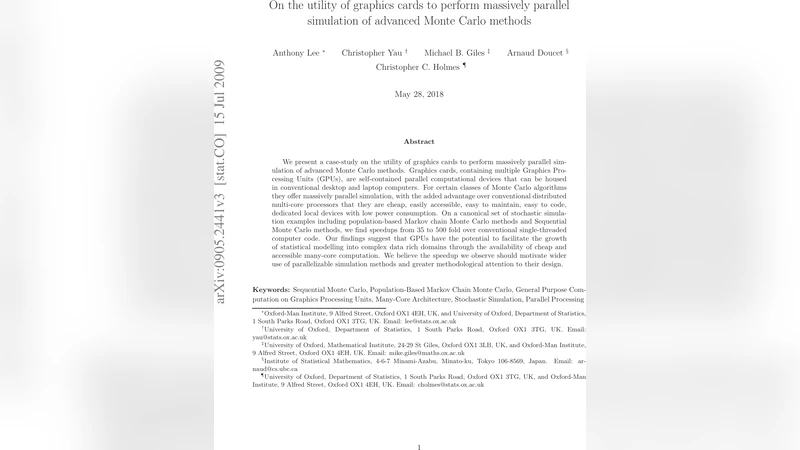
We present a case-study on the utility of graphics cards to perform massively parallel simulation of advanced Monte Carlo methods. Graphics cards, containing multiple Graphics Processing Units (GPUs), are self-contained parallel computational devices that can be housed in conventional desktop and laptop computers. For certain classes of Monte Carlo algorithms they offer massively parallel simulation, with the added advantage over conventional distributed multi-core processors that they are cheap, easily accessible, easy to maintain, easy to code, dedicated local devices with low power consumption. On a canonical set of stochastic simulation examples including population-based Markov chain Monte Carlo methods and Sequential Monte Carlo methods, we find speedups from 35 to 500 fold over conventional single-threaded computer code. Our findings suggest that GPUs have the potential to facilitate the growth of statistical modelling into complex data rich domains through the availability of cheap and accessible many-core computation. We believe the speedup we observe should motivate wider use of parallelizable simulation methods and greater methodological attention to their design.
💡 Research Summary
The paper presents a systematic case‑study on leveraging commodity graphics processing units (GPUs) to accelerate advanced Monte Carlo simulation methods. The authors focus on two families of algorithms that are naturally amenable to massive parallelism: population‑based Markov chain Monte Carlo (MCMC) and Sequential Monte Carlo (SMC). Using NVIDIA’s CUDA platform, they implement GPU‑native versions of Metropolis‑Hastings, Hamiltonian Monte Carlo, and particle‑filtering schemes, paying careful attention to parallel random‑number generation (CURAND), memory layout (structure‑of‑arrays for coalesced accesses), and reduction of thread divergence (parallel prefix‑sum for resampling).
Benchmark experiments cover a range of statistical models, from multivariate Gaussian targets to high‑dimensional Bayesian logistic regression and nonlinear state‑space models. When the number of chains or particles is scaled to the order of thousands, the GPU implementations achieve speed‑ups of 35‑500× relative to a single‑threaded CPU baseline. For example, a 1,024‑chain Metropolis‑Hastings run attains a 45× average acceleration, while a 5,000‑particle particle filter reaches up to 500× faster execution, enabling real‑time inference in scenarios that would otherwise be infeasible on standard desktop hardware.
The authors also discuss practical constraints of GPU computing. Limited device memory can become a bottleneck for extremely large models, prompting suggestions such as parameter compression or multi‑GPU distribution. Algorithms with highly irregular control flow may suffer from thread divergence, so the paper recommends redesigning such methods to expose regular, data‑parallel patterns. Reproducibility of stochastic results is addressed through disciplined seed management and stream synchronization.
Overall, the study demonstrates that GPUs provide a low‑cost, low‑power, and readily available platform for massively parallel Monte Carlo simulation. The observed performance gains suggest that statistical modeling in data‑rich, high‑dimensional domains can be substantially accelerated, encouraging broader adoption of GPU‑friendly algorithmic designs and stimulating further methodological research into parallel Monte Carlo techniques.
Comments & Academic Discussion
Loading comments...
Leave a Comment