Discussion of various models related to cloud performance
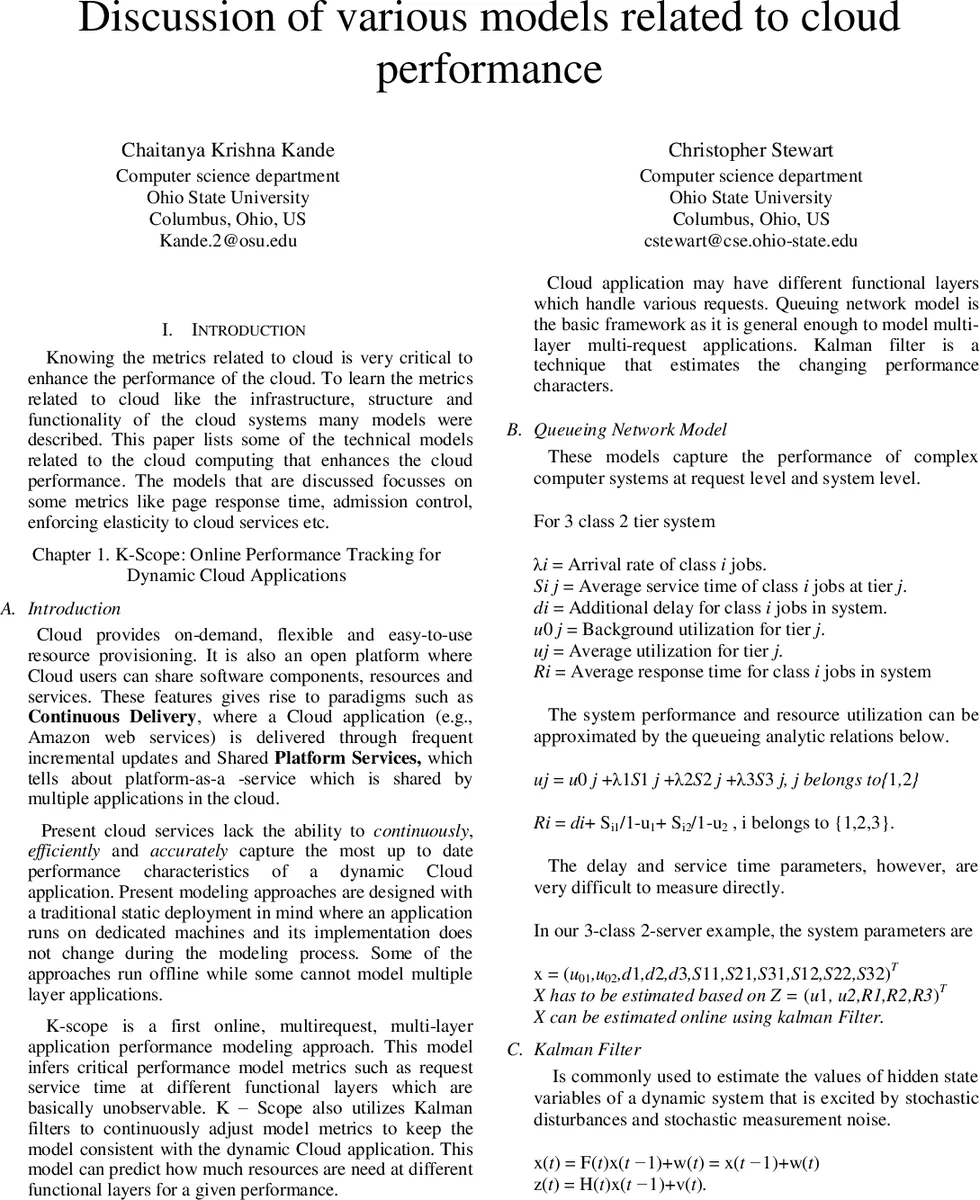
This paper discusses the various models related to cloud computing. Knowing the metrics related to infrastructure is very critical to enhance the performance of cloud services. Various metrics related to clouds such as pageview response time, admission control and enforcing elasticity to cloud infrastructure are very crucial in analyzing the characteristics of the cloud to enhance the cloud performance.
💡 Research Summary
The paper surveys four contemporary approaches to cloud performance modeling and elasticity evaluation, each targeting a different aspect of cloud service management.
-
K‑Scope – This model treats a multi‑tier cloud application as a queuing network and employs Kalman filtering to continuously estimate hidden parameters such as per‑layer service times and background utilizations. By updating these estimates online, K‑Scope can predict resource requirements for each tier, answer “what‑if” queries, and support capacity planning. The authors claim that the approach overcomes the static assumptions of traditional models, but they provide limited experimental evidence on convergence speed, scalability to many tenants, and sensitivity to initial conditions.
-
Magpie – Magpie is an online, black‑box instrumentation framework that records fine‑grained request traces across multiple machines. It reconstructs end‑to‑end request paths, clusters requests based on behavioral similarity (rather than URL), and builds probabilistic models of normal request behavior using the ALERGIA algorithm to infer stochastic context‑free grammars. These models enable anomaly detection, performance debugging, and capacity forecasting. While the methodology is sound, the paper does not quantify logging overhead, address clock‑synchronization challenges, or compare clustering alternatives beyond Euclidean distance.
-
DC2 (Dependable Compute Cloud) – DC2 proposes a model‑driven auto‑scaling system that combines a queuing‑network performance model with Kalman‑filter‑based parameter inference. Users supply an initial deployment model and SLA constraints; a monitoring agent gathers hypervisor‑level and application‑level metrics; the modeling engine estimates hidden state variables; and a policy engine issues scaling actions via OpenStack APIs. The system reportedly converges to accurate parameter estimates within about a minute, after which scaling decisions become more precise than rule‑based or purely black‑box methods. However, the evaluation lacks real‑world workload diversity, and the impact of API latency and multi‑application resource contention is not explored.
-
ADVISE – ADVISE is a framework for pre‑emptively evaluating cloud service elasticity. It models a service as a collection of structural, infrastructure, and elasticity information, linked through an Elasticity Dependency Graph. Elasticity Control Processes (ECPs) are sequences of Elasticity Capabilities (ECs) that modify the graph and underlying resources. ADVISE extracts Relevant Time‑Series Sections (RTS) for each metric during ECP execution, clusters the resulting behavior points, and builds a multidimensional correlation matrix to predict the impact of any ECP on service parts. This approach moves beyond simple VM‑metric thresholds, incorporating service topology and deployment strategies. Nonetheless, the clustering methodology is not fully described, and the risk of over‑fitting in high‑dimensional spaces is not addressed.
Overall, the paper provides a useful taxonomy of recent cloud performance and elasticity techniques, highlighting the synergy between queuing theory, Kalman filtering, black‑box tracing, and clustering. Its main shortcomings are the paucity of rigorous experimental validation, limited discussion of overhead and scalability, and the absence of an integrated framework that combines the strengths of the four models. Future work should focus on comparative benchmarking, quantifying instrumentation costs, and designing a unified orchestration layer that can dynamically select the most appropriate modeling technique based on workload characteristics and service-level objectives.
Comments & Academic Discussion
Loading comments...
Leave a Comment