Cited Half-Life of the Journal Literature
Analyzing 13,455 journals listed in the Journal Citation Report (Thomson Reuters) from 1997 through 2013, we report that the mean cited half-life of the scholarly literature is 6.5 years and growing a
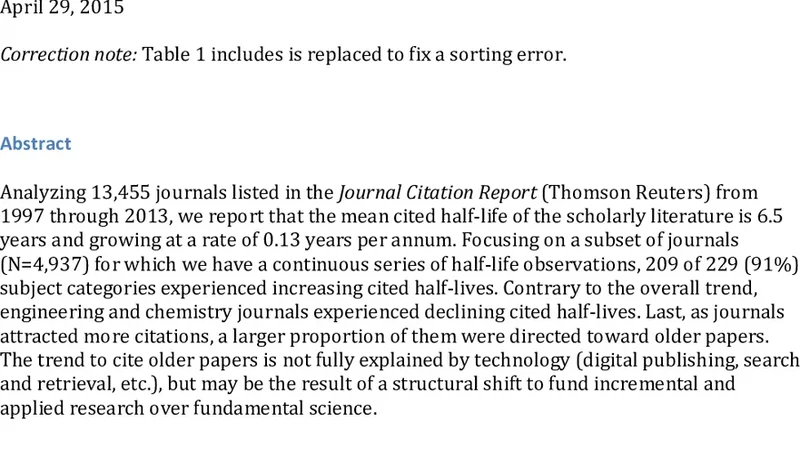
Analyzing 13,455 journals listed in the Journal Citation Report (Thomson Reuters) from 1997 through 2013, we report that the mean cited half-life of the scholarly literature is 6.5 years and growing at a rate of 0.13 years per annum. Focusing on a subset of journals (N=4,937) for which we have a continuous series of half-life observations, 209 of 229 (91%) subject categories experienced increasing cited half-lives. Contrary to the overall trend, engineering and chemistry journals experienced declining cited half-lives. Last, as journals attracted more citations, a larger proportion of them were directed toward older papers. The trend to cite older papers is not fully explained by technology (digital publishing, search and retrieval, etc.), but may be the result of a structural shift to fund incremental and applied research over fundamental science.
💡 Research Summary
The paper conducts a longitudinal bibliometric analysis of cited half‑life across a large sample of scholarly journals, aiming to uncover temporal trends in how far back researchers look when citing prior work. Using data from the Thomson Reuters Journal Citation Report, the authors examined 13,455 journals over the 17‑year period from 1997 to 2013. The cited half‑life metric represents the age (in years) at which half of the citations received by a journal in a given year are to articles published before that age. By aggregating these values, the study quantifies the “memory” of the scholarly literature.
The primary findings are threefold. First, the overall mean cited half‑life for the entire dataset is 6.5 years, and it exhibits a steady upward trajectory of approximately 0.13 years per calendar year. This indicates that, on average, scholars are citing older literature now than they did at the start of the study period. Second, a subset of 4,937 journals with uninterrupted half‑life records was used to assess discipline‑specific dynamics. Out of 229 subject categories, 209 (about 91 %) show a positive slope, meaning that most fields are experiencing lengthening citation windows. Notable exceptions are engineering and chemistry, where the cited half‑life declines, reflecting a stronger reliance on recent research in these technologically driven domains. Third, the analysis reveals a correlation between journal citation volume and the age distribution of cited items: journals that attract more citations tend to allocate a larger proportion of those citations to older papers. This “citation inflation” effect suggests that high‑impact venues are not merely amplifying recent breakthroughs but also reinforcing the relevance of foundational work.
The authors explore potential drivers of these patterns. While digital publishing, online search engines, and open‑access platforms have undeniably facilitated access to older articles, the magnitude of the observed half‑life increase cannot be fully explained by these technological factors alone. Instead, the paper posits that shifts in research funding and evaluation criteria play a pivotal role. Over the past two decades, funding agencies in many countries have increasingly emphasized incremental and applied research, favoring projects that promise near‑term, tangible outcomes. Such a policy environment encourages researchers to build directly upon recent, applied findings, yet paradoxically also leads to broader citation of older, well‑established studies that serve as methodological or theoretical scaffolding for applied work.
The study’s implications are multifaceted. For scholars, the growing citation half‑life underscores the importance of maintaining a robust knowledge of the historical literature, even in fast‑moving fields. For policymakers and funding bodies, the findings caution against overly narrow performance metrics that prioritize short‑term impact, as these may inadvertently distort the scholarly record and undervalue long‑term, fundamental research. For publishers, the trend suggests that journals with high citation counts may benefit from curating legacy content, such as retrospective collections or citation‑rich review articles, to sustain their influence.
In conclusion, the paper documents a clear, sustained elongation of the citation window across most scientific disciplines, with notable discipline‑specific deviations. The phenomenon appears to be driven by a complex interplay of technological accessibility and systemic shifts toward applied, incremental research funding. Recognizing and addressing these dynamics is essential for preserving the balance between innovation and the cumulative, long‑term growth of scientific knowledge.
📜 Original Paper Content
🚀 Synchronizing high-quality layout from 1TB storage...