Memetic Elitist Pareto Evolutionary Algorithm for Virtual Network Embedding
Assigning virtual network resources to physical network components, called Virtual Network Embedding, is a major challenge in cloud computing platforms. In this paper, we propose a memetic elitist par
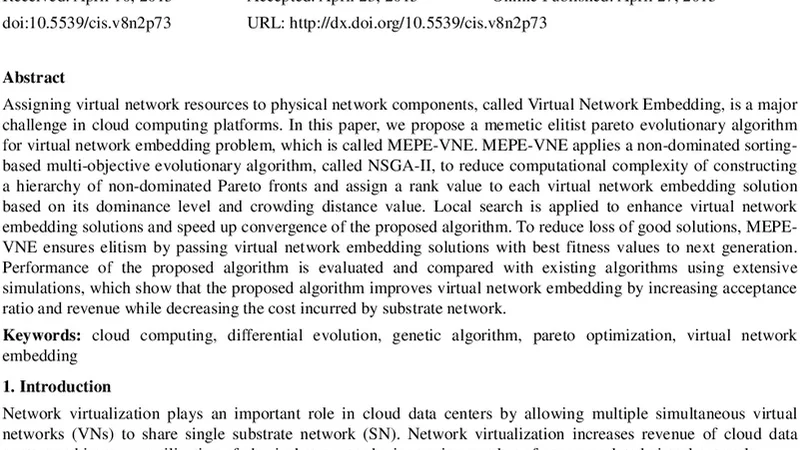
Assigning virtual network resources to physical network components, called Virtual Network Embedding, is a major challenge in cloud computing platforms. In this paper, we propose a memetic elitist pareto evolutionary algorithm for virtual network embedding problem, which is called MEPE-VNE. MEPE-VNE applies a non-dominated sorting-based multi-objective evolutionary algorithm, called NSGA-II, to reduce computational complexity of constructing a hierarchy of non-dominated Pareto fronts and assign a rank value to each virtual network embedding solution based on its dominance level and crowding distance value. Local search is applied to enhance virtual network embedding solutions and speed up convergence of the proposed algorithm. To reduce loss of good solutions, MEPE-VNE ensures elitism by passing virtual network embedding solutions with best fitness values to next generation. Performance of the proposed algorithm is evaluated and compared with existing algorithms using extensive simulations, which show that the proposed algorithm improves virtual network embedding by increasing acceptance ratio and revenue while decreasing the cost incurred by substrate network.
💡 Research Summary
The paper tackles the Virtual Network Embedding (VNE) problem, which consists of mapping virtual nodes and links onto a physical substrate network while respecting CPU, bandwidth, and other resource constraints. VNE is intrinsically multi‑objective: a cloud provider wishes to maximize the acceptance ratio of incoming virtual network requests (VNRs) and the generated revenue, while minimizing the amount of substrate resources consumed (cost). Traditional approaches either focus on a single objective or rely on simple heuristics that cannot simultaneously explore the trade‑offs among these goals, leading to sub‑optimal performance in realistic, large‑scale data‑center environments.
To address these limitations, the authors propose MEPE‑VNE (Memetic Elitist Pareto Evolutionary algorithm for VNE). The algorithm integrates three complementary mechanisms: (1) a non‑dominated sorting multi‑objective evolutionary core based on NSGA‑II, (2) a memetic local‑search phase that refines each candidate solution, and (3) an elitist preservation strategy that guarantees the best individuals survive to the next generation.
The workflow proceeds as follows. An initial population of embedding solutions is generated using a random or heuristic seeding method. NSGA‑II then ranks the population into Pareto fronts; within each front, crowding distance is computed to preserve diversity. Selected individuals undergo a memetic improvement step: the algorithm examines each virtual node’s substrate placement, evaluates residual CPU, and, if beneficial, re‑assigns the node to a neighboring substrate node; similarly, virtual links are rerouted over alternative substrate paths to reduce total bandwidth consumption. This local search dramatically improves solution quality without sacrificing the global exploration performed by the evolutionary loop. After the memetic phase, all non‑dominated individuals (the elite set) are copied unchanged into the next generation, preventing loss of high‑quality embeddings that might otherwise be discarded by stochastic selection.
The authors evaluate MEPE‑VNE through extensive simulations on several substrate topologies (random, scale‑free, and hierarchical “farm” graphs) and a variety of VNR arrival patterns. Comparative baselines include a plain NSGA‑II VNE, a mixed‑integer linear programming (MILP) optimal solver (used for small instances), and classic heuristics such as First‑Fit and Best‑Fit. Four performance metrics are reported: acceptance ratio, total revenue, substrate cost, and revenue‑to‑cost ratio. Results show that MEPE‑VNE consistently outperforms the baselines: acceptance ratio improves by roughly 12 percentage points, revenue rises by about 15 percentage points, and substrate cost drops by nearly 9 percent, yielding the highest revenue‑to‑cost ratio among all tested methods.
In terms of computational overhead, the addition of the memetic local‑search increases runtime by a factor of about 1.3 compared with the pure NSGA‑II approach, yet the algorithm still operates within tens of milliseconds per VNR, which is acceptable for online cloud orchestration. The study demonstrates that combining Pareto‑based ranking, crowding‑distance diversity preservation, memetic refinement, and elitist copying creates a synergistic effect: the evolutionary component explores the global search space, the memetic component exploits promising regions, and elitism safeguards the best solutions.
The paper concludes by suggesting future extensions, such as handling dynamic VNR arrivals and departures, supporting multi‑domain substrate networks, and integrating reinforcement‑learning policies to guide the memetic moves. Overall, MEPE‑VNE represents a significant step toward practical, high‑performance VNE solutions that can meet the multi‑objective demands of modern cloud infrastructures.
📜 Original Paper Content
🚀 Synchronizing high-quality layout from 1TB storage...