Characterizing Weighted MSO for Trees by Branching Transitive Closure Logics
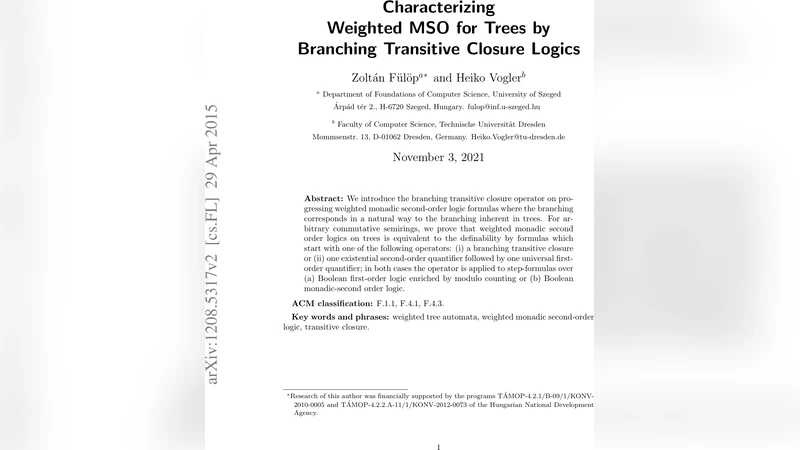
We introduce the branching transitive closure operator on weighted monadic second-order logic formulas where the branching corresponds in a natural way to the branching inherent in trees. For arbitrary commutative semirings, we prove that weighted monadic second order logics on trees is equivalent to the definability by formulas which start with one of the following operators: (i) a branching transitive closure or (ii) an existential second-order quantifier followed by one universal first-order quantifier; in both cases the operator is applied to step-formulas over (a) Boolean first-order logic enriched by modulo counting or (b) Boolean monadic-second order logic.
💡 Research Summary
The paper investigates the expressive power of weighted monadic second‑order logic (Weighted MSO) on finite trees and introduces a novel operator, the branching transitive closure (BTC), that captures the inherent branching of tree structures. Traditional transitive closure operators are well suited for linear structures such as words, where a single successor relation can be iterated. In contrast, a tree node may have several children, and a closure that follows multiple branches simultaneously is required. BTC is defined with respect to a “step‑formula” φ(x, y₁,…,y_k) that relates a current node x to a tuple of its children y_i. The expression BTC(φ) denotes the set of nodes reachable from x by repeatedly applying φ along any branch, thereby closing over all possible branching paths.
The authors restrict the step‑formulas to two well‑studied fragments: (a) Boolean first‑order logic enriched with modulo‑counting predicates (FO
Comments & Academic Discussion
Loading comments...
Leave a Comment