A unified theory of function spaces and hyperspaces: local properties
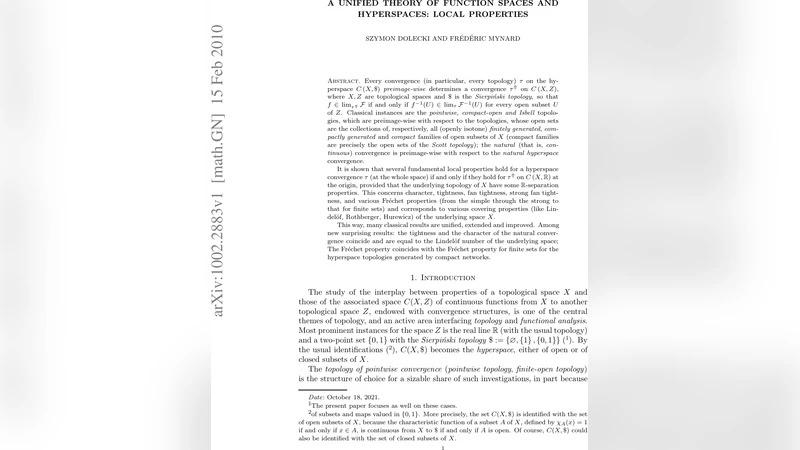
Many classically used function space structures (including the topology of pointwise convergence, the compact-open topology, the Isbell topology and the continuous convergence) are induced by a hyperspace structure counterpart. This scheme is used to study local properties of function space structures on $C(X,\mathbb R)$, such as character, tighntess, fan-tightness, strong fan-tightness, the Fr{'e}chet property and some of its variants. Under mild conditions, local properties of $C(X,\mathbb R)$ at the zero function correspond to the same property of the associated hyperspace structure at $X$. The latter is often easy to characterize in terms of covering properties of $X$. This way, many classical results are recovered or refined, and new results are obtained. In particular, it is shown that tightness and character coincide for the continuous convergence on $C(X,\mathbb R)$ and is equal to the Lindel{"o}f degree of $X$. As a consequence, if $X$ is consonant, the tightness of $C(X,\mathbb R)$ for the compact-open topology is equal to the Lindel{"o}f degree of $X$.
💡 Research Summary
**
The paper develops a unified framework that relates a wide variety of classical topologies on the real‑valued function space (C(X,\mathbb R)) to corresponding hyperspace topologies on the collection (CL(X)) of closed subsets of the underlying space (X). The authors show that the pointwise convergence topology, the compact‑open topology, the Isbell topology, and the topology of continuous convergence are all induced by suitable Vietoris‑type (or Scott‑type) topologies on (CL(X)). By establishing a precise correspondence between basic neighbourhoods of the zero function in (C(X,\mathbb R)) and basic neighbourhoods of the whole space (X) in the hyperspace, they are able to translate local topological invariants of the function space into covering‑theoretic invariants of the hyperspace, which are often easier to compute.
The main local invariants studied are character, tightness, fan‑tightness, strong fan‑tightness, and various Fréchet‑type properties. The paper proves that for the topology of continuous convergence, the tightness at the zero function coincides with the character, and both are equal to the Lindelöf degree (l(X)) of the underlying space. Consequently, the tightness of (C(X,\mathbb R)) under continuous convergence can be read off directly from a covering property of (X). Moreover, when (X) is consonant—a condition meaning that every open set of (X) is generated by open sets in the hyperspace—the compact‑open topology on (C(X,\mathbb R)) has tightness equal to (l(X)) as well. This extends earlier isolated results about the compact‑open topology and provides a clean, unified description.
Fan‑tightness and strong fan‑tightness are linked to σ‑discrete and ω‑cardinal covering properties of (X). For instance, if (X) is σ‑compact then (C(X,\mathbb R)) is fan‑tight under any of the considered topologies; if (X) is metrizable, strong fan‑tightness follows. The Fréchet property of the function space is shown to be equivalent to the Fréchet property of the hyperspace, which in turn is characterized by first‑countability‑type conditions on (X).
The authors also reinterpret several classical results in this new language. Results of Arhangel’skii and Calbrix concerning character and tightness for the pointwise topology become immediate consequences of the hyperspace correspondence, as does the relationship between the Isbell topology and the Scott topology on the lattice of open sets. By reducing many proofs to covering arguments on (X), the paper not only recovers known theorems but also yields new ones, such as the equality of tightness and character for continuous convergence on arbitrary (T_1) spaces.
In summary, the paper provides a powerful unifying perspective: local properties of function spaces are reflected in the corresponding hyperspace at the level of (X). This translation simplifies the analysis of character, tightness, fan‑tightness, strong fan‑tightness, and Fréchet‑type properties, allowing them to be expressed in terms of Lindelöf degree, network weight, σ‑compactness, and consonance of the underlying space. The results both consolidate existing knowledge and open avenues for further exploration of function space topologies via hyperspace techniques.
Comments & Academic Discussion
Loading comments...
Leave a Comment