On the Sign Problem of the Fermionic Shadow Wave Function
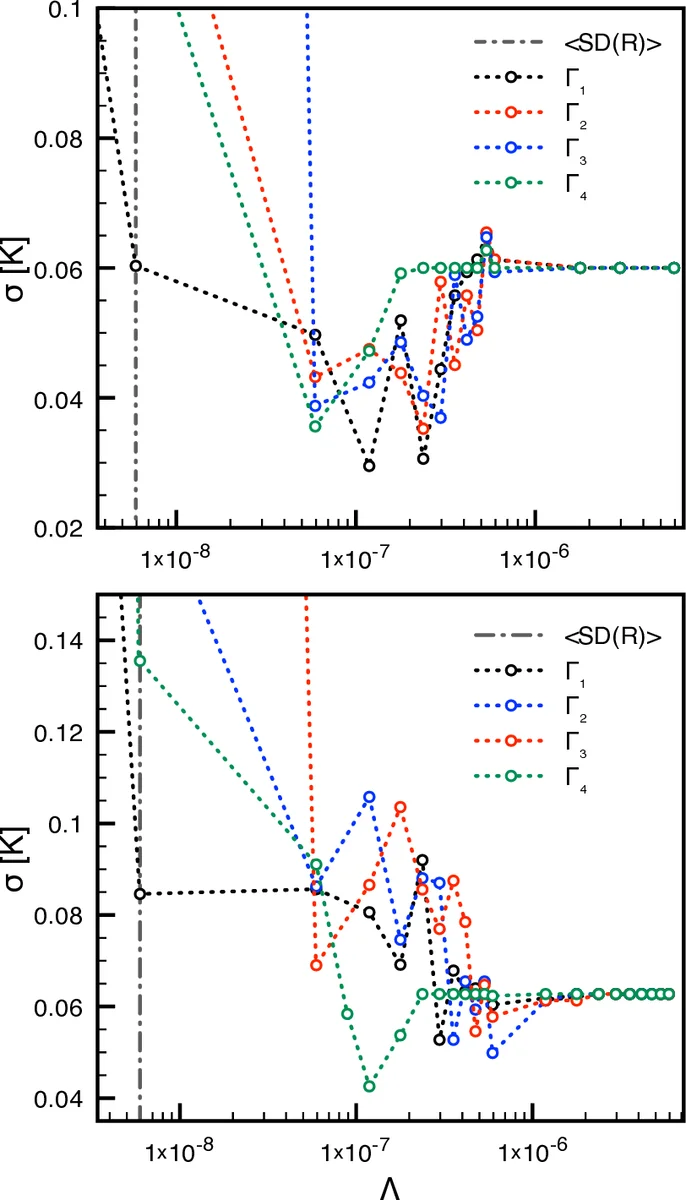
We present a whole series of novel methods to alleviate the sign problem of the Fermionic Shadow Wave Function in the context of Variational Monte Carlo. The effectiveness of our new techniques is demonstrated on the example of liquid 3He. We found that although the variance is substantially reduced, the gain in efficiency is restricted by the increased computational cost. Yet, this development not only extends the scope of the Fermionic Shadow Wave Function, but also facilitates highly accurate Quantum Monte Carlo simulations previously thought not feasible.
💡 Research Summary
The paper addresses a long‑standing obstacle in applying the Fermionic Shadow Wave Function (FSWF) within Variational Monte Carlo (VMC): the sign problem that arises because the FSWF involves two independent shadow configurations, S₁ and S₂, whose Slater determinants can have opposite signs. When the local energy is estimated by sampling from the squared wave function, the required probability density is no longer positive definite, forcing the use of absolute‑value sampling together with a fluctuating sign weight w = sign
Comments & Academic Discussion
Loading comments...
Leave a Comment