Galois groups and cohomological functors
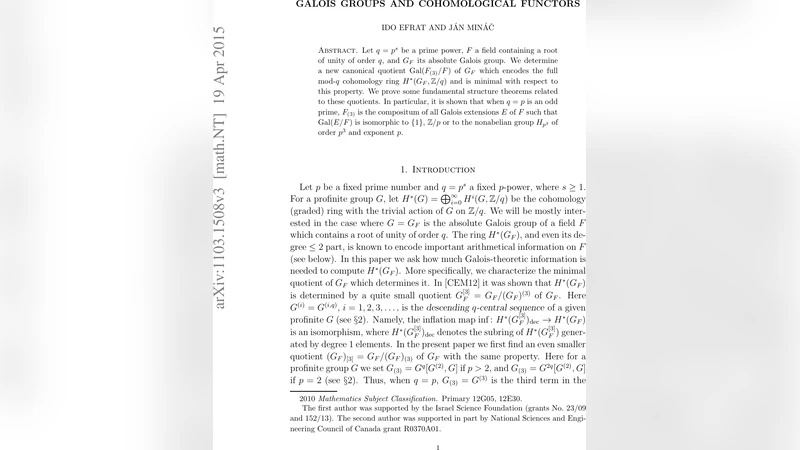
Let $q=p^s$ be a prime power, $F$ a field containing a root of unity of order $q$, and $G_F$ its absolute Galois group. We determine a new canonical quotient $\mathrm{Gal}(F_{(3)}/F)$ of $G_F$ which encodes the full mod-$q$ cohomology ring $H^*(G_F,\mathbb{Z}/q)$ and is minimal with respect to this property. We prove some fundamental structure theorems related to these quotients. In particular, it is shown that when $q=p$ is an odd prime, $F_{(3)}$ is the compositum of all Galois extensions $E$ of $F$ such that $\mathrm{Gal}(E/F)$ is isomorphic to ${1}$, $\mathbb{Z}/p$ or to the nonabelian group $H_{p^3}$ of order $p^3$ and exponent $p$.
💡 Research Summary
The paper investigates the relationship between an absolute Galois group (G_F) of a field (F) and its mod‑(q) cohomology ring (H^{*}(G_F,\mathbb{Z}/q)). The authors introduce a new canonical quotient (\mathrm{Gal}(F_{(3)}/F)) that is minimal yet sufficient to encode the entire cohomology algebra. The construction relies on the presence in (F) of a primitive (q)‑th root of unity, which allows the use of Kummer theory to identify (H^{1}(G_F,\mathbb{Z}/q)) with (F^{\times}/(F^{\times})^{q}). Together with the Bloch–Kato conjecture (now a theorem) that identifies Milnor (K)-theory modulo (q) with Galois cohomology, the authors are able to describe a filtration of (G_F) by the (q)-Zassenhaus series (G_F^{(i)}). The third term of this series, denoted (G_F^{
Comments & Academic Discussion
Loading comments...
Leave a Comment