Fire in the sky: The southern lights in Indigenous oral traditions
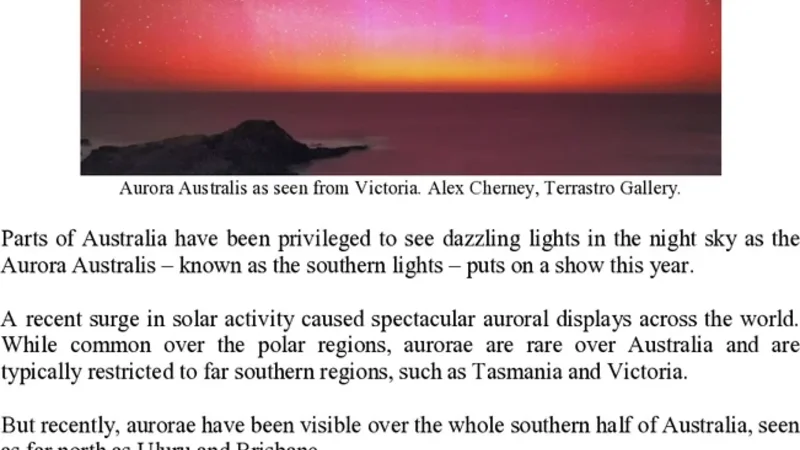
Parts of Australia have been privileged to see dazzling lights in the night sky as the Aurora Australis (known as the southern lights) puts on a show this year. Aurorae are significant in Australian Indigenous astronomical traditions. Aboriginal people associate aurorae with fire, death, blood, and omens, sharing many similarities with Native American communities.
💡 Research Summary
The paper provides a comprehensive examination of the Aurora Australis—commonly known as the southern lights—and its place within Australian Indigenous oral traditions. Beginning with a brief overview of the physical characteristics of the aurora and its visibility across high‑latitude regions of the Southern Hemisphere, the authors set the stage for a cultural investigation. They then compile a wide range of source material, including 19th‑century explorer journals, early 20th‑century anthropological field notes, and contemporary recordings made by Aboriginal communities themselves. From this corpus four dominant symbolic motifs emerge: fire, blood, death, and ominous portent.
Fire is interpreted as a celestial flame that simultaneously embodies creation, destruction, and purification. For example, the Tundra peoples of southern Australia refer to the aurora as “the sky‑fire,” a conduit for ancestral spirits descending from the heavens. Blood and death are linked to warfare, hunting, and the movement of ancestors; a reddish auroral display is often read as a warning from forebears or a prelude to conflict. The motif of ominous portent functions as a social regulator: when the lights appear, communities enact fasting, prayer, and dance rituals designed to reinforce communal norms and alert members to potential environmental or moral crises.
A comparative section situates these Australian motifs alongside those of Indigenous peoples in Alaska and northern Canada. Despite geographic separation and limited direct contact, both cultural spheres describe the aurora as a “sky fire” and associate it with sacred warfare or the passage of souls, suggesting a universal human tendency to mythologize extreme atmospheric phenomena. This cross‑cultural parallel underscores how similar environmental experiences can generate analogous symbolic systems.
From a sociocultural perspective, the aurora narrative serves as a keystone of group identity. Periodic auroral events trigger communal ceremonies that transmit knowledge across generations, strengthen social cohesion, and embed adaptive practices—such as halting hunts or stockpiling food—into cultural memory. The authors argue that these practices constitute a form of environmental resilience encoded in oral tradition.
The final chapter addresses the tension between modern scientific explanations of the aurora and the preservation of Indigenous knowledge. Rather than viewing scientific accounts as a replacement for traditional narratives, the paper advocates for a dialogic approach that integrates Indigenous stories into educational curricula and fosters collaborative research projects between scientists and Aboriginal communities. Case studies of successful partnerships illustrate how such integration can enrich both scientific literacy and cultural heritage preservation.
In conclusion, the Aurora Australis is portrayed not merely as a physical light display but as a complex cultural phenomenon that weaves together cosmology, morality, and communal regulation. The study highlights the intricate ways in which natural events are embedded within social meaning‑making processes, offering valuable insights for policymakers, educators, and researchers interested in cultural preservation and science communication.
Comments & Academic Discussion
Loading comments...
Leave a Comment