Protoadditive functors, derived torsion theories and homology
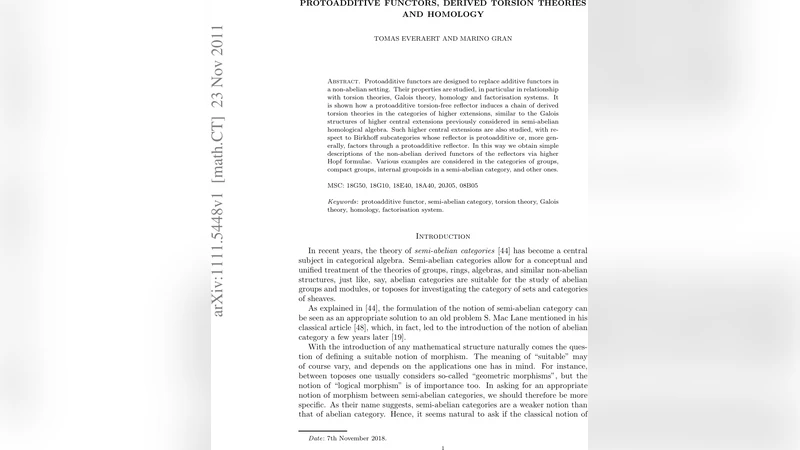
Protoadditive functors are designed to replace additive functors in a non-abelian setting. Their properties are studied, in particular in relationship with torsion theories, Galois theory, homology and factorisation systems. It is shown how a protoadditive torsion-free reflector induces a chain of derived torsion theories in the categories of higher extensions, similar to the Galois structures of higher central extensions previously considered in semi-abelian homological algebra. Such higher central extensions are also studied, with respect to Birkhoff subcategories whose reflector is protoadditive or, more generally, factors through a protoadditive reflector. In this way we obtain simple descriptions of the non-abelian derived functors of the reflectors via higher Hopf formulae. Various examples are considered in the categories of groups, compact groups, internal groupoids in a semi-abelian category, and other ones.
💡 Research Summary
The paper introduces the notion of a proto‑additive functor, a weakening of the classical additive functor that is suitable for non‑abelian contexts such as semi‑abelian categories. A proto‑additive functor preserves pushouts and pullbacks but does not require full additivity on morphism sums. The authors first develop the elementary properties of such functors, showing that they automatically preserve regular epimorphisms, regular monomorphisms, and the two‑step regular factorisation system that underlies much of non‑abelian homological algebra.
A central theme is the interaction between proto‑additivity and torsion theories. Given a reflector (R\colon \mathcal{C}\to\mathcal{X}) whose image is a torsion‑free subcategory, the paper proves that if (R) is proto‑additive then the pair ((\mathcal{T},\mathcal{X})) (torsion objects versus torsion‑free objects) forms a genuine torsion theory. Moreover, the reflector itself becomes a proto‑additive torsion‑free reflector. This observation is the key to constructing a whole hierarchy of derived torsion theories in the categories of higher extensions.
Starting from the ordinary (1‑st‑order) torsion theory, the authors iterate the construction: the torsion‑free reflector on (\mathcal{C}) induces a torsion‑free reflector on the category of extensions (\mathrm{Ext}(\mathcal{C})); this in turn yields a new torsion theory on the category of double extensions, and so on. At each level (n) one obtains a higher central extension in the sense of Galois theory, but the centrality condition is now expressed through proto‑additivity rather than strict normality. Consequently, the classical Galois structures of higher central extensions (as studied in semi‑abelian homological algebra) appear as a special case when the reflector is additive.
The paper then examines Birkhoff subcategories—full reflective subcategories closed under subobjects and quotients. If the reflector of a Birkhoff subcategory factors through a proto‑additive reflector, the induced higher central extensions admit a particularly simple description. In this situation the authors are able to write down higher Hopf formulae for the non‑abelian derived functors of the reflector. The formulae express the (n)‑th derived functor as a quotient of an (n)-fold intersection of kernels by an (n)-fold commutator, exactly mirroring the classical Hopf formula for group homology but now valid in any semi‑abelian setting where a proto‑additive reflector exists.
A substantial part of the work is devoted to examples that illustrate the theory. In the category of groups the proto‑additive reflector coincides with the usual abelianisation, and the higher Hopf formulae recover the well‑known expressions for group homology. For compact groups the reflector to the subcategory of profinite groups is shown to be proto‑additive, yielding new homological calculations for compact‑group extensions. The authors also treat internal groupoids in a semi‑abelian category, showing that the reflector to the subcategory of internal equivalence relations is proto‑additive and that the associated higher central extensions give a clean description of internal categorical homology. Additional examples include varieties of algebras where the reflector to a Birkhoff subvariety is proto‑additive, demonstrating the broad applicability of the framework.
In summary, the paper achieves three major contributions:
- Conceptual – It isolates proto‑additivity as the right weakening of additivity for non‑abelian homological constructions, and shows how this property interacts with torsion theories and Galois structures.
- Structural – It builds a systematic ladder of derived torsion theories in the categories of higher extensions, providing a unified perspective on higher central extensions.
- Computational – It derives higher Hopf formulae for the derived functors of proto‑additive reflectors, giving concrete tools for calculating non‑abelian homology in a wide variety of algebraic contexts.
Overall, the work extends the reach of semi‑abelian homological algebra, offering both a deeper theoretical understanding and practical computational methods for non‑abelian derived functors.
Comments & Academic Discussion
Loading comments...
Leave a Comment