Testing Cluster Structure of Graphs
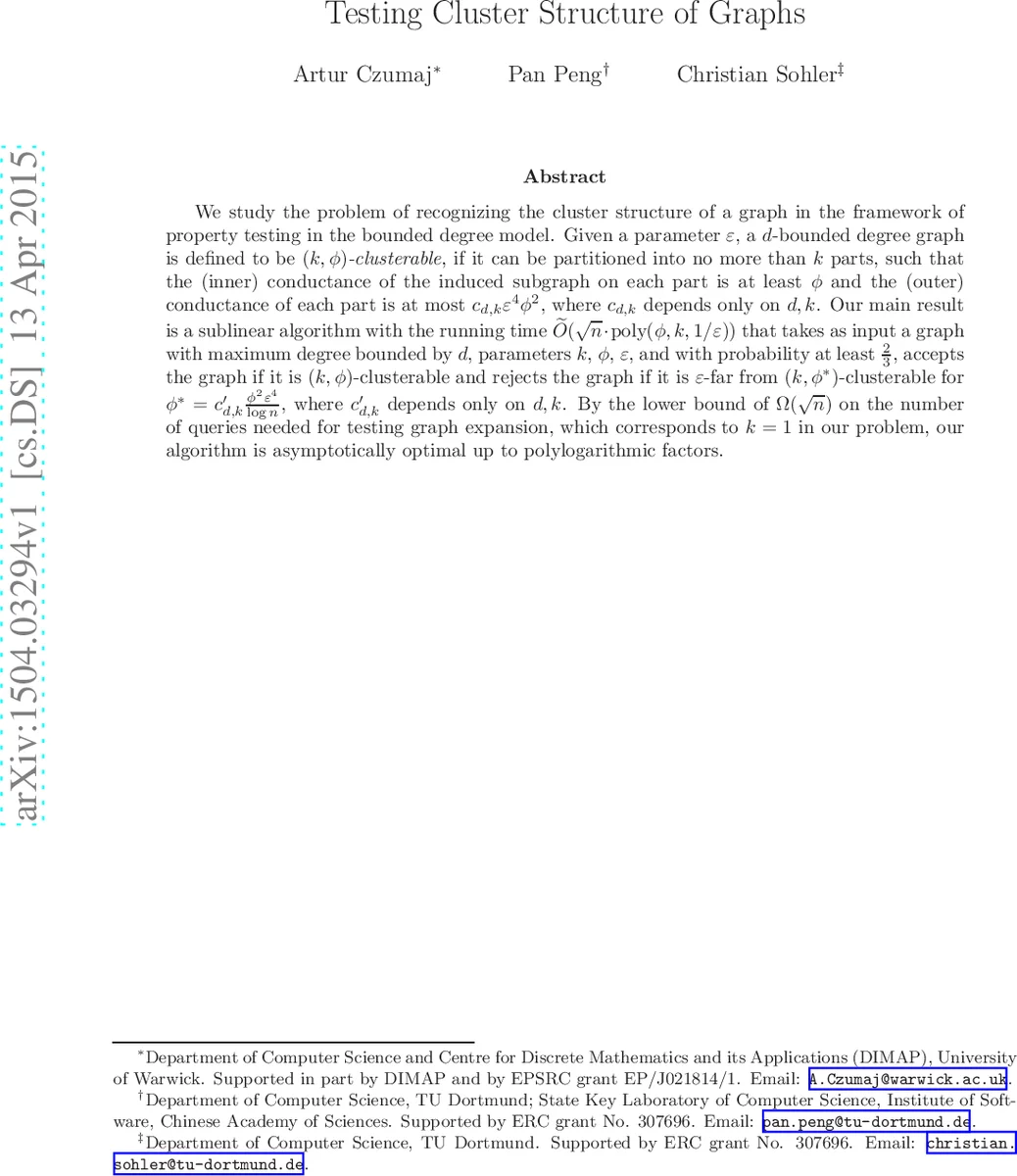
We study the problem of recognizing the cluster structure of a graph in the framework of property testing in the bounded degree model. Given a parameter $\varepsilon$, a $d$-bounded degree graph is defined to be $(k, \phi)$-clusterable, if it can be partitioned into no more than $k$ parts, such that the (inner) conductance of the induced subgraph on each part is at least $\phi$ and the (outer) conductance of each part is at most $c_{d,k}\varepsilon^4\phi^2$, where $c_{d,k}$ depends only on $d,k$. Our main result is a sublinear algorithm with the running time $\widetilde{O}(\sqrt{n}\cdot\mathrm{poly}(\phi,k,1/\varepsilon))$ that takes as input a graph with maximum degree bounded by $d$, parameters $k$, $\phi$, $\varepsilon$, and with probability at least $\frac23$, accepts the graph if it is $(k,\phi)$-clusterable and rejects the graph if it is $\varepsilon$-far from $(k, \phi^)$-clusterable for $\phi^ = c’{d,k}\frac{\phi^2 \varepsilon^4}{\log n}$, where $c’{d,k}$ depends only on $d,k$. By the lower bound of $\Omega(\sqrt{n})$ on the number of queries needed for testing graph expansion, which corresponds to $k=1$ in our problem, our algorithm is asymptotically optimal up to polylogarithmic factors.
💡 Research Summary
The paper addresses the problem of testing whether a bounded‑degree graph possesses a clear cluster structure, formalized as “(k, φ)-clusterable,” within sublinear time. A graph is (k, φ)-clusterable if its vertex set can be partitioned into at most k parts such that each part has high internal conductance (≥ φ) and low external conductance (≤ c_{d,k}·ε⁴·φ²). Conductance measures the ratio of edges crossing a cut to the volume of the smaller side; high internal conductance guarantees that vertices inside a cluster are well‑connected, while low external conductance ensures that clusters are sparsely linked to the rest of the graph.
The authors present a property‑testing algorithm that, with probability at least 2/3, accepts every (k, φ)-clusterable graph and rejects any graph that is ε‑far from being (k, φ*)‑clusterable, where φ* = O_{d,k}(φ²·ε⁴ / log n). The algorithm runs in time (\widetilde{O}(\sqrt{n}\cdot \mathrm{poly}(\phi,k,1/\varepsilon))), matching the known Ω(√n) lower bound for testing graph expansion (the special case k = 1). Hence the result is asymptotically optimal up to polylogarithmic factors.
Algorithmic Overview
- Sampling: Randomly select O(√n·poly(1/ε, k, 1/φ)) vertices.
- Random Walks: From each sampled vertex, perform a lazy random walk of length ℓ, where ℓ is chosen based on φ and ε so that the walk mixes well inside its own cluster but rarely escapes to other clusters.
- Distribution Comparison: For each pair of sampled vertices (v, u), compute the ℓ₂² distance between the endpoint distributions p_ℓ(v) and p_ℓ(u). If the distance is below a threshold τ, the pair is considered to belong to the same cluster.
- Similarity Graph Construction: Build a “similarity graph” whose vertices are the samples and whose edges connect pairs deemed similar.
- Decision: Accept if the similarity graph consists of at most k connected components; otherwise reject.
The key technical tool for step 3 is an ℓ₂‑distribution tester due to Chanda et al. (2014), which can distinguish whether two distributions are ε′‑close or far using a number of samples proportional to √n·poly(…). The algorithm also checks that each walk distribution has a small ℓ₂ norm, which is guaranteed when the graph is (k, φ)-clusterable and helps avoid false positives caused by high‑conductance cuts.
Analysis
Completeness: In a (k, φ)-clusterable graph, each cluster induces a subgraph with conductance at least φ. Spectral gap arguments (Cheeger’s inequality) imply that the Laplacian eigenvalues satisfy λ_h < λ_{h+1} for some h ≤ k. By choosing ℓ large enough, contributions from eigenvectors beyond the first h decay exponentially, making the walk distribution inside a cluster essentially stationary on that cluster. Consequently, endpoint distributions from vertices in the same cluster are nearly identical, leading to small ℓ₂ distances and a similarity graph with exactly the cluster partition.
Soundness: If the input graph is ε‑far from any (k, φ*)‑clusterable graph, then either some cluster has internal conductance below φ or some set has external conductance larger than the allowed bound. In either case, random walks started from vertices in different “would‑be” clusters produce endpoint distributions that differ by more than τ in ℓ₂ distance. The similarity graph therefore either has more than k components or contains a component whose external conductance exceeds the prescribed threshold, causing the algorithm to reject. The analysis yields φ* = O_{d,k}(φ²·ε⁴ / log n); the logarithmic factor arises from the need to control the ℓ₂ norm of the walk distributions and appears unavoidable given current techniques (it mirrors the gap required in expansion testing).
Complexity
The dominant cost is the number of random‑walk queries and ℓ₂‑tests, each proportional to √n·poly(φ,k,1/ε). Hence the overall query and time complexity is (\widetilde{O}(\sqrt{n}\cdot \mathrm{poly}(\phi,k,1/\varepsilon))). For constant degree d and constant k, this matches the Ω(√n) lower bound for testing expansion (Goldreich–Ron 2002), establishing near‑optimality.
Contributions and Significance
- Introduces a rigorous conductance‑based definition of clustered graphs suitable for property testing.
- Develops the first sublinear‑time tester that directly compares pairwise random‑walk distributions rather than testing closeness to uniformity.
- Shows how to exploit a “stable” random‑walk regime that is intermediate between the start vertex and the global stationary distribution, a novel technique for multi‑cluster settings.
- Provides a tight upper bound matching known lower bounds, extending expansion‑testing results to the richer setting of multiple clusters.
Limitations and Future Work
The dependence on log n in the gap between φ and φ* may be an artifact of the analysis; removing it or improving the ε‑exponent remains open. Extending the approach to non‑constant k, to graphs with unbounded degree, or to dynamic/streaming settings would broaden applicability. Moreover, empirical evaluation on real‑world networks could validate practical performance and guide parameter tuning.
In summary, the paper delivers a theoretically sound, near‑optimal sublinear algorithm for testing the existence of a well‑structured cluster partition in bounded‑degree graphs, bridging the gap between classical expansion testing and modern community‑detection tasks.
Comments & Academic Discussion
Loading comments...
Leave a Comment