The tectonic cause of mass extinctions and the genomic contribution to biodiversification
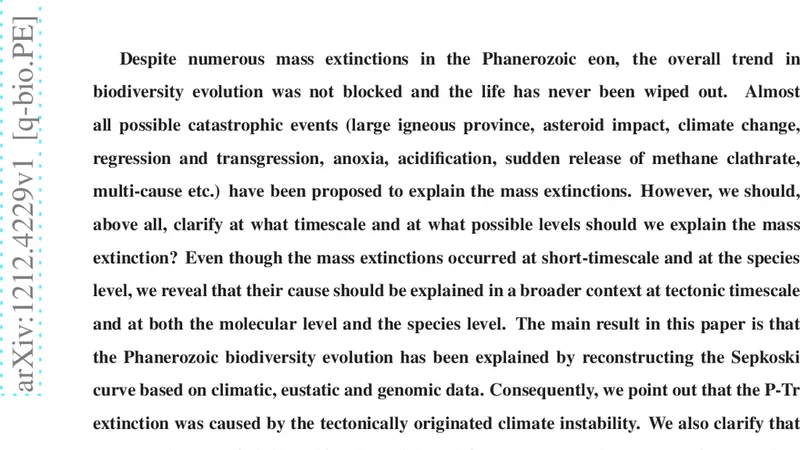
Despite numerous mass extinctions in the Phanerozoic eon, the overall trend in biodiversity evolution was not blocked and the life has never been wiped out. Almost all possible catastrophic events (large igneous province, asteroid impact, climate change, regression and transgression, anoxia, acidification, sudden release of methane clathrate, multi-cause etc.) have been proposed to explain the mass extinctions. However, we should, above all, clarify at what timescale and at what possible levels should we explain the mass extinction? Even though the mass extinctions occurred at short-timescale and at the species level, we reveal that their cause should be explained in a broader context at tectonic timescale and at both the molecular level and the species level. The main result in this paper is that the Phanerozoic biodiversity evolution has been explained by reconstructing the Sepkoski curve based on climatic, eustatic and genomic data. Consequently, we point out that the P-Tr extinction was caused by the tectonically originated climate instability. We also clarify that the overall trend of biodiversification originated from the underlying genome size evolution, and that the fluctuation of biodiversity originated from the interactions among the earth’s spheres. The evolution at molecular level had played a significant role for the survival of life from environmental disasters.
💡 Research Summary
The paper tackles one of the most persistent puzzles in paleobiology – why mass‑extinction events, despite their catastrophic nature, have never halted the long‑term increase in Earth’s biodiversity. The authors argue that the conventional focus on short‑term, species‑level causes (asteroid impacts, volcanic eruptions, climate swings, sea‑level changes, anoxia, acidification, methane release, etc.) is insufficient. Instead, they propose a hierarchical framework that links mass‑extinctions to processes operating on tectonic time scales and to molecular‑level evolutionary dynamics.
To substantiate this view, the authors reconstruct the classic Sepkoski biodiversity curve using three independent data streams: (1) climatic proxies (atmospheric CO₂ concentrations, ocean temperature reconstructions), (2) eustatic sea‑level curves derived from sedimentary sequences, and (3) genomic information (average genome size of major clades through time). Climate and sea‑level variations are modeled as the surface expression of plate‑tectonic activity – continental collisions, rifting, and large igneous province (LIP) eruptions – which drive long‑term shifts in atmospheric composition and ocean circulation. The genomic component is introduced via the “genome‑expansion hypothesis”: over the Phanerozoic, average genome size follows a log‑normal distribution that steadily increases, providing a reservoir of genetic novelty that fuels speciation and the occupation of new ecological niches.
The integrated model reproduces the major peaks and troughs of the Sepkoski curve. Crucially, the authors demonstrate that the Permian‑Triassic (P‑Tr) extinction coincides with a period of extreme tectonic instability: massive LIP activity in the Siberian Traps released vast quantities of CO₂, triggered rapid sea‑level fall and rise, and disrupted oceanic overturning. This cascade produced widespread anoxia, acidification, and a sudden release of methane clathrates. In the authors’ view, such a multi‑faceted environmental shock exceeded the adaptive capacity of most taxa, but lineages possessing larger genomes – and therefore greater genetic redundancy and phenotypic plasticity – were more likely to survive and later diversify.
From this synthesis the paper draws four principal conclusions:
-
Tectonic‑driven climate and sea‑level change are the ultimate drivers of mass‑extinction timing. The rapid, global perturbations that define extinction horizons are rooted in plate‑tectonic processes that operate over millions of years.
-
Long‑term biodiversity growth is fundamentally linked to genome‑size evolution. As genomes expand, the mutational target size and regulatory complexity increase, raising the probability of novel adaptations and speciation events.
-
Short‑term biodiversity fluctuations reflect the interaction of Earth’s spheres (atmosphere, hydrosphere, lithosphere). The model shows that the amplitude of biodiversity dips and rebounds can be quantitatively related to the magnitude of climate‑sea‑level perturbations.
-
Molecular evolution provides a buffering mechanism during crises. Lineages with larger, more complex genomes act as a “genomic safety net,” allowing life to persist through catastrophic episodes and to drive the post‑extinction radiation that restores the overall upward trend.
The study’s strengths lie in its interdisciplinary ambition and its quantitative attempt to fuse paleontological, geophysical, and genomic datasets. By treating the fossil record as a manifestation of underlying Earth‑system dynamics and molecular evolution, the authors move beyond the “single‑cause” narrative that has dominated much of the extinction literature.
However, several limitations temper the conclusions. First, the temporal resolution of the fossil record is coarse and uneven, making precise alignment with climate and sea‑level curves challenging. Second, the reconstruction of ancient genome sizes relies on extrapolations from extant taxa, which may not capture the true distribution of genome sizes in deep time. Third, the causal chain from plate tectonics to climate to biodiversity is modeled with relatively simple functional forms; more sophisticated Earth‑system models (e.g., coupled carbon‑climate‑tectonic simulations) would be needed to rigorously test the inferred relationships.
In summary, the paper offers a compelling, multi‑scale perspective on mass extinctions and the persistent rise of biodiversity. It highlights the importance of integrating tectonic processes, climate dynamics, sea‑level changes, and genomic evolution to understand Earth’s biological history. Future work that incorporates high‑resolution geochemical proxies, advances in ancient DNA retrieval, and fully coupled Earth‑system–evolutionary models will be essential to refine and validate the proposed framework.
Comments & Academic Discussion
Loading comments...
Leave a Comment