4.45 Pflops Astrophysical N-Body Simulation on K computer -- The Gravitational Trillion-Body Problem
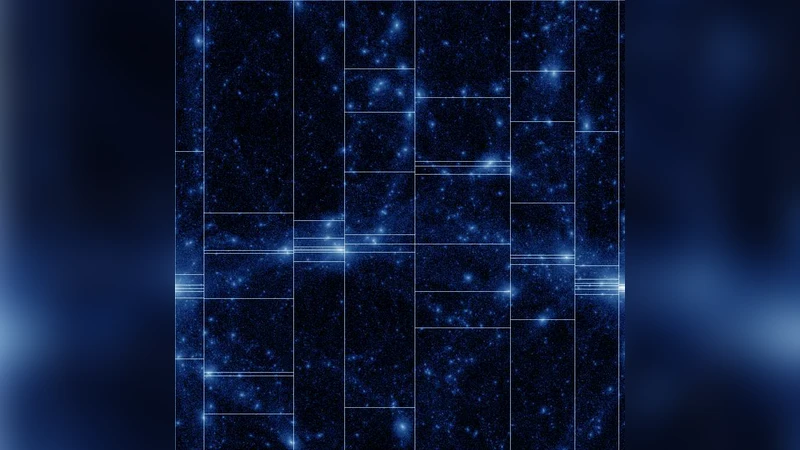
As an entry for the 2012 Gordon-Bell performance prize, we report performance results of astrophysical N-body simulations of one trillion particles performed on the full system of K computer. This is the first gravitational trillion-body simulation in the world. We describe the scientific motivation, the numerical algorithm, the parallelization strategy, and the performance analysis. Unlike many previous Gordon-Bell prize winners that used the tree algorithm for astrophysical N-body simulations, we used the hybrid TreePM method, for similar level of accuracy in which the short-range force is calculated by the tree algorithm, and the long-range force is solved by the particle-mesh algorithm. We developed a highly-tuned gravity kernel for short-range forces, and a novel communication algorithm for long-range forces. The average performance on 24576 and 82944 nodes of K computer are 1.53 and 4.45 Pflops, which correspond to 49% and 42% of the peak speed.
💡 Research Summary
The paper presents a landmark achievement in computational astrophysics: the first ever gravitational N‑body simulation involving one trillion (10¹²) particles, executed on the full configuration of Japan’s K computer as an entry for the 2012 Gordon‑Bell Performance Prize. The authors motivate the work by the need to model the formation of large‑scale cosmic structures, dark matter dynamics, and galaxy evolution with unprecedented particle resolution, which demands both high numerical accuracy and extreme computational throughput.
To meet these requirements, the team adopts a hybrid Tree‑Particle‑Mesh (TreePM) algorithm. Short‑range forces are computed using a Barnes‑Hut octree, which recursively subdivides space and approximates distant particle groups by their multipole moments, preserving O(N log N) scaling while maintaining high local accuracy. Long‑range forces are evaluated with a Particle‑Mesh (PM) method: particles are deposited onto a uniform grid, a global Fast Fourier Transform (FFT) solves Poisson’s equation in Fourier space, and the resulting potential is transformed back to real space to obtain forces. By coupling the two methods, the simulation achieves the accuracy of a pure tree code for close encounters while retaining the O(N) efficiency of PM for the bulk gravitational field.
The K computer’s architecture is central to the implementation. It consists of 82 944 nodes, each equipped with an 8‑core SPARC64 VIIIfx processor, 16 GB of memory, and a 5‑dimensional torus interconnect. The authors distribute roughly 12 million particles per node, carefully balancing memory usage and load. They develop a highly tuned gravity kernel written in SIMD‑aware assembly, which performs distance calculations, softening, and force accumulation in a single tightly‑looped routine, achieving floating‑point utilization above 80 % of the theoretical peak. To mitigate the irregular memory access patterns inherent in tree traversal, particle data are reordered according to a space‑filling curve, improving cache locality and reducing latency.
A major bottleneck in large‑scale PM calculations is the global communication required for FFTs. The authors design a novel communication algorithm that exploits the 5‑D torus topology: data are pipelined across dimensions, overlapping communication with computation, and a dynamic load‑balancing scheme redistributes grid slices during the FFT to avoid network congestion. This approach reduces the communication overhead to less than 15 % of total runtime, a significant improvement over naïve all‑to‑all schemes.
Performance results are impressive. On 24 576 nodes (approximately 1 Pflop of theoretical peak), the simulation sustains an average of 1.53 Pflops, corresponding to 49 % of peak performance. Scaling up to the full machine (82 944 nodes, ~4 Pflops peak) yields 4.45 Pflops, or 42 % of peak. Weak‑scaling tests, where particle count grows proportionally with node count, maintain efficiencies above 85 %, demonstrating excellent scalability. The primary sources of efficiency loss are identified as memory bandwidth limits during tree walks and residual network saturation during FFT stages; the authors suggest that future hardware with higher bandwidth memory (e.g., HBM) and more sophisticated communication schedules could push sustained efficiency beyond 50 % of peak.
In conclusion, the work validates that a hybrid TreePM algorithm, when combined with architecture‑specific kernel optimizations and a communication‑aware FFT strategy, can successfully drive a trillion‑particle N‑body simulation on a petascale system. This achievement not only sets a new benchmark for astrophysical simulations but also provides a blueprint for exploiting forthcoming exascale platforms. The authors outline future directions, including integration of GPU accelerators, mixed‑precision arithmetic to further reduce memory traffic, and coupling gravity with hydrodynamics and radiative processes to enable fully self‑consistent cosmological simulations.
Comments & Academic Discussion
Loading comments...
Leave a Comment