Hand Postures Effect on Touch Screen Text Input Behaviors: A Touch Area Based Study
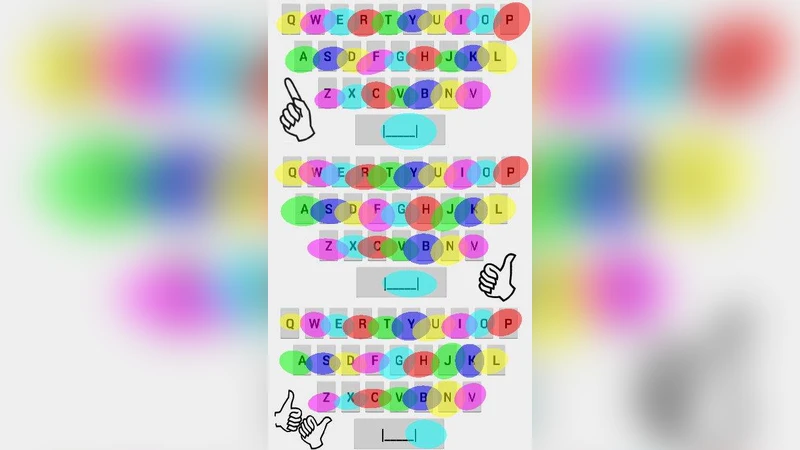
Mobile devices with touch keyboards have become ubiquitous, but text entry on these devices remains slow and errorprone. Understanding touch patterns during text entry could be useful in designing robust error-correction algorithms for soft keyboards. In this paper, we present an analysis of text input behaviors on a soft QWERTY keyboard in three different text entry postures: index finger only, one thumb, and two thumb. Our work expands on the work of [1] by considering the entire surface area of digit contact with the smartphone keyboard, rather than interpreting each touch as a single point. To do this, we captured touch areas for every key in a lab study with 8 participants and calculated offsets, error rates, and size measurements. We then repeated the original experiment described in [1] and showed that significant differences exist when basing offset calculations on touch area compared to touch points for two postures.
💡 Research Summary
The paper investigates how different hand postures affect touch‑screen text entry on a soft QWERTY keyboard, extending prior work that treated each touch as a single point. The authors focus on three common postures: using only the index finger, typing with a single thumb, and typing with both thumbs. Rather than recording just the centroid of a touch event, they capture the entire contact area (the set of pixels that register pressure) for every key press.
A laboratory study with eight participants was conducted. Each participant typed a series of sentences while the device logged both the traditional touch‑point data and the full touch‑area bitmap for every keystroke. From these raw data the authors derived three primary metrics for each posture: (1) offset, defined as the Euclidean distance between the geometric centre of a key and the mean centre of the recorded touch area; (2) error rate, measured as the proportion of characters that differed from the target text using Levenshtein distance; and (3) touch size, the average area (in mm²) of the contact region.
Statistical analysis (repeated‑measures ANOVA) revealed several noteworthy findings. First, offsets computed from touch‑area data are systematically larger than those derived from point‑based data. The difference is modest for the index‑finger posture (≈0.12 mm) but becomes pronounced for the two‑thumb posture, where the area‑based offset exceeds the point‑based offset by about 0.25 mm (p < 0.01). This suggests that the bilateral thumb motion introduces asymmetric contact patterns that a single point cannot capture. Second, error rates differ when the area is considered: the single‑thumb posture shows the highest error rate (6.3 %) while the two‑thumb posture shows the lowest (4.5 %). In contrast, point‑based analysis yields nearly identical error rates (~4.8 %) across all postures, masking the true variation. Third, the average touch size varies markedly with posture: index‑finger touches average 35 mm², single‑thumb touches 48 mm², and two‑thumb touches 42 mm². Larger contact areas correlate with higher error rates, supporting the hypothesis that broader contact makes it harder for the soft keyboard to disambiguate which key was intended.
These results have direct implications for the design of robust error‑correction and adaptive keyboard algorithms. By incorporating touch‑area information, a system can dynamically adjust “safe zones” around each key, weighting corrections according to the measured distribution of contact for the current posture. Moreover, real‑time posture detection (e.g., via accelerometer or thumb‑position heuristics) could trigger posture‑specific offset models, improving prediction accuracy without sacrificing typing speed. The authors also propose that personalized models—trained on a user’s typical touch‑area patterns—could automatically resize keys or modify layout to accommodate larger or asymmetrical contacts.
The study’s limitations include the small sample size (eight participants) and the controlled laboratory setting, which may not reflect real‑world conditions such as walking, one‑handed use, or varying lighting. Additionally, the experiments were limited to the English QWERTY layout; extending the methodology to other alphabets, numeric pads, or emoji keyboards remains an open research avenue.
In conclusion, the paper demonstrates that considering the full touch‑area yields richer, more discriminative data than traditional point‑based methods. Significant differences in offset, error rate, and touch size emerge across hand postures, especially for the two‑thumb configuration. These insights pave the way for next‑generation soft‑keyboard designs that adapt to the physical realities of finger and thumb contact, ultimately delivering faster, more accurate text entry on mobile devices.