Operations in Milnor K-theory
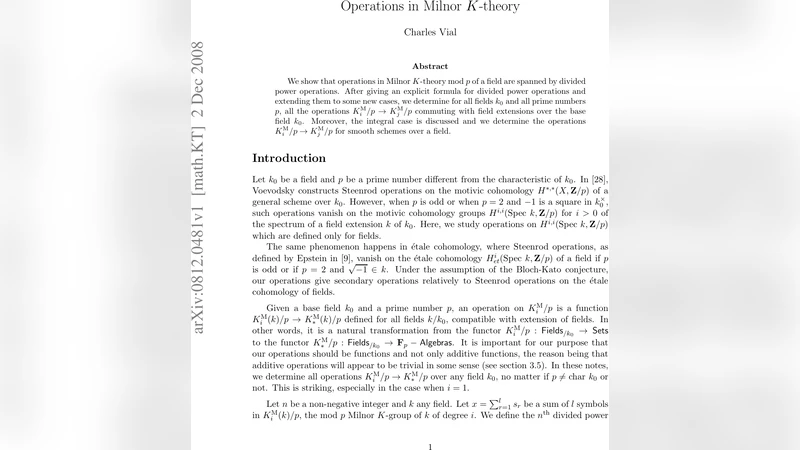
We show that operations in Milnor K-theory mod $p$ of a field are spanned by divided power operations. After giving an explicit formula for divided power operations and extending them to some new cases, we determine for all fields $k$ and all prime numbers $p$, all the operations $K^M_i/p \to K^M_j/p$ commuting with field extensions over the base field $k$. Moreover, the integral case is discussed and we determine the operations $K^M_i/p \to K^M_j/p$ for smooth schemes over a field.
💡 Research Summary
The paper addresses a fundamental problem in the algebraic K‑theory of fields: to describe all natural operations on Milnor K‑theory modulo a prime p. For a field k and integers i, j ≥ 0, the authors consider the functors (K_i^M/p) and (K_j^M/p) from the category of field extensions of k to the category of (\mathbb{F}_p)-vector spaces. An operation is a natural transformation (\Phi:K_i^M/p\to K_j^M/p) that commutes with every field extension over k. The main result is that every such operation is a linear combination (over (\mathbb{F}_p)) of divided‑power operations (\gamma_n). In other words, the (\mathbb{F}_p)-vector space of all operations is spanned by the family ({\gamma_n\mid n\ge0}).
The authors begin by recalling the definition of Milnor K‑theory (K_i^M(k)) as the i‑th tensor power of the multiplicative group modulo Steinberg relations, and they explain why the mod p reduction is the natural setting for cohomological applications (e.g., the Bloch–Kato conjecture). They then introduce divided‑power operations in this context. For a symbol ({a_1,\dots,a_i}\in K_i^M(k)) the n‑th divided power (\gamma_n) is defined by a symmetrised product divided by (n!). When p is odd, (n!) is invertible in (\mathbb{F}_p) and the definition works verbatim. For p = 2 the authors construct a modified operation using a “difference” map (\delta) that compensates for the lack of an inverse of 2, thereby obtaining a well‑defined family (\gamma_n^{(2)}).
The core of the proof of the spanning theorem proceeds in two steps. First, using the naturality condition, the authors show that any operation is determined by its values on pure symbols and that these values must satisfy polynomial relations dictated by the behavior under field extensions (e.g., adjoining p‑th roots). This forces the operation to be a polynomial in the symbols, and the coefficients of this polynomial are forced to be constant across all extensions. Second, they identify these constant coefficients with the coefficients of the divided‑power operations, establishing a bijection between operations and (\mathbb{F}_p)-linear combinations of the (\gamma_n). Uniqueness follows from the linear independence of the (\gamma_n), which is proved by evaluating on suitable transcendental extensions where the symbols remain algebraically independent.
Beyond the basic case, the paper treats two important extensions. (1) For p = 2, the authors develop a complete description by adding the difference operations (\delta) to the divided‑power basis, showing that every operation is a combination of (\gamma_n^{(2)}) and (\delta). (2) In the integral setting (i.e., without mod p reduction), they introduce integral divided powers (\Gamma_n) and prove an analogous spanning result for operations (K_i^M\to K_j^M). This requires a careful analysis of torsion‑free parts of Milnor K‑theory and a reduction modulo all primes simultaneously.
The authors also lift the results from fields to smooth schemes over a base field k. Using the Gersten resolution and Bloch–Ogus theory, they define sheafified Milnor K‑theory (\mathcal{K}_i^M) on the Zariski (or Nisnevich) site and show that the divided‑power operations extend to morphisms of sheaves (\gamma_n:\mathcal{K}i^M/p\to\mathcal{K}{i+n}^M/p). Consequently, any natural transformation of sheaves commuting with pull‑back along morphisms of smooth k‑schemes is again a linear combination of these sheafified divided powers. This provides a complete classification of operations in the algebro‑geometric context.
In the final section the authors discuss implications and future directions. The identification of the operation algebra with the divided‑power algebra connects Milnor K‑theory to classical Steenrod algebra structures and suggests new computational tools for motivic cohomology. Moreover, the integral version may shed light on the behavior of higher Chow groups and on the construction of refined invariants in arithmetic geometry. The paper thus not only resolves a long‑standing classification problem but also opens a pathway for applying divided‑power techniques across a broad range of problems in algebraic K‑theory, motivic homotopy theory, and arithmetic geometry.
Comments & Academic Discussion
Loading comments...
Leave a Comment