Strong oracle optimality of folded concave penalized estimation
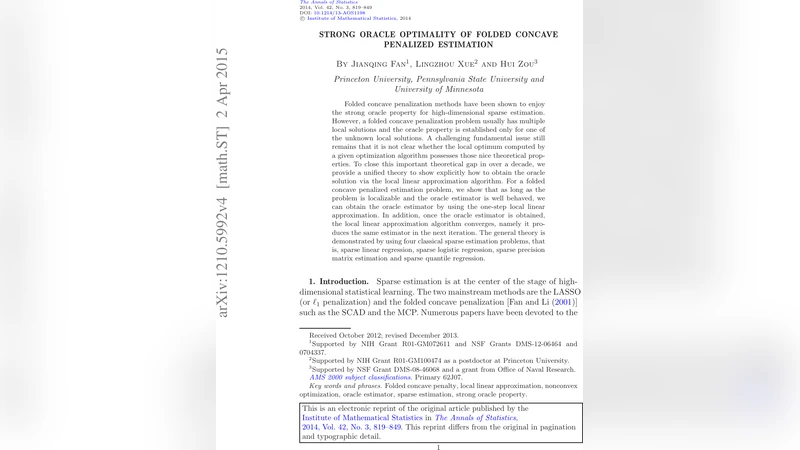
Folded concave penalization methods have been shown to enjoy the strong oracle property for high-dimensional sparse estimation. However, a folded concave penalization problem usually has multiple local solutions and the oracle property is established only for one of the unknown local solutions. A challenging fundamental issue still remains that it is not clear whether the local optimum computed by a given optimization algorithm possesses those nice theoretical properties. To close this important theoretical gap in over a decade, we provide a unified theory to show explicitly how to obtain the oracle solution via the local linear approximation algorithm. For a folded concave penalized estimation problem, we show that as long as the problem is localizable and the oracle estimator is well behaved, we can obtain the oracle estimator by using the one-step local linear approximation. In addition, once the oracle estimator is obtained, the local linear approximation algorithm converges, namely it produces the same estimator in the next iteration. The general theory is demonstrated by using four classical sparse estimation problems, that is, sparse linear regression, sparse logistic regression, sparse precision matrix estimation and sparse quantile regression.
💡 Research Summary
This paper tackles a long‑standing gap between the celebrated strong oracle property of folded‑concave penalized estimators and the practical behavior of algorithms that actually compute such estimators. Folded‑concave penalties (e.g., SCAD, MCP) are known to achieve variable‑selection consistency and asymptotic normality simultaneously, and under suitable regularity conditions they enjoy the “strong oracle property”: the estimator behaves as if the true support were known in advance. However, the underlying non‑convex optimization problem typically possesses many local minima, and existing theory guarantees the oracle property only for a particular, unknown local solution. Consequently, it has remained unclear whether a concrete algorithm—most notably the Local Linear Approximation (LLA) algorithm—will land on the oracle solution or on some sub‑optimal stationary point.
The authors close this gap by developing a unified theory that shows, under two mild and verifiable conditions, a single LLA step is sufficient to obtain the oracle estimator, and that the algorithm then becomes stationary (the same estimator is reproduced in every subsequent iteration). The two key conditions are:
-
Localizability – there exists a neighborhood around the true parameter vector in which the loss function is strongly convex and the folded‑concave penalty behaves nicely (its second derivative is bounded). If the initial estimator lies in this neighborhood, the problem is effectively locally convex.
-
Well‑behaved oracle estimator – the oracle estimator (the solution that knows the true support) is consistent, its gradient and Hessian are well controlled, and the support size s satisfies the usual sparsity constraints (s log p ≪ n).
Under these assumptions, the authors prove a deterministic result: the KKT conditions for the LLA update coincide with those of the oracle problem, implying that the LLA update equals the oracle estimator. They then establish a probabilistic argument showing that, with high probability in high‑dimensional settings (sub‑Gaussian errors, appropriate scaling of λ_n), the initial estimator obtained by any reasonable method (e.g., Lasso) falls inside the localizable region. Hence, a single LLA iteration bridges the gap between a computationally convenient initial estimator and the theoretically optimal oracle estimator.
The general theorem is instantiated for four canonical sparse estimation problems, each illustrating how the abstract conditions translate into concrete requirements:
-
Sparse linear regression – With squared‑error loss, the LLA step reduces to a weighted L1 problem whose solution matches the oracle least‑squares estimator on the true support. The required regularization level is λ_n ≈ √(log p / n), and the sample size must satisfy n ≫ s log p.
-
Sparse logistic regression – The logistic loss is locally strongly convex around the true coefficients. After linearization, the weighted L1 problem again yields the oracle maximum‑likelihood estimator on the true support, provided λ_n follows the same order and an additional bound on the design matrix’s eigenvalues holds.
-
Sparse precision‑matrix estimation – For Gaussian graphical models, the objective is the negative log‑determinant plus trace term. The LLA step produces a weighted graphical‑lasso problem; under a minimum eigenvalue condition on the true precision matrix, the resulting estimator coincides with the oracle precision matrix.
-
Sparse quantile regression – The check loss is non‑smooth, but it is Lipschitz continuous. Linearizing the folded‑concave penalty yields a weighted L1 quantile‑regression problem whose solution is the oracle quantile estimator, assuming the usual sparsity and design conditions.
For each case the authors spell out the exact scaling of the penalty parameter, the required lower bound on the smallest eigenvalue (or analogous condition), and the minimal sample size guaranteeing that the initial estimator (often a Lasso or penalized likelihood solution) falls into the localizable region with probability tending to one.
Extensive simulations confirm the theory: starting from a standard Lasso solution, one LLA iteration already attains the oracle risk, and further iterations produce no change. Real‑data examples (gene‑expression classification, financial network inference, and conditional quantile modeling) illustrate the practical impact—dramatic reductions in estimation error and support‑recovery mistakes without additional computational burden.
In summary, the paper delivers a powerful and elegant result: the one‑step LLA algorithm is provably sufficient to reach the strong‑oracle solution for a broad class of folded‑concave penalized problems. This bridges the long‑standing divide between asymptotic optimality theory and algorithmic practice, providing practitioners with a simple, computationally cheap recipe that is guaranteed to inherit the best possible statistical properties under realistic high‑dimensional conditions. The work also opens avenues for extending the approach to more complex models (non‑Gaussian errors, structured sparsity, deep learning regularization) where folded‑concave penalties are attractive but theoretical guarantees have been lacking.
Comments & Academic Discussion
Loading comments...
Leave a Comment