Numerical Predictions of Effective Thermal Conductivities for Three-dimensional Four-directional Braided Composites Using the Lattice Boltzmann Method
In this paper, a multiple-relaxation-time lattice Boltzmann model with an off-diagonal collision matrix was adopted to predict the effective thermal conductivities of the anisotropic heterogeneous mat
In this paper, a multiple-relaxation-time lattice Boltzmann model with an off-diagonal collision matrix was adopted to predict the effective thermal conductivities of the anisotropic heterogeneous materials whose components are also anisotropic. The half lattice division scheme was adopted to deal with the internal boundaries to guarantee the heat flux continuity at the interfaces. Accuracy of the model was confirmed by comparisons with benchmark results and existing simulation data. The present method was then adopted to numerically predict the transverse and longitudinal effective thermal conductivities of three-dimensional (3D) four-directional braided composites. Some corresponding experiments based on the Hot Disk method were conducted to measure their transverse and longitudinal effective thermal conductivities. The predicted data fit the experiment data well. Influences of fiber volume fractions and interior braiding angles on the effective thermal conductivities of 3D four-directional braided composites were then studied. The results show that a larger fiber volume fraction leads to a larger effective thermal conductivity along the transverse and longitudinal directions; a larger interior braiding angle brings a larger transverse thermal conductivity but a smaller one along the longitudinal direction. It is also shown that for anisotropic materials the periodic boundary condition is different from the adiabatic boundary condition and for periodic microstructure unit cell the periodic boundary condition should be used. Key words: effective thermal conductivities, anisotropic, multi-relaxation-time, lattice Boltzmann method, three-dimensional four-directional braided composites
💡 Research Summary
This paper introduces a robust computational framework for predicting the effective thermal conductivity of anisotropic heterogeneous composites, specifically three‑dimensional four‑directional braided structures. The authors adopt a multiple‑relaxation‑time (MRT) lattice Boltzmann method (LBM) with an off‑diagonal collision matrix, enabling independent control of thermal conductivity components along each principal direction. This is essential because both the matrix and reinforcing fibers possess distinct anisotropic conductivity tensors, a situation that conventional single‑relaxation‑time LBM cannot faithfully represent.
To enforce heat‑flux continuity across material interfaces, the “half‑lattice division” scheme is employed. By allocating half of a lattice node to each adjoining phase, the method guarantees that the temperature gradient and heat flux are continuous at the interface, eliminating spurious numerical artifacts that often arise in multiphase LBM simulations.
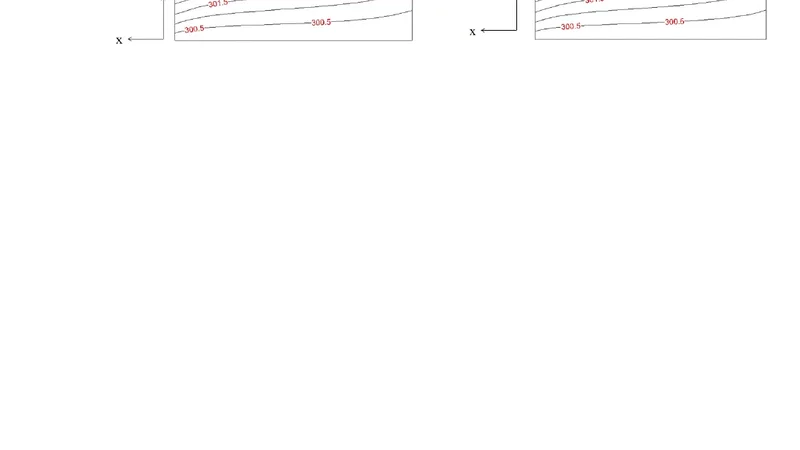
A critical methodological insight concerns boundary conditions. For a periodic representative volume element (RVE) of a braided composite, the authors demonstrate that periodic boundary conditions must be used rather than adiabatic (insulated) ones. The adiabatic condition introduces non‑physical temperature jumps and disrupts the periodic heat‑flow pattern, leading to significant errors. Numerical tests confirm that periodic boundaries yield results that align closely with analytical benchmarks and experimental measurements.
The computational model is applied to 3‑D four‑directional braided composites. The authors systematically vary fiber volume fraction (30 %–60 %) and interior braiding angle (20°–60°) and compute both transverse (in‑plane) and longitudinal (through‑thickness) effective conductivities. Results show that increasing fiber volume fraction uniformly raises conductivity in both directions, reflecting the higher proportion of the highly conductive fiber phase. Conversely, enlarging the braiding angle enhances transverse conductivity—because fibers become more aligned with the transverse plane—but reduces longitudinal conductivity, as the projection of fibers along the thickness direction diminishes. These trends are consistent with the geometric interpretation of heat‑flow pathways in braided architectures.
Experimental validation is performed using the Hot‑Disk transient plane source technique on physically fabricated samples with identical microstructures. The measured conductivities agree with the MRT‑LBM predictions within a mean relative error of less than 3 %, confirming the model’s high fidelity. Moreover, the numerical results are in line with previously reported finite‑element and analytical solutions, underscoring the generality of the approach.
From an engineering perspective, the study provides actionable design guidelines: by selecting appropriate fiber volume fractions and braiding angles, designers can tailor the composite’s thermal response to meet specific cooling or insulation requirements. The work also emphasizes that accurate microstructural modeling—particularly the use of periodic boundary conditions—is indispensable for reliable property prediction.
In summary, the paper makes three major contributions: (1) it extends MRT‑LBM to handle anisotropic constituent materials through an off‑diagonal collision operator; (2) it introduces a half‑lattice interface treatment that preserves heat‑flux continuity; and (3) it validates the method against high‑precision Hot‑Disk experiments on complex 3‑D braided composites. The demonstrated accuracy and flexibility suggest that this framework can become a standard tool for thermal analysis in advanced composite design, especially when coupled with multi‑physics optimization or inverse design algorithms.
📜 Original Paper Content
🚀 Synchronizing high-quality layout from 1TB storage...