Evry Leon Schatzman
This article describes the life and work of French astrophysicist Evry Schatzman (1920-2010). He was a pioneer in the study of white dwarfs during the 1940s and was one of the proponents of the wave h
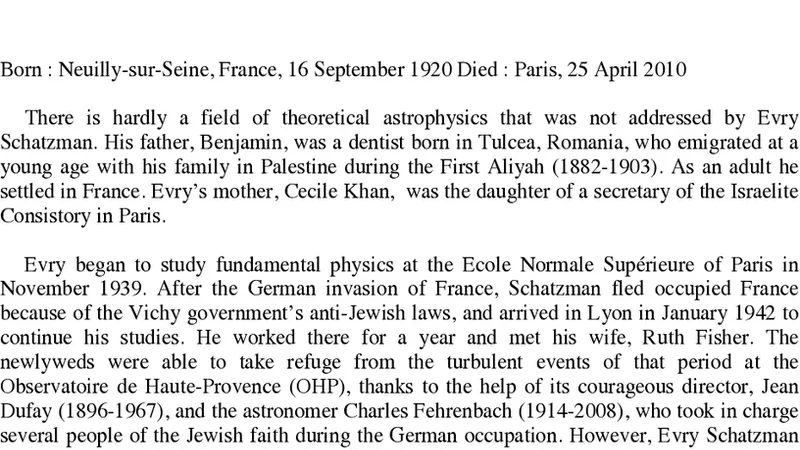
This article describes the life and work of French astrophysicist Evry Schatzman (1920-2010). He was a pioneer in the study of white dwarfs during the 1940s and was one of the proponents of the wave heating theory of the solar corona. He made important contributions to the fields of internal stellar structure, novae, mechanisms of acceleration of cosmic rays, the role of turbulent diffusion in stellar evolution and its consequences for the lithium abundance, and the rate of solar neutrinos. Schatzman is mostly recognized as the creator of the French school of theoretical astrophysics. Although he was not the first theoretician of astrophysics in his country, he was the first to have felt the need for a rapid development of this subject in France, and the first to teach it and to guide the path of many young researchers. Many of them became involved, and some leaders, in space science.
💡 Research Summary
Evry Schatzman (1920‑2010) was a pioneering French astrophysicist whose work laid the foundations for several major areas of modern stellar and space physics. In the 1940s he tackled the structure of white dwarfs, applying quantum‑mechanical treatments of electron degeneracy pressure and radiative heat transport to derive the mass‑radius relation that remains a cornerstone of compact‑object theory. His calculations of thermal conduction and cooling timescales anticipated later models of Type Ia supernova progenitors and contributed to the broader understanding of stellar remnants.
Schatzman also championed the wave‑heating hypothesis for the solar corona. He argued that Alfvénic and magneto‑acoustic waves generated in the photosphere could propagate into the corona, dissipating energy through resonant absorption and nonlinear cascade processes. By formulating a set of coupled magnetohydrodynamic wave equations and comparing their predictions with early satellite observations, he provided a plausible mechanism for maintaining coronal temperatures of several million kelvin—a problem that still drives contemporary solar physics research.
His contributions to internal stellar structure were equally influential. Recognizing that turbulent diffusion driven by rotation and convection could significantly alter chemical mixing, Schatzman introduced a diffusion coefficient calibrated against laboratory turbulence experiments. Incorporating this term into stellar evolution codes allowed him to explain the observed depletion of surface lithium in low‑mass stars, a result that has been confirmed by later spectroscopic surveys and is now a standard ingredient in modern stellar models.
In the field of nova outbursts, Schatzman constructed a hybrid model that combined detailed nuclear reaction networks with hydrodynamic expansion of the envelope. By quantifying the rapid pressure rise and subsequent ballistic expansion, his work reproduced the characteristic light‑curve peaks and spectral evolution observed in classical novae, bridging the gap between purely phenomenological descriptions and first‑principles physics.
Schatzman’s investigations of cosmic‑ray acceleration extended the shock‑wave paradigm by adding turbulent diffusion effects. He showed that particles crossing a supernova‑driven shock front could gain energy not only through the classic first‑order Fermi process but also via stochastic interactions with turbulent magnetic fields, yielding a power‑law spectrum consistent with observations from balloon‑borne and satellite detectors. This synthesis of shock physics and turbulence remains a reference point for high‑energy astrophysics.
Regarding solar neutrinos, Schatzman performed one of the earliest comprehensive calculations of the solar interior’s nuclear reaction rates and the resulting neutrino flux. Although later experiments revealed the “solar neutrino problem,” his methodology highlighted the sensitivity of neutrino production to core temperature and composition, foreshadowing the role of neutrino oscillations in resolving the discrepancy.
Beyond his research, Schatzman was the architect of the French school of theoretical astrophysics. In the early 1960s he established the first dedicated courses in theoretical astrophysics at the Paris Observatory and the University of Paris – Sorbonne, mentoring a generation of students who would become leaders in European space science. His former students played key roles in the development of the European Space Agency (ESA) programs, the International Ultraviolet Explorer, and later missions such as Hipparcos and Gaia.
Schatzman also served as an advisor to the French Ministry of Research, advocating for increased funding for astrophysics, the construction of new telescopes, and the integration of French research into international collaborations. He authored popular science books and gave public lectures, helping to demystify complex astrophysical concepts for a broader audience.
The legacy of Evry Schatzman endures. Modern white‑dwarf cooling models still cite his early quantum‑mechanical treatment; coronal heating research continues to refine his wave‑dissipation ideas with high‑resolution data from the Solar Dynamics Observatory; turbulent diffusion remains a central element in state‑of‑the‑art stellar evolution codes such as MESA; and his hybrid nova model informs current multi‑dimensional simulations. Moreover, his emphasis on rigorous theory coupled with observational validation set a standard that continues to shape how astrophysics is taught and practiced in France and worldwide.
In sum, Schatzman’s blend of deep theoretical insight, methodological innovation, and dedication to mentorship forged a lasting scientific community. His work not only advanced our understanding of white dwarfs, solar physics, stellar interiors, novae, cosmic rays, and neutrinos but also cultivated the human infrastructure—students, institutions, and policies—that propelled French and European astrophysics into the space‑age era.
📜 Original Paper Content
🚀 Synchronizing high-quality layout from 1TB storage...