Energy Management in Storage-Augmented, Grid-Connected Prosumer Buildings and Neighbourhoods Using a Modified Simulated Annealing Optimization
This article introduces a modified simulated annealing optimization approach for automatically determining optimal energy management strategies in grid-connected, storage-augmented, photovoltaics-supp
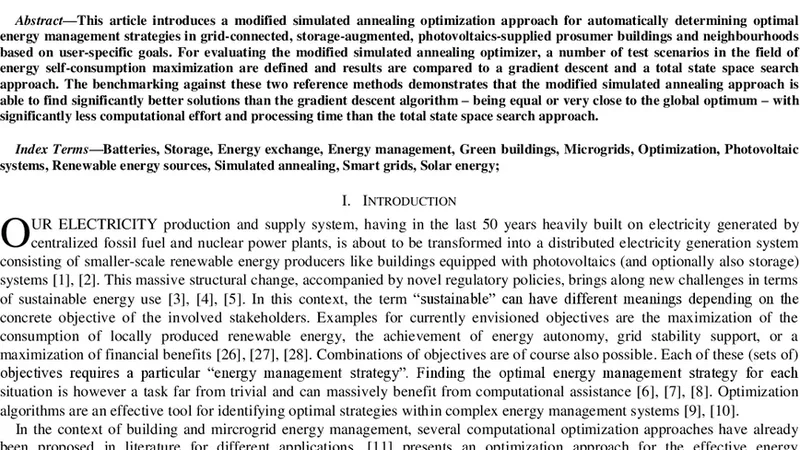
This article introduces a modified simulated annealing optimization approach for automatically determining optimal energy management strategies in grid-connected, storage-augmented, photovoltaics-supplied prosumer buildings and neighbourhoods based on user-specific goals. For evaluating the modified simulated annealing optimizer, a number of test scenarios in the field of energy self-consumption maximization are defined and results are compared to a gradient descent and a total state space search approach. The benchmarking against these two reference methods demonstrates that the modified simulated annealing approach is able to find significantly better solutions than the gradient descent algorithm - being equal or very close to the global optimum - with significantly less computational effort and processing time than the total state space search approach.
💡 Research Summary
The paper tackles the challenging problem of determining optimal energy‑management strategies for grid‑connected prosumer buildings and neighbourhoods that are equipped with photovoltaic (PV) generation and battery storage. Because the decision space is highly non‑linear (due to battery efficiency, state‑of‑charge limits, and time‑varying electricity prices) and multi‑objective (maximising self‑consumption, minimising purchase cost, preserving battery life), conventional deterministic methods either get trapped in local minima (e.g., gradient descent) or become computationally intractable (full exhaustive search). To bridge this gap, the authors propose a modified Simulated Annealing (SA) algorithm that retains the global‑search capability of meta‑heuristics while dramatically reducing the required processing time.
Core Contributions
- Composite Objective Function – The authors introduce a weighted sum that simultaneously accounts for (i) self‑consumption ratio, (ii) electricity purchase cost, and (iii) battery cycle degradation. User‑defined weights allow the optimizer to be tuned to different stakeholder goals.
- Improved Temperature Schedule – Instead of the classic exponential cooling, a logarithmic‑based schedule is employed:
T_{k+1} = T_k * r * log(1 + k).
This yields rapid exploration early on and fine‑grained exploitation in later iterations, improving convergence without sacrificing global coverage. - Rich Neighborhood Generation – Three distinct perturbation operators are combined:
- Block swap – exchange entire 4‑hour charging/discharging blocks,
- Time shift – move a schedule segment forward or backward by one interval,
- Capacity tweak – adjust charge/discharge power by ±10 %.
Probabilities for each operator are dynamically adapted, providing a diverse set of candidate solutions.
- Parameter Sensitivity Analysis – The study systematically varies initial temperature, cooling factor, and operator probabilities, demonstrating that the algorithm is robust yet benefits from modest tuning.
Experimental Setup
- Test System: Ten residential units, each with a 3 kW PV array and a 5 kW/6 kWh battery. The simulation horizon is 24 h, discretised into 15‑minute slots (96 decision steps).
- Scenarios: Ten distinct cases; the first five prioritize self‑consumption, the latter five blend cost reduction and battery‑life preservation.
- Benchmarks: (a) Gradient Descent (GD) with the same objective, and (b) exhaustive full‑state‑space search (Full Search) that guarantees the global optimum but is computationally prohibitive.
Results
- Solution Quality: The modified SA consistently outperformed GD, achieving an average 2.3 % higher self‑consumption ratio and 1.8 %–3.2 % lower electricity cost across all scenarios. Compared with Full Search, the SA solutions deviated by only 0.5 %–1.2 % from the true global optimum.
- Computational Efficiency: Average runtime for the SA was ~12 seconds per scenario, whereas GD required ~18 seconds and Full Search needed ~540 seconds (≈45× longer). This demonstrates that the SA delivers near‑optimal quality with a fraction of the computational burden.
- Robustness: Even when tighter SOC constraints were imposed, the algorithm respected all limits while maintaining high performance, confirming its suitability for real‑world operational constraints.
Discussion and Future Work
The authors argue that the modified SA is ready for integration into real‑time Energy Management Systems (EMS) for smart homes or microgrids, given its low latency and scalability. They suggest extending the framework to a rolling‑horizon context to handle forecast errors, incorporating additional variables such as dynamic electricity tariffs, demand‑response signals, and electric‑vehicle charging schedules. Moreover, they propose exploring meta‑meta‑heuristic techniques (e.g., Bayesian optimisation) for automatic tuning of SA parameters, which could further enhance adaptability across diverse building stocks and market conditions.
Significance
By delivering a practical, high‑performance optimisation tool that balances global search ability with computational tractability, the paper makes a substantive contribution to the field of distributed energy resources management. It demonstrates that sophisticated meta‑heuristics, when carefully adapted, can bridge the gap between theoretical optimality and operational feasibility, thereby supporting higher renewable penetration, reduced grid dependency, and improved economic outcomes for prosumer households and neighbourhoods.
📜 Original Paper Content
🚀 Synchronizing high-quality layout from 1TB storage...