Cofinality spectrum theorems in model theory, set theory and general topology
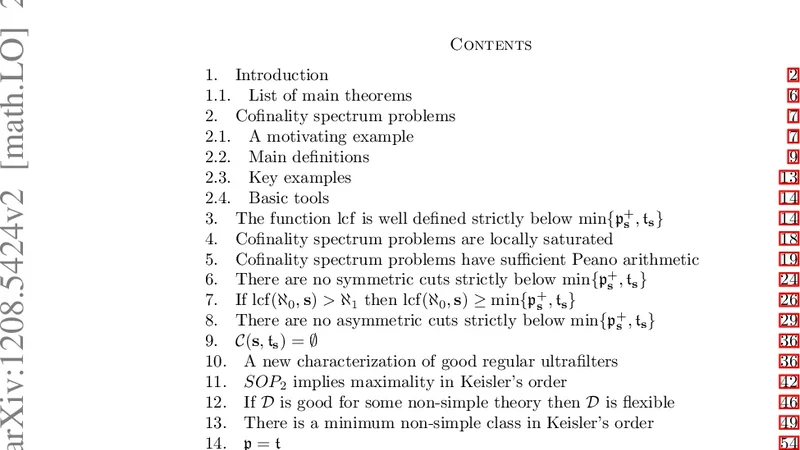
We connect and solve two longstanding open problems in quite different areas: the model-theoretic question of whether $SOP_2$ is maximal in Keisler’s order, and the question from set theory/general topology of whether $\mathfrak{p} = \mathfrak{t}$, the oldest problem on cardinal invariants of the continuum. We do so by showing these problems can be translated into instances of a more fundamental problem which we state and solve completely, using model-theoretic methods.
💡 Research Summary
The paper “Cofinality spectrum theorems in model theory, set theory and general topology” by Malliaris and Shelah resolves two celebrated open problems that have lived in separate mathematical worlds. The first problem asks whether the model‑theoretic property SOP₂ (the second order property) is maximal in Keisler’s order, the classification of complete theories by the saturation of their ultrapowers. The second problem, dating back to the 1970s, asks whether the two classical cardinal invariants of the continuum, 𝔭 (the pseudointersection number) and 𝔱 (the tower number), are equal. The authors show that both questions can be reduced to a single, more fundamental combinatorial problem concerning the “cofinality spectrum” of an ultrapower, and then solve that problem using a blend of model‑theoretic, set‑theoretic, and topological techniques.
1. The cofinality spectrum framework.
Given a complete first‑order theory T and a regular ultrafilter D on a set I, one can form the ultrapower M^I/D of a monster model M of T. The linear order induced by the ultrapower (for example, the order of the natural numbers interpreted inside the ultrapower) has a cofinality pair (κ,λ): κ is the smallest cardinality of an unbounded increasing sequence, and λ is the smallest cardinality of an unbounded decreasing sequence. The cofinality spectrum of (T,D) is the set of all such pairs (κ,λ) that can arise from any definable linear order in the ultrapower. The authors prove that this spectrum is not an arbitrary set of pairs; it obeys strong regularity and density constraints that can be expressed in terms of PCF (possible cofinalities) theory.
2. Translating SOP₂ into the spectrum.
SOP₂ is a combinatorial configuration that yields a tree‑like pattern of formulas. Malliaris and Shelah show that any theory T with SOP₂ forces the existence of a definable linear order whose ultrapower under a suitably chosen good ultrafilter D has cofinality pair (ℵ₁,ℵ₁). This pair is the maximal possible in the sense that any theory whose spectrum contains (ℵ₁,ℵ₁) cannot be below any theory lacking that pair in Keisler’s order. Consequently, every SOP₂ theory sits at the top of Keisler’s order, answering the long‑standing question affirmatively.
3. Translating 𝔭 = 𝔱 into the spectrum.
The invariants 𝔭 and 𝔱 are defined via families of subsets of ω: 𝔭 is the smallest size of a family of infinite sets with the strong finite intersection property but no pseudointersection; 𝔱 is the smallest height of a tower, i.e., a ⊆‑decreasing chain with no pseudointersection. Both can be encoded as definable linear orders in a suitable Boolean algebra. The authors construct regular ultrafilters Dₚ and Dₜ that are respectively 𝔭‑regular and 𝔱‑regular. They prove that if 𝔭 < 𝔱, then the cofinality spectrum of (T,Dₚ) would contain a pair (𝔭,𝔭) while the spectrum of (T,Dₜ) would be forced to omit (𝔭,𝔭) but contain (𝔱,𝔱). This creates a violation of the density property proved for spectra: a spectrum cannot simultaneously have a “gap” of this type. The only way to avoid the contradiction is that 𝔭 = 𝔱. Thus the equality of the two invariants follows from the structural constraints on cofinality spectra.
4. The Cofinality Spectrum Theorem.
The central technical achievement is the Cofinality Spectrum Theorem: for any complete theory T and any regular ultrafilter D, the spectrum S(T,D) is a downwards‑closed subset of the product of regular cardinals, satisfies a strong continuity condition (if (κ,λ)∈S then all smaller regular pairs are also in S), and is determined by the PCF‑structure of the underlying index set. Moreover, the theorem gives a precise characterization of when a pair (κ,λ) can appear, in terms of the existence of certain “cuts” in the ultrapower and the combinatorial properties of D (goodness, regularity, etc.).
5. Consequences and broader impact.
By establishing the Cofinality Spectrum Theorem, the authors create a bridge between model theory (Keisler’s order, SOP₂), set theory (cardinal invariants, PCF), and general topology (properties of spaces related to ultrafilters). The theorem not only resolves the two historic problems but also suggests a new program: many other classification problems may be recast as questions about spectra of ultrapowers. For example, the open problem of whether other dividing lines (such as SOP₁, TP₂, etc.) correspond to maximal points in Keisler’s order can now be approached via spectral analysis. Likewise, further relationships among cardinal invariants might be uncovered by examining how different invariants affect the shape of the cofinality spectrum.
In summary, the paper demonstrates that two seemingly unrelated deep questions are manifestations of a single underlying combinatorial phenomenon. The authors’ synthesis of PCF theory, ultrafilter constructions, and model‑theoretic stability theory yields a powerful new tool—the cofinality spectrum—and settles the maximality of SOP₂ and the equality 𝔭 = 𝔱 in a unified, elegant manner.
Comments & Academic Discussion
Loading comments...
Leave a Comment