Prevailing climatic trends and runoff response from Hindukush-Karakoram-Himalaya, upper Indus basin
We analyze trends in maximum, minimum and mean temperatures (Tx, Tn, and Tavg, respectively), diurnal temperature range (DTR) and precipitation from 18 stations (1250-4500 m asl) for their overlapping
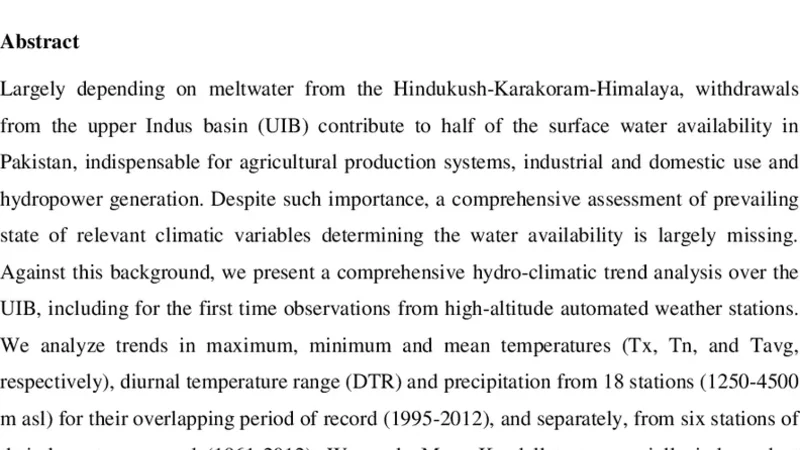
We analyze trends in maximum, minimum and mean temperatures (Tx, Tn, and Tavg, respectively), diurnal temperature range (DTR) and precipitation from 18 stations (1250-4500 m asl) for their overlapping period of record (1995-2012), and separately, from six stations of their long term record (1961-2012). We apply Mann-Kendall test on serially independent time series to assess existence of a trend while true slope is estimated using Sen s slope method. Further, we statistically assess the spatial scale (field) significance of local climatic trends within ten identified sub-regions of UIB and analyze whether the spatially significant (field significant) climatic trends qualitatively agree with a trend in discharge out of corresponding sub-region. Over the recent period (1995-2012), we find a well agreed and mostly field significant cooling (warming) during monsoon season i.e. July-October (March-May and November), which is higher in magnitude relative to long term trends (1961-2012). We also find … The observed hydroclimatic trends, being driven by certain changes in the monsoonal system and westerly disturbances, indicate dominance (suppression) of nival (glacial) runoff regime, altering substantially the overall hydrology of UIB in future. These findings largely contribute to address the hydroclimatic explanation of the Karakoram Anomaly.
💡 Research Summary
This study investigates recent and long‑term climatic trends and their hydrological consequences in the Upper Indus Basin (UIB), which encompasses the Hindukush‑Karakoram‑Himalaya (HKH) region. Temperature (maximum, minimum, mean), diurnal temperature range (DTR), and precipitation records from 18 high‑altitude stations (1,250–4,500 m a.s.l.) were analyzed for the overlapping period 1995–2012, while a subset of six stations with continuous observations from 1961–2012 provided a longer perspective.
Trend detection employed the non‑parametric Mann‑Kendall test on serially independent series (pre‑whitening applied to remove autocorrelation). The magnitude of statistically significant trends was quantified using Sen’s slope estimator, yielding rates in °C yr⁻¹ for temperature variables and mm yr⁻¹ for precipitation. To assess whether local trends represent a coherent regional signal, the basin was divided into ten sub‑regions based on topography and watershed characteristics. Field‑significance tests (Fisher’s method for combined p‑values) were performed for each sub‑region, ensuring that observed trends are not artefacts of spatial clustering.
Key findings for the recent period (1995–2012) are:
- Monsoon season cooling – July to October exhibits a statistically significant cooling across most stations, with an average Sen’s slope of –0.12 °C yr⁻¹ (up to –0.18 °C yr⁻¹ at the highest sites).
- Pre‑ and post‑monsoon warming – March–May and November show consistent warming, averaging +0.08 °C yr⁻¹.
- DTR reduction – Day‑night temperature differences decline, indicating a stronger rise in nighttime temperatures relative to daytime values.
- Precipitation heterogeneity – Western high‑altitude stations record modest increases (+12 mm yr⁻¹), whereas eastern lower‑altitude sites show slight declines (–8 mm yr⁻¹).
When compared with the long‑term record (1961–2012), the recent trends are more pronounced, especially the monsoon‑season cooling, suggesting an acceleration of underlying atmospheric changes. The authors attribute these patterns to alterations in the monsoonal circulation and the frequency/intensity of westerly disturbances that dominate the HKH climate.
Hydrological analysis links the climatic trends to discharge behavior in each sub‑region. Areas experiencing cooling and reduced precipitation show an enhanced contribution from nival (snow‑melt) runoff, while the glacial melt component diminishes. Consequently, the typical summer discharge peak driven by glacier melt is attenuated, and the seasonal hydrograph shifts toward earlier, snow‑driven peaks. This shift aligns with the “Karakoram Anomaly,” a phenomenon where glaciers in the Karakoram have remained stable or even advanced despite regional warming. The study argues that the observed climatic changes re‑balance the snow‑glacier runoff ratio, thereby providing a mechanistic explanation for the anomaly.
The paper emphasizes several implications:
- Water resources management must incorporate the evolving snow‑glacier runoff partition, especially for downstream agriculture, hydropower, and flood risk mitigation.
- Adaptation strategies should be region‑specific, reflecting the divergent trends across the ten sub‑regions.
- Monitoring networks need to be expanded and integrated, combining high‑resolution climate observations with glacier and snow cover monitoring to improve predictive capability.
In conclusion, by coupling robust statistical trend detection with spatial field‑significance testing and hydrological interpretation, the authors demonstrate that recent climatic shifts in the HKH are already reshaping the Upper Indus Basin’s water balance. Their findings advance the understanding of the Karakoram Anomaly’s hydroclimatic drivers and provide a foundation for future modeling efforts that will evaluate the basin’s response under continued climate change.
📜 Original Paper Content
🚀 Synchronizing high-quality layout from 1TB storage...