The Emergence and Dynamical Evolution of Complex Transport Networks from Simple Low-Level Behaviours
The true slime mould Physarum polycephalum is a recent well studied example of how complex transport networks emerge from simple auto-catalytic and self- organising local interactions, adapting structure and function against changing environmental conditions and external perturbation. Physarum networks also exhibit computationally desirable measures of transport efficiency in terms of overall path length, minimal connectivity and network resilience. Although significant progress has been made in mathematically modelling the behaviour of Physarum networks (and other biological transport networks) based on observed features in experimental settings, their initial emergence - and in particular their long-term persistence and evolution - is still poorly understood. We present a low-level, bottom-up, approach to the modelling of emergent transport networks. A population of simple particle-like agents coupled with paracrine chemotaxis behaviours in a dissipative environment results in the spontaneous emergence of persistent, complex structures. Second order emergent behaviours, in the form of network surface minimisation, are also observed contributing to the long term evolution and dynamics of the networks. The framework is extended to allow data presentation and the population is used to perform a direct (spatial) approximation of network minimisation problems. Three methods are employed, loosely relating to behaviours of Physarum under different environmental conditions. Finally, the low-level approach is summarised with a view to further research.
💡 Research Summary
The paper presents a bottom‑up, agent‑based framework that reproduces the emergence and long‑term evolution of complex transport networks reminiscent of the slime mould Physarum polycephalum. Instead of relying on top‑down mathematical descriptions, the authors define a population of simple, particle‑like software agents that interact only through local chemotactic signaling (paracrine chemotaxis) and diffusion of a scalar “trail” field. Each agent occupies a single pixel on a 2‑D lattice, possesses three forward‑oriented sensors (front, left, right), and at each discrete time step samples the trail intensity at these sensors. Based on the relative intensities, the agent either continues straight, rotates left or right by a fixed angle, or, if forward movement is blocked, selects a new random orientation. Successful moves deposit a constant amount of trail; the trail map is then smoothed each step by a 3×3 mean filter with an adjustable damping factor, providing a simple diffusion/evaporation process.
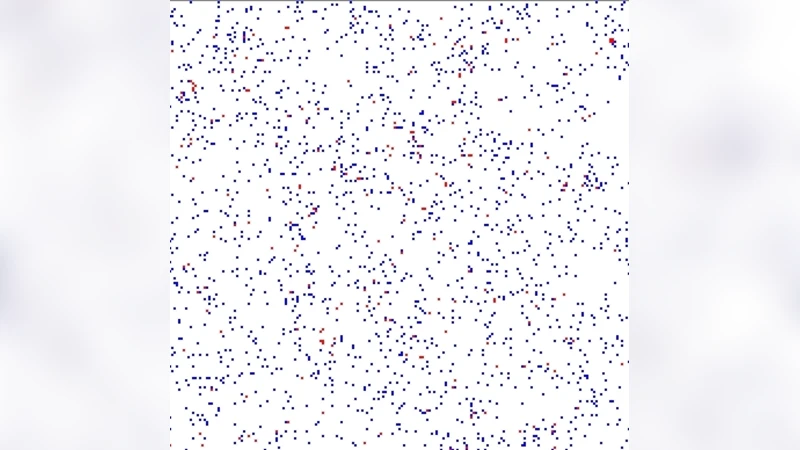
With a modest population density (5 % of the lattice) and baseline parameters (sensor angle 15°, sensor offset 15 px, rotation angle 45°, deposition rate 5, damping 0.1), the initially random distribution of agents undergoes a rapid phase transition: agents aggregate along locally higher trail concentrations, forming a web of high‑density paths. Over time the web self‑organises into regular lattice‑like structures; when the sensor angle is increased to 45°, branching streams are suppressed and the system settles into a dynamic equilibrium that resembles a hexagonal honeycomb. This pattern corresponds to a minimal‑surface connector in two dimensions, indicating that the emergent network is performing a form of surface‑area minimisation purely through local rules.
The authors explore the influence of boundary conditions. With periodic boundaries the honeycomb tiles seamlessly; with fixed boundaries the network tends to adhere to the four corners because agents facing a corner receive asymmetric sensor input (no trail on the side sensors, but a front signal remains). By modifying the algorithm so that agents whose sensors fall outside the image turn right arbitrarily, the corner adhesion disappears and the network contracts toward the centre, further confirming the surface‑minimisation behaviour.
Beyond the spontaneous formation of networks, the framework is applied to classic network optimisation problems by adding very limited external stimuli. Three distinct modes are demonstrated, each loosely inspired by observed Physarum behaviours under different environmental conditions:
-
Shortest‑path approximation – Food sources are encoded as weighted nodes that inject trail into the map. Agents preferentially follow the strongest trail gradients, quickly reinforcing the minimal‑length connection between sources, analogous to Physarum’s ability to solve maze problems.
-
Spanning‑tree construction – By adjusting deposition and diffusion rates, the agents collectively prune redundant loops, yielding a cycle‑free, low‑total‑length network that spans all nutrient points, mirroring experimental observations of Physarum forming efficient transport trees.
-
Cyclic network generation – Increasing the agent population and reducing sensor offset reproduces a foraging‑exploratory mode where the mass expands, creates loops, and then gradually contracts, similar to the behaviour of a large plasmodium that balances exploration and exploitation.
The paper emphasizes that the spatial (pixel‑based) representation, unlike traditional graph‑based formulations, captures the physical embedding of the network, allowing investigation of how congestion, space constraints, or sudden changes in available area affect the emergent transport dynamics. The authors note that while the model is highly sensitive to low‑level parameter tweaks—small changes can dramatically alter global topology—the reduced set of assumptions (no explicit pressure, flow, or tube thickness equations) may grant greater generality across disparate biological and engineered systems.
In conclusion, the study demonstrates that complex, adaptive transport networks can arise from extremely simple, locally defined rules. By tuning sensor geometry, rotation angles, deposition rates, and diffusion damping, a single framework can reproduce static minimal surfaces, dynamic branching, equilibrium honeycombs, and problem‑specific optimisation behaviours. This suggests promising applications in distributed robotics, self‑organising sensor fields, and bio‑inspired material design, where global functionality must emerge from minimal local intelligence. Future work is proposed to incorporate internal agent states (e.g., energy reserves, memory) and richer environmental interactions (e.g., fluid flow, obstacles) to bridge the gap between the abstract model and real‑world biological transport systems.
Comments & Academic Discussion
Loading comments...
Leave a Comment