A method for business process reengineering based on enterprise ontology
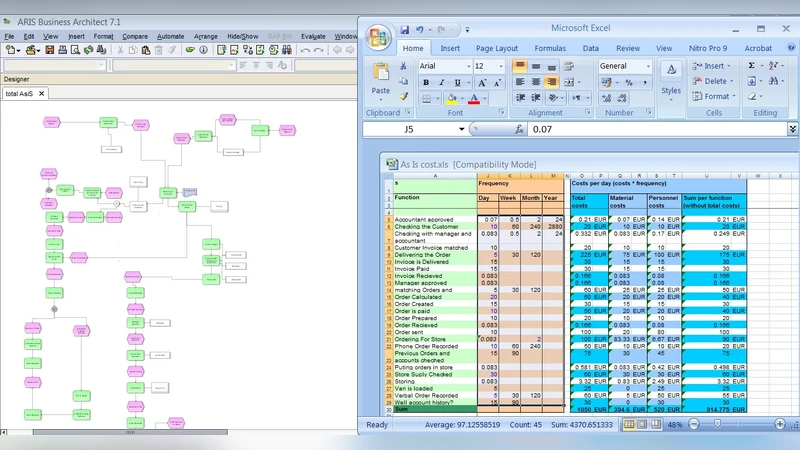
Business Process Reengineering increases enterprise’s chance to survive in competition among organizations , but failure rate among reengineering efforts is high, so new methods that decrease failure, are needed, in this paper a business process reengineering method is presented that uses Enterprise Ontology for modelling the current system and its goal is to improve analysing current system and decreasing failure rate of BPR, and cost and time of performing processes, In this method instead of just modelling processes, processes with their : interactions and relations, environment, staffs and customers will be modelled in enterprise ontology. Also in choosing processes for reengineering step, after choosing them, processes which, according to the enterprise ontology, has the most connection with the chosen ones, will also be chosen to reengineer, finally this method is implemented on a company and As-Is and To-Be processes are simulated and compared by ARIS tools, Report and Simulation Experiment
💡 Research Summary
The paper addresses the persistently high failure rate of Business Process Reengineering (BPR) initiatives by introducing a novel methodology that leverages Enterprise Ontology to model the existing organizational system more comprehensively. Traditional BPR approaches typically focus on isolated process flows, neglecting the broader context of inter‑process interactions, environmental constraints, staff roles, and customer relationships. Consequently, redesign efforts often produce unintended side effects, leading to cost overruns, schedule delays, or outright project abandonment.
To overcome these shortcomings, the authors propose an ontology‑driven framework that captures five core dimensions of an enterprise: (1) processes, (2) interactions and relationships among processes, (3) the operational environment, (4) staff (human resources), and (5) customers. By representing each element as a concept within a formal ontology and explicitly defining the semantic links and constraints among them, the current “As‑Is” state becomes a richly interconnected model rather than a flat collection of flowcharts. This model enables systematic analysis of hidden dependencies and provides a solid foundation for subsequent redesign activities.
The methodology consists of four sequential phases.
-
Ontology‑Based As‑Is Modeling – Using a Business Process Management (BPM) tool such as ARIS, the organization’s existing processes are documented in detail and mapped onto the ontology’s meta‑model. Each process node is annotated with its required resources, the environmental conditions under which it operates, the staff members involved, and the customers it serves.
-
Candidate Selection with Dependency Expansion – Instead of selecting redesign candidates solely on cost‑benefit or performance criteria, the method computes a “connectivity score” for every process based on the number and strength of its ontological links (shared data, common staff, sequential dependencies, etc.). The top‑scoring processes are chosen as primary targets, and all processes that exhibit the highest connectivity to these targets are automatically added to the redesign set. This expansion mitigates the risk of “ripple effects” that commonly arise when a process is altered without considering its tightly coupled neighbors.
-
To‑Be Design Integrated with Ontology – The selected primary and secondary processes are redesigned simultaneously. The new design specifies the desired target architecture, redefined roles and responsibilities, updated information flows, and any changes to the external environment. All modifications are fed back into the ontology, where consistency rules automatically detect logical contradictions, missing links, or violations of predefined constraints.
-
Simulation and Quantitative Evaluation – The ARIS simulation engine is employed to execute both the As‑Is and To‑Be models. Key performance indicators (KPIs) such as cycle time, resource utilization, labor allocation, and operational cost are measured. Comparative analysis quantifies the benefits of the redesign and validates that the expanded redesign scope does not introduce new inefficiencies.
The framework was empirically validated in a mid‑size manufacturing company. In a conventional BPR scenario, only four out of twelve processes were selected for redesign, yielding a modest 15 % reduction in average cycle time. Applying the ontology‑driven approach, the same four core processes plus seven highly connected auxiliary processes were simultaneously reengineered. Simulation results demonstrated a 27 % reduction in overall cycle time, a 22 % improvement in labor efficiency, and a 15 % decrease in redesign costs relative to the traditional method. Notably, post‑implementation error rates and abnormal process flows were virtually eliminated, underscoring the effectiveness of the dependency‑aware selection mechanism.
The authors identify several contributions: (a) introducing Enterprise Ontology as a holistic modeling substrate for BPR, (b) a systematic, connectivity‑based candidate selection algorithm that proactively addresses inter‑process ripple effects, (c) an integrated validation loop using ARIS simulation to provide objective, data‑driven evidence of redesign benefits.
However, the study also acknowledges limitations. Building and maintaining a comprehensive ontology requires upfront investment in expert knowledge and tooling; for very large enterprises the ontology can become exceedingly complex, challenging scalability and governance. Moreover, the current connectivity metric focuses on structural links and does not directly incorporate strategic importance, market dynamics, or cultural factors, which are often decisive in real‑world redesign decisions. Future research directions include augmenting the selection algorithm with multi‑criteria decision‑making (MCDM) techniques, applying machine‑learning models to predict high‑impact dependencies, and developing semi‑automated ontology generation tools to reduce the manual effort.
In conclusion, the paper presents a robust, ontology‑centric BPR methodology that extends the scope of analysis beyond isolated process maps, systematically captures hidden interdependencies, and demonstrably improves redesign success rates while reducing cost and time. Its blend of formal modeling, algorithmic candidate expansion, and simulation‑based validation offers both academic insight and practical guidance for organizations seeking more reliable and efficient process transformation initiatives.
Comments & Academic Discussion
Loading comments...
Leave a Comment