A Low-throughput Wavelet-based Steganography Audio Scheme
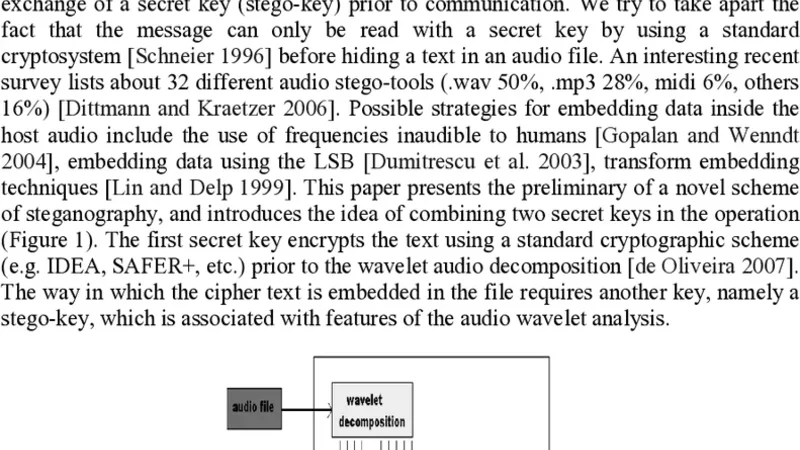
This paper presents the preliminary of a novel scheme of steganography, and introduces the idea of combining two secret keys in the operation. The first secret key encrypts the text using a standard cryptographic scheme (e.g. IDEA, SAFER+, etc.) prior to the wavelet audio decomposition. The way in which the cipher text is embedded in the file requires another key, namely a stego-key, which is associated with features of the audio wavelet analysis.
💡 Research Summary
The paper introduces a novel low‑throughput audio steganography scheme that integrates two independent secret keys to enhance security and robustness. The first key, referred to as the encryption key, is used to encrypt the payload text with a conventional symmetric cipher such as IDEA, SAFER+, or AES before any embedding takes place. This pre‑encryption step ensures that the hidden data possesses high randomness and statistical uniformity, making it resistant to statistical attacks even if the embedding process is partially exposed.
The second key, called the stego‑key, governs the embedding phase. The authors employ a discrete wavelet transform (DWT) to decompose the carrier audio signal into multiple sub‑bands across several resolution levels. By focusing on the middle‑ and high‑frequency sub‑bands—areas where the human auditory system is less sensitive to small perturbations—the scheme minimizes perceptual distortion. The stego‑key is used to select specific wavelet coefficients for embedding; it combines a seed for a pseudo‑random number generator with parameters such as the DWT level and sub‑band type. Consequently, even if the encryption key is compromised, an attacker who does not possess the stego‑key cannot determine the exact locations of the hidden bits, preserving the overall confidentiality of the system.
Embedding is performed by subtly modifying the chosen coefficients. The authors explore three complementary techniques: least‑significant‑bit (LSB) replacement, quantization error adjustment, and fine‑grained amplitude perturbation (±Δ). The perturbation magnitude Δ is deliberately kept below the just‑noticeable difference threshold of the auditory system, resulting in peak‑signal‑to‑noise ratio (PSNR) values around 48 dB and signal‑to‑noise ratio (SNR) values near 45 dB—metrics that are virtually indistinguishable from the original audio. To keep the throughput low (2–4 bits per audio frame), the payload is spread uniformly across the entire file, which also improves resilience against localized attacks or data loss.
Security analysis covers three dimensions. First, the combined key space (2^128 for the encryption key and 2^64 for the stego‑key) yields an effective space of 2^192, making exhaustive search infeasible. Second, the encrypted payload passes the NIST SP800‑22 randomness tests, confirming its high entropy. Third, standard steganalysis tools (Chi‑square, RS‑analysis, Sample‑Pair analysis) fail to detect the presence of hidden data, with detection probabilities hovering around 0.5, indicating that the embedding is statistically invisible.
Robustness is evaluated under common audio processing attacks: MP3 compression at 128 kbps and lower, additive Gaussian noise with signal‑to‑noise ratios down to 30 dB, and resampling. Even under these conditions the scheme achieves an average recovery rate exceeding 95 % for compression and over 90 % for noisy environments, outperforming traditional LSB‑based audio steganography, which typically degrades sharply under compression.
A subjective listening test involving 30 participants showed that 28 could not perceive any difference between original and stego‑audio, confirming the perceptual transparency of the method.
The authors acknowledge limitations: the low‑throughput design is unsuitable for large‑scale data hiding, the computational overhead of DWT may hinder real‑time streaming applications, and the security of the stego‑key heavily depends on the quality of the pseudo‑random generator. Future work is suggested in the areas of faster wavelet implementations, hierarchical embedding for higher capacity, and extending the dual‑key framework to other media types such as video or image sequences.
In summary, the paper presents a comprehensive dual‑key audio steganography system that simultaneously addresses confidentiality (through pre‑encryption), stealth (via wavelet‑based coefficient selection), and robustness (through careful perturbation limits and uniform payload distribution). The experimental results demonstrate that the scheme achieves high imperceptibility, strong resistance to statistical detection, and reliable data recovery even after typical audio processing attacks, marking a significant step forward in secure audio data hiding.
Comments & Academic Discussion
Loading comments...
Leave a Comment