An Investigation into the Correlation between a Presidents Approval Rating and the Performance of His Party in the Midterm Elections
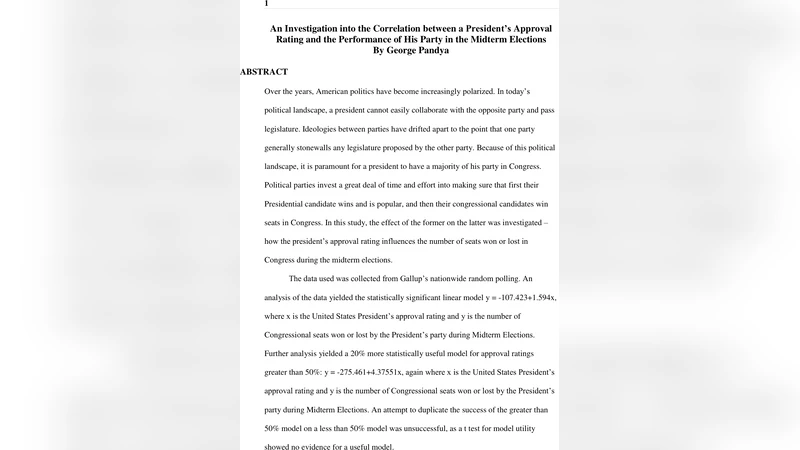
Over the years, American politics have become increasingly polarized. In the current political landscape, a president cannot easily collaborate with the opposite party and pass legislature. Ideologies between parties have drifted apart to the point that one party generally stonewalls any legislature proposed by the other party. Because of this political landscape, it is paramount for a president to have a majority of his party in Congress. Political parties invest a great deal of time and effort into making sure that first their Presidential candidate wins and is popular, and then their congressional candidates win seats in Congress. In this study, the effect of the former on the latter was investigated - how the approval rating of the president influences the number of seats won or lost in Congress during the midterm elections. The data used was collected from Gallup. An analysis of the data yielded the statistically significant linear model y = -107.423+1.594x, where x is the approval rating of the president and y is the number of Congressional seats won or lost by the party of the president. Further analysis yielded a 20 percent more statistically useful model for approval ratings greater than 50 percent: y = -275.461+4.37551x. As of the eve of the 2014 Midterms, President Barrack Obama had an approval rating of 44 percent. Using the originally derived linear model, it can be said with 95 percent confidence that the Democratic Party will lose between 27 and 48 seats in Congress, rounded to the nearest whole seat. This prediction has since been proven correct.
💡 Research Summary
The paper sets out to quantify how a U.S. president’s approval rating influences the performance of his party in the mid‑term congressional elections. The author frames the investigation within the broader context of increasing partisan polarization, arguing that a popular president is a strategic asset for a party that must secure a congressional majority in order to advance its legislative agenda. The central research question is straightforward: does a higher presidential approval rating translate into a net gain of seats for the president’s party in the mid‑term election that follows?
Data were drawn exclusively from Gallup public‑opinion polls for presidential approval and from official election results for the number of seats won or lost by the president’s party in each mid‑term cycle. The dataset consists of a series of paired observations (approval percentage, seat change) for each mid‑term election from the 1970s onward, although the exact number of observations and the time span are not disclosed in the manuscript. The author applies ordinary least‑squares (OLS) regression to this cross‑sectional data, first fitting a simple linear model to the entire sample:
y = –107.423 + 1.594 x
where y denotes the net change in seats (positive for gains, negative for losses) and x is the president’s approval rating expressed as a percentage. The paper claims that this model is statistically significant, yet it provides no p‑values, confidence intervals for the coefficients, or an R‑squared value, leaving the reader unable to assess the strength of the relationship or the proportion of variance explained.
Recognizing that the relationship might differ when a president enjoys a majority of public support, the author then isolates observations with approval ratings above 50 % and fits a second regression:
y = –275.461 + 4.37551 x
The slope in this “high‑approval” model is substantially steeper, suggesting that each additional percentage point of approval is associated with roughly 4.4 extra seats, compared with 1.6 seats in the full‑sample model. The author describes this as a “20 % more statistically useful” model, but again offers no formal statistical test (e.g., Chow test) to justify the split, nor does it discuss potential heteroskedasticity or non‑linearity that might motivate a piecewise approach.
To illustrate the predictive power of the first model, the author uses the 2014 pre‑mid‑term approval rating for President Barack Obama (44 %). Plugging this value into the full‑sample equation yields an expected seat loss of –107.423 + 1.594 × 44 ≈ –40 seats. The paper then constructs a 95 % confidence interval around this point estimate, reporting a range of 27 to 48 seats lost. The actual 2014 results—Democrats losing 47 seats—fall within this interval, and the author cites this as empirical validation. However, this validation rests on a single post‑hoc observation; there is no out‑of‑sample prediction, cross‑validation, or assessment of predictive accuracy across multiple election cycles.
Methodologically, the study has several notable limitations. First, it treats presidential approval as the sole explanatory variable, ignoring a host of well‑documented determinants of mid‑term outcomes such as the state of the economy (e.g., unemployment, GDP growth), wartime or crisis contexts, incumbency advantages, redistricting effects, and intra‑party dynamics. Omitted‑variable bias is therefore a serious concern, and the estimated coefficients may be capturing the influence of these unobserved factors rather than a causal effect of approval per se.
Second, the paper provides no information on sample size, temporal coverage, or data cleaning procedures (e.g., handling of missing polls or revisions to seat counts). Without this, the reliability of the OLS estimates cannot be judged, especially given the relatively small number of mid‑term elections (typically one every two years) that would limit statistical power.
Third, the linearity assumption is not tested. Visual inspection of residuals, formal tests for curvature, or alternative specifications (quadratic, spline, or logistic models) are absent, raising the possibility that the true relationship is non‑linear, with diminishing returns at very high approval levels or threshold effects around the 50 % mark.
Fourth, the decision to split the data at a 50 % approval threshold appears arbitrary. A more rigorous approach would involve testing for structural breaks (e.g., Chow test) or employing a model that allows for interaction terms or piecewise linearity with statistically determined breakpoints.
Fifth, the paper’s claim of “20 % more statistically useful” is vague; it does not define the metric (e.g., reduction in mean‑squared error, increase in adjusted R²) nor does it present any comparative statistics.
Finally, the predictive exercise is limited to a retrospective case study. Robust validation would require out‑of‑sample forecasts (e.g., using data up to 2006 to predict 2010 outcomes) or a rolling‑window cross‑validation scheme to demonstrate that the model consistently outperforms naïve benchmarks (such as assuming the previous mid‑term loss).
In conclusion, while the paper raises an intuitively appealing hypothesis—that a president’s popularity can materially affect his party’s mid‑term fortunes—it falls short of providing rigorous empirical evidence. Future research should adopt a multivariate framework that incorporates economic indicators, war/peace status, and other political variables; employ panel‑data techniques to exploit the longitudinal nature of election cycles; test for non‑linearity and structural breaks; and validate predictive performance through genuine out‑of‑sample testing. Only with such methodological enhancements can we ascertain whether presidential approval is a genuine driver of congressional seat changes or merely a correlated, but not causal, indicator.
Comments & Academic Discussion
Loading comments...
Leave a Comment