The Interplay Between Dynamics and Networks: Centrality, Communities, and Cheeger Inequality
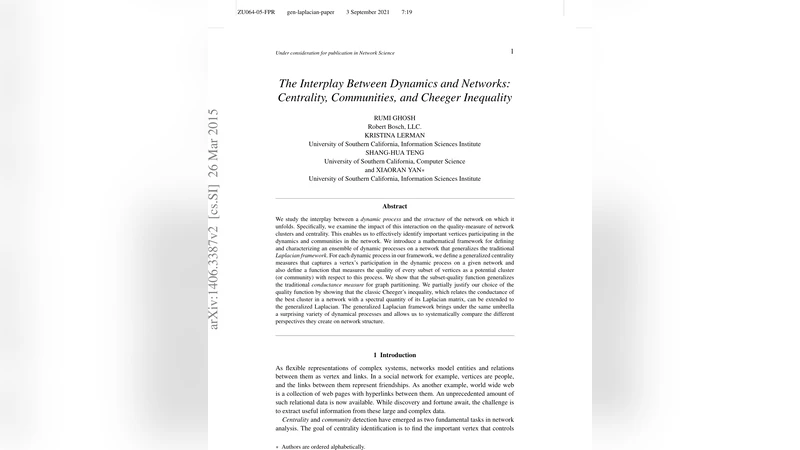
We study the interplay between a dynamic process and the structure of the network on which it is defined. Specifically, we examine the impact of this interaction on the quality-measure of network clusters and node centrality. This enables us to effectively identify network communities and important nodes participating in the dynamics. As the first step towards this objective, we introduce an umbrella framework for defining and characterizing an ensemble of dynamic processes on a network. This framework generalizes the traditional Laplacian framework to continuous-time biased random walks and also allows us to model some epidemic processes over a network. For each dynamic process in our framework, we can define a function that measures the quality of every subset of nodes as a potential cluster (or community) with respect to this process on a given network. This subset-quality function generalizes the traditional conductance measure for graph partitioning. We partially justify our choice of the quality function by showing that the classic Cheeger’s inequality, which relates the conductance of the best cluster in a network with a spectral quantity of its Laplacian matrix, can be extended from the Laplacian-conductance setting to this more general setting.
💡 Research Summary
This paper introduces a unified mathematical framework that generalizes the traditional graph Laplacian to encompass a broad class of continuous‑time dynamic processes on networks. By inserting a bias matrix B (which can encode degree‑based or other node preferences) and a diagonal delay matrix T (representing node‑specific waiting times) into the normalized Laplacian, the authors define a “generalized Laplacian” L̂ = T⁻¹(I − B A B · D_B⁻¹). This construction captures unbiased random walks, biased random walks, maximum‑entropy walks, epidemic spreading operators, and consensus/opinion dynamics as special cases, showing that many seemingly unrelated processes are related by simple basis changes.
Using this operator, the paper redefines node centrality as the components of the leading non‑trivial eigenvector of L̂, which corresponds to the stationary distribution of the underlying process. Classical centrality measures such as PageRank, eigenvector centrality, and degree centrality emerge as particular choices of B and T. The authors also prove a conservation law stating that the total centrality mass remains constant across all processes within the framework.
For community detection, the authors generalize conductance. The classic conductance φ(S) = cut(S, S̅)/min(vol(S), vol(S̅)) is extended to φ̂(S) = cut̂(S, S̅)/min(vol̂(S), vol̂(S̅)), where cut̂ and vol̂ are defined using the off‑diagonal entries and the “dynamic volume” derived from L̂. This generalized conductance reflects how frequently nodes interact under the specific dynamics, yielding different quality functions for biased walks, epidemic models, and consensus processes.
A central theoretical contribution is the extension of Cheeger’s inequality to the generalized setting. The authors prove that the second smallest eigenvalue λ₂(L̂) bounds the optimal generalized conductance φ̂* in the same way as in the classic case (λ₂ ≥ φ̂*²/2). Consequently, spectral partitioning algorithms such as sweep cuts can be applied directly to L̂, providing provably good communities that are tailored to the chosen dynamics.
Empirical evaluations on several real‑world networks (social, web, biological) illustrate how varying bias (β) and delay (τ) parameters changes the ranking of central nodes and the composition of detected communities. For instance, a positive bias toward high‑degree nodes highlights hubs in the centrality ranking, while a negative bias emphasizes peripheral nodes. In epidemic simulations, nodes with high infection rates become central, diverging from degree‑based rankings. Consensus dynamics converge to uniform beliefs, but the speed of convergence and intermediate community structure depend strongly on the delay matrix.
The paper acknowledges that not every possible dynamic process can be expressed by the proposed operator, yet it captures a surprisingly wide variety of processes that were previously studied in isolation. The authors suggest future work on extending the framework to nonlinear dynamics, time‑varying graphs, multilayer networks, and learning the bias and delay parameters from data.
In summary, the work provides (1) a mathematically rigorous, flexible generalization of the Laplacian, (2) unified definitions of centrality and community quality that adapt to the dynamics of interest, (3) a generalized Cheeger inequality linking spectral properties to community quality, and (4) practical algorithms that inherit the efficiency of classic spectral methods while being applicable to a broad spectrum of dynamic processes. This unified perspective clarifies how the choice of dynamic model influences network analysis outcomes and offers a solid foundation for future research in dynamic network science.
Comments & Academic Discussion
Loading comments...
Leave a Comment