A polynomial time approximation scheme for computing the supremum of Gaussian processes
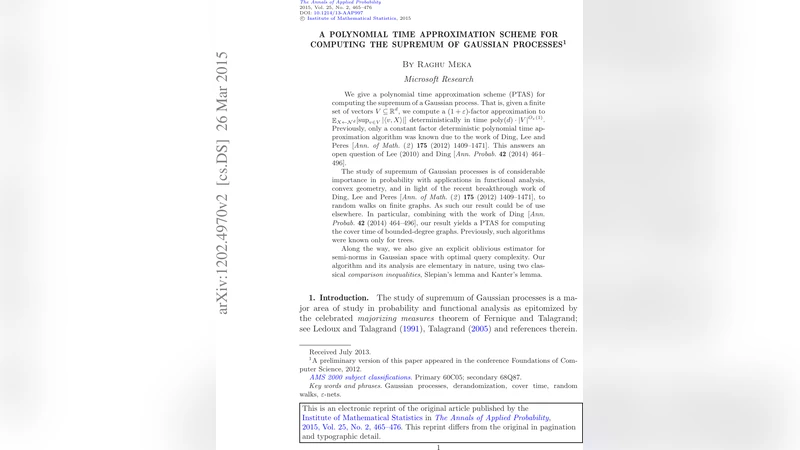
We give a polynomial time approximation scheme (PTAS) for computing the supremum of a Gaussian process. That is, given a finite set of vectors $V\subseteq\mathbb{R}^d$, we compute a $(1+\varepsilon)$-factor approximation to $\mathop {\mathbb{E}}{X\leftarrow\mathcal{N}^d}[\sup{v\in V}|\langle v,X\rangle|]$ deterministically in time $\operatorname {poly}(d)\cdot|V|^{O_{\varepsilon}(1)}$. Previously, only a constant factor deterministic polynomial time approximation algorithm was known due to the work of Ding, Lee and Peres [Ann. of Math. (2) 175 (2012) 1409-1471]. This answers an open question of Lee (2010) and Ding [Ann. Probab. 42 (2014) 464-496]. The study of supremum of Gaussian processes is of considerable importance in probability with applications in functional analysis, convex geometry, and in light of the recent breakthrough work of Ding, Lee and Peres [Ann. of Math. (2) 175 (2012) 1409-1471], to random walks on finite graphs. As such our result could be of use elsewhere. In particular, combining with the work of Ding [Ann. Probab. 42 (2014) 464-496], our result yields a PTAS for computing the cover time of bounded-degree graphs. Previously, such algorithms were known only for trees. Along the way, we also give an explicit oblivious estimator for semi-norms in Gaussian space with optimal query complexity. Our algorithm and its analysis are elementary in nature, using two classical comparison inequalities, Slepian’s lemma and Kanter’s lemma.
💡 Research Summary
The paper addresses the computational problem of estimating the expected supremum of a Gaussian process defined by a finite set of vectors (V\subset\mathbb{R}^d). Formally, given (V), one wishes to compute
\
Comments & Academic Discussion
Loading comments...
Leave a Comment