On topological twin buildings and topological split Kac-Moody groups
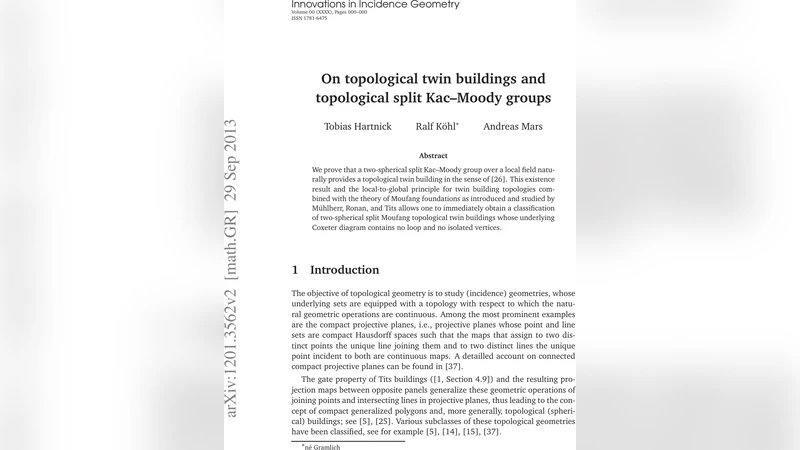
We prove that a two-spherical split Kac-Moody group over a local field naturally provides a topological twin building in the sense of Kramer. This existence result and the local-to-global principle for twin building topologies combined with the theory of Moufang foundations as introduced and studied by M"uhlherr, Ronan, and Tits allows one to immediately obtain a classification of two-spherical split Moufang topological twin buildings whose underlying Coxeter diagram contains no loop and no isolated vertices.
💡 Research Summary
The paper establishes a deep link between split Kac‑Moody groups of two‑spherical type over a local field and the theory of topological twin buildings as introduced by Kramer. After recalling the necessary background—Kac‑Moody groups, BN‑pairs, the definition of a topological twin building, and the concept of Moufang foundations—the author proves the main existence theorem: any two‑spherical split Kac‑Moody group G defined over a local field K naturally carries a pair of twin buildings Δ⁺ and Δ⁻ equipped with compatible topologies that satisfy Kramer’s axioms. The proof proceeds by constructing the positive and negative buildings from the BN‑pair (B⁺, B⁻, N) of G, endowing each chamber, panel, and codimension‑one residue with a topology induced from the local field. A crucial step is the “local‑to‑global” principle: continuity and openness are first verified on rank‑1 and rank‑2 residues (the “local” pieces), and then extended to the whole building using the combinatorial structure of the Coxeter diagram. At this stage the theory of Moufang foundations, developed by Mühlherr, Ronan, and Tits, is employed to guarantee that each apartment satisfies the Moufang condition, which in turn forces the global twin building to inherit a well‑behaved topology.
Having secured the existence of a topological twin building for any such G, the paper turns to classification. The author shows that when the underlying Coxeter diagram contains no loops (i.e., no edge joining a vertex to itself) and no isolated vertices (every node is incident to at least one edge), the topological twin building is uniquely determined by its Moufang foundation. Consequently, all two‑spherical split Moufang topological twin buildings with these diagrammatic restrictions are classified up to isomorphism by the corresponding split Kac‑Moody groups. In other words, the combinatorial data of the diagram together with the local field completely dictate the global topological structure.
The work includes explicit examples illustrating the theory. For instance, when K is a non‑archimedean local field such as ℚₚ, the associated twin buildings are totally disconnected, whereas for K = ℝ the buildings acquire a real analytic structure. These examples demonstrate how the topology of the underlying field influences the geometry of the twin building while the algebraic framework remains uniform.
The paper concludes by outlining open problems. The classification result does not cover diagrams with loops or isolated nodes, and extending the methods to those cases remains a challenging direction. Moreover, the interaction between the automorphism groups of the topological twin buildings and the original Kac‑Moody groups invites further investigation, potentially leading to new rigidity phenomena in infinite‑dimensional Lie theory.
Overall, the article provides a comprehensive synthesis of algebraic Kac‑Moody theory, topological building theory, and Moufang foundations, delivering both an existence theorem for topological twin buildings attached to split Kac‑Moody groups and a clean classification under natural diagrammatic constraints.
Comments & Academic Discussion
Loading comments...
Leave a Comment