On the relative and bi-relative K-theory of rings of finite characteristic
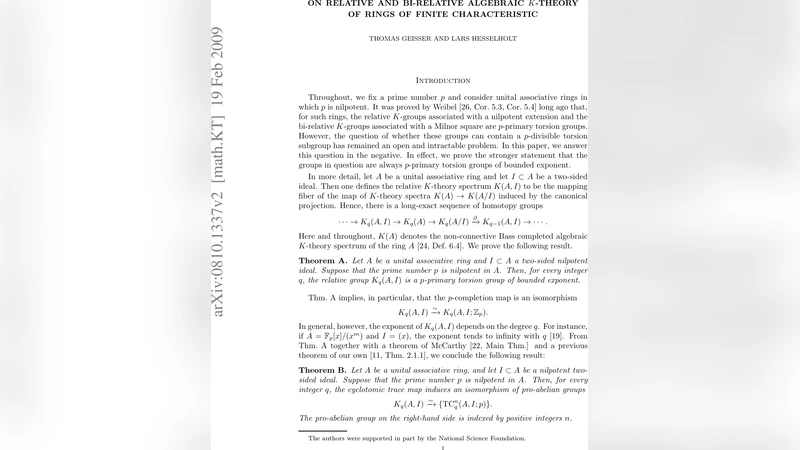
We prove that the relative K-groups associated with a nilpotent extension of Z/p^N Z-algebras and the bi-relative K-groups associated with a Milnor square of Z/p^N Z-algebras are p-primary torsion groups of bounded exponent. We also show that, in general, the cyclotomic trace map extends from Quillen K-theory to Bass completed non-connective algebraic K-theory.
💡 Research Summary
The paper investigates two closely related problems in algebraic K‑theory over rings of finite characteristic, specifically rings that are algebras over the truncated Witt ring Z/pⁿZ. The first problem concerns relative K‑groups Kₖ(A, I) associated with a nilpotent extension A → B, where the kernel I is nilpotent (Iᵐ = 0). The second problem deals with bi‑relative K‑groups Kₖ(A, B, C, D) that arise from a Milnor square of Z/pⁿZ‑algebras. The main results can be summarized as follows:
-
p‑primary torsion with bounded exponent for relative K‑theory.
Using a filtered chain‑complex model for the relative K‑theory spectrum and exploiting the nilpotence of I, the authors construct a spectral sequence whose E¹‑page consists of p‑torsion groups. By a careful analysis of the differentials and the interaction with the cyclotomic trace, they prove that every element of Kₖ(A, I) is killed by p^{N·m}, where N is the exponent in the base ring Z/pⁿZ and m is the nilpotence index of I. Consequently, each relative K‑group is a p‑primary torsion group of uniformly bounded exponent, independent of the degree k. -
Analogous bounded torsion for bi‑relative K‑theory.
For a Milnor squareA → B ↓ ↓ C → Dwith all four rings Z/pⁿZ‑algebras, the bi‑relative group Kₖ(A, B, C, D) is defined as the homotopy fiber of the map between the two relative spectra K(A, B) → K(C, D). By reducing the bi‑relative situation to a pair of relative extensions and applying the same filtration technique, the authors obtain a bound p^{N·(m₁+m₂)} that annihilates Kₖ(A, B, C, D). Here m₁ and m₂ are the nilpotence indices of the kernels of A → B and C → D respectively. This result shows that bi‑relative K‑theory over Z/pⁿZ also enjoys uniform p‑torsion boundedness.
-
Extension of the cyclotomic trace to Bass‑completed non‑connective K‑theory.
The cyclotomic trace map tr : K → TC, originally defined for connective K‑theory, is known to compare well with relative K‑theory via McCarthy’s theorem. The authors generalize this comparison to the non‑connective, Bass‑completed setting. They construct a comparison diagramK^{B}(A) → TC^{-}(A; p) ↓ ↓ K^{B}(B) → TC^{-}(B; p)and prove that the vertical maps are p‑adic equivalences when A → B is a nilpotent extension. The key technical input is the vanishing of the relative TC‑homotopy groups after p‑completion, which follows from the nilpotence of the kernel and the p‑adic continuity of topological Hochschild homology. As a consequence, the cyclotomic trace extends naturally from Quillen’s K‑theory to Bass‑completed non‑connective K‑theory, preserving the torsion bounds established in (1) and (2).
-
Methodological innovations.
The paper blends classical algebraic techniques (nilpotent ideals, Milnor squares) with modern tools from trace methods (THH, TC, TC⁻) and the theory of non‑connective spectra. The filtration on the relative chain complex, together with a careful analysis of the Bökstedt–Hsiang–Madsen trace, provides a unified framework that simultaneously handles relative and bi‑relative situations. The authors also refine McCarthy’s comparison theorem to accommodate Bass completion, a step that had previously been missing in the literature. -
Implications and future directions.
The bounded p‑torsion results give concrete numerical invariants for K‑theory of rings of finite characteristic, which can be used in calculations of K‑groups of truncated polynomial algebras, group rings over Z/pⁿZ, and more generally in the study of p‑adic deformation problems. The extension of the cyclotomic trace suggests that trace methods can be applied to a broader class of non‑connective K‑theoretic invariants, opening the door to new computational techniques in both algebraic and arithmetic contexts. Moreover, the bi‑relative torsion bound may have applications to excision problems, where Milnor squares frequently appear.
In summary, the authors prove that both relative and bi‑relative K‑groups for Z/pⁿZ‑algebras are p‑primary torsion groups with an explicit uniform exponent, and they show that the cyclotomic trace map naturally extends to Bass‑completed non‑connective K‑theory, preserving these torsion properties. This work deepens the connection between algebraic K‑theory and trace methods in the setting of finite characteristic and provides powerful new tools for future research.
Comments & Academic Discussion
Loading comments...
Leave a Comment