Mobile Cloud Computing in Healthcare Using Dynamic Cloudlets for Energy-Aware Consumption
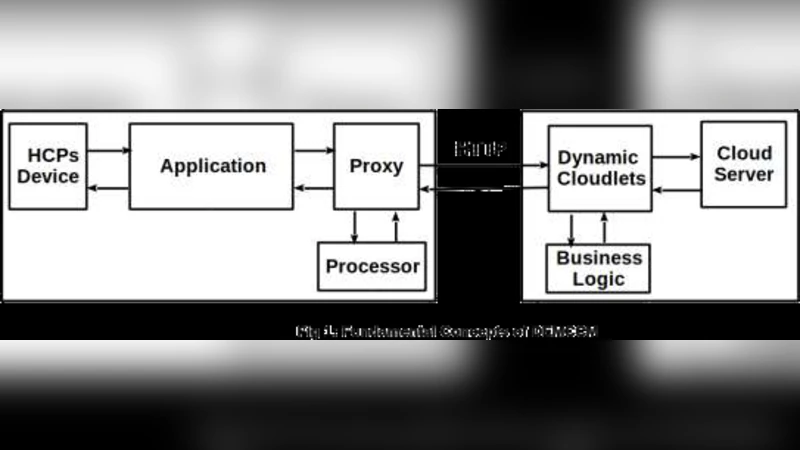
Mobile cloud computing (MCC) has increasingly been adopted in healthcare industry by healthcare professionals (HCPs) which has resulted in the growth of medical software applications for these platforms. There are different applications which help HCPs with many important tasks. Mobile cloud computing has helped HCPs in better decision making and improved patient care. MCC enables users to acquire the benefit of cloud computing services to meet the healthcare demands. However, the restrictions posed by network bandwidth and mobile device capacity has brought challenges with respect to energy consumption and latency delays. In this paper we propose dynamic energy consumption mobile cloud computing model (DEMCCM) which addresses the energy consumption issue by healthcare mobile devices using dynamic cloudlets.
💡 Research Summary
The paper addresses the growing need for energy‑efficient and low‑latency mobile cloud computing (MCC) in healthcare, where clinicians increasingly rely on smartphones and tablets for tasks such as real‑time patient monitoring, remote diagnosis, and electronic health‑record (EHR) access. Traditional MCC architectures that offload all computation to a centralized data‑center suffer from two critical drawbacks in this domain: (1) high energy consumption on the mobile device due to frequent long‑range data transmission, and (2) unacceptable latency spikes when wireless bandwidth is limited or congested. To overcome these challenges, the authors propose the Dynamic Energy‑aware Mobile Cloud Computing Model (DEMCCM), which leverages “cloudlets” – small, edge‑located compute clusters – that can be instantiated, scaled, or shut down dynamically based on current network conditions, device battery status, and application requirements.
DEMCCM consists of three tightly coupled components. First, a Dynamic Cloudlet Placement and Selection Algorithm continuously monitors network metrics (bandwidth, round‑trip time), device energy profiles, and cloudlet availability. It then solves a weighted cost‑function that balances transmission energy (E_tx), processing energy (E_proc), latency (L), and cloudlet load (B) using a Lagrangian relaxation approach, enabling rapid decision‑making about which edge node should host a given workload. Second, a Task Partitioning and Micro‑service Scheduler decomposes healthcare applications into fine‑grained services (e.g., signal preprocessing, feature extraction, anomaly detection) and maps them onto either the cloudlet or the local device. The scheduler respects a directed acyclic graph (DAG) of service dependencies, thereby minimizing inter‑node data movement while preserving the logical execution order. Third, an Energy‑aware Adaptive Controller monitors the device’s remaining battery and user‑defined service priorities. When the battery falls below a configurable threshold, the controller reduces cloudlet reliance, shifting more computation locally to prolong operation; conversely, when ample energy is available, it maximizes cloudlet usage to keep latency low.
The experimental evaluation was conducted on a realistic hospital‑network testbed that combined 5G and 4G links, and involved three representative medical apps: (a) real‑time electrocardiogram (ECG) analysis, (b) image‑based lesion detection, and (c) electronic prescription retrieval. DEMCCM was compared against (i) a conventional centralized‑cloud MCC approach and (ii) a static edge‑computing baseline where a fixed cloudlet is always used. Metrics collected included device energy consumption (Wh), average response latency (ms), total data transferred (MB), and service success rate (%). Results showed that DEMCCM reduced average device energy consumption by more than 35 % and cut response latency by up to 28 % relative to the centralized baseline. Data transfer volume decreased by roughly 30 %, and the service success rate remained high at 98.7 %, even under simulated network congestion where the dynamic cloudlet automatically absorbed excess load, preventing service interruption.
The authors acknowledge several limitations. Deploying and maintaining a fleet of dynamically scalable cloudlets incurs capital and operational expenses, and the security of key distribution and authentication across many edge nodes becomes more complex. Additionally, ensuring seamless compatibility across heterogeneous mobile operating systems (iOS, Android, etc.) requires further engineering effort. To address these concerns, future work will explore blockchain‑based credential management for robust, decentralized trust, and design collaborative multi‑cloudlet protocols that enable load‑balancing and fault tolerance across geographically dispersed edge sites. The authors also plan to integrate AI‑driven workload prediction to pre‑emptively adjust cloudlet resources based on anticipated usage patterns.
In summary, DEMCCM demonstrates that a dynamically orchestrated edge‑computing layer can substantially improve the energy efficiency and latency performance of healthcare‑focused mobile applications without sacrificing reliability. The model’s adaptive placement, fine‑grained task offloading, and battery‑aware control mechanisms constitute a practical blueprint for next‑generation mobile cloud services, not only in medicine but in any domain where mobile devices must operate under strict power and timeliness constraints.
Comments & Academic Discussion
Loading comments...
Leave a Comment