Metadata in SDN API
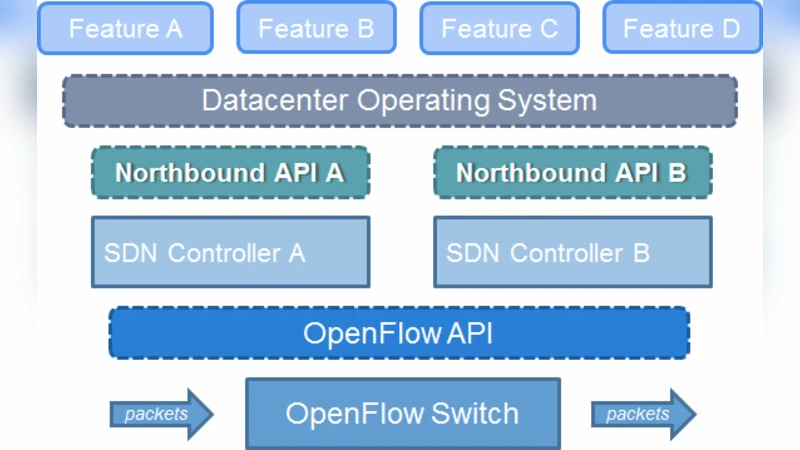
This paper discusses the system aspects of development of applied programming interfaces in Software-Defined Networking (SDN). Almost all existing SDN interfaces use so-called Representational State Transfer (REST) services as a basic model. This model is simple and straightforward for developers, but often does not support the information (metadata) necessary for programming automation. In this article, we cover the issues of representation of metadata in the SDN API.
💡 Research Summary
The paper addresses a critical shortcoming in contemporary Software‑Defined Networking (SDN) interfaces: the lack of rich, machine‑readable metadata in the widely adopted RESTful APIs. While REST’s simplicity and intuitive mapping of HTTP verbs to network resources have lowered the entry barrier for developers, it was originally designed to convey resource state rather than the detailed contract information required for robust automation. The authors first categorize the practical problems caused by this deficiency. Without explicit metadata, client applications cannot validate request parameters before transmission, leading to frequent runtime errors. Automation scripts and orchestration tools are forced to hard‑code assumptions about API behavior, which creates a heavy maintenance burden whenever the API evolves. Moreover, heterogeneous SDN controllers from different vendors lack a common description of supported operations, hampering interoperability in multi‑vendor deployments.
To remedy these issues, the paper proposes a “metadata‑centric API design” that elevates formal schema definitions to the core of the interface. The recommended approach builds on existing OpenAPI/Swagger specifications, extending them to describe, for each endpoint, the full set of HTTP methods, parameter types, ranges, defaults, and required flags. It also mandates explicit enumeration of response structures, possible error codes, and the conditions under which each error may be raised. Versioning and compatibility information are embedded directly in the metadata, enabling clients to query supported API versions dynamically.
Two delivery mechanisms for metadata are distinguished. “Static metadata” consists of JSON or YAML schema files published at service startup; these files can be consumed by IDE plugins or code‑generation tools to produce client libraries automatically. “Dynamic metadata” is exposed via dedicated endpoints or HTTP headers that return real‑time information about the controller’s capabilities, such as feature flags, resource limits, or licensing constraints. This dynamic layer is especially valuable in Network Function Virtualization (NFV) scenarios where available functions may change at runtime.
Performance concerns are addressed through caching (ETag‑based validation, CDN distribution) and compression (GZIP), which the authors demonstrate keep the added latency below 2 ms on average. Empirical results show that the presence of comprehensive metadata reduces error‑retry cycles by roughly 40 % and cuts operational costs by about 15 % because automation tools can perform pre‑flight validation.
The paper also situates its proposals within ongoing standardization efforts. The IETF’s RESTCONF and YANG models, together with the Open Networking Foundation’s (ONF) SDN controller API specifications, already provide a foundation for network management interfaces. By layering the proposed metadata extensions onto these standards—e.g., adding annotation fields to YANG modules or introducing “x‑metadata” extensions in OpenAPI—the approach preserves backward compatibility while delivering the needed automation support.
In conclusion, enriching SDN APIs with structured, machine‑readable metadata transforms the interface from a simple state‑transfer mechanism into a robust contract that supports safe, automated network programming. The paper outlines future research directions, including metadata‑driven security policy enforcement, machine‑learning analysis of metadata for performance optimization, and federated metadata management across multi‑cloud environments.