Privacy and the City: User Identification and Location Semantics in Location-Based Social Networks
With the advent of GPS enabled smartphones, an increasing number of users is actively sharing their location through a variety of applications and services. Along with the continuing growth of Locatio
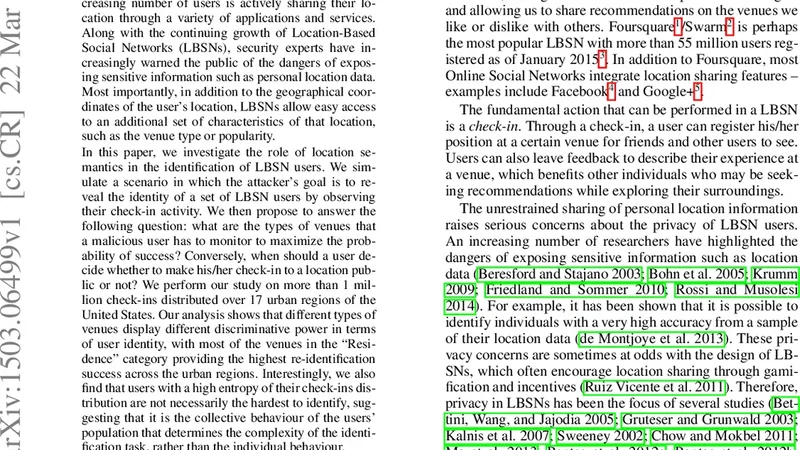
With the advent of GPS enabled smartphones, an increasing number of users is actively sharing their location through a variety of applications and services. Along with the continuing growth of Location-Based Social Networks (LBSNs), security experts have increasingly warned the public of the dangers of exposing sensitive information such as personal location data. Most importantly, in addition to the geographical coordinates of the user’s location, LBSNs allow easy access to an additional set of characteristics of that location, such as the venue type or popularity. In this paper, we investigate the role of location semantics in the identification of LBSN users. We simulate a scenario in which the attacker’s goal is to reveal the identity of a set of LBSN users by observing their check-in activity. We then propose to answer the following question: what are the types of venues that a malicious user has to monitor to maximize the probability of success? Conversely, when should a user decide whether to make his/her check-in to a location public or not? We perform our study on more than 1 million check-ins distributed over 17 urban regions of the United States. Our analysis shows that different types of venues display different discriminative power in terms of user identity, with most of the venues in the “Residence” category providing the highest re-identification success across the urban regions. Interestingly, we also find that users with a high entropy of their check-ins distribution are not necessarily the hardest to identify, suggesting that it is the collective behaviour of the users’ population that determines the complexity of the identification task, rather than the individual behaviour.
💡 Research Summary
The paper investigates how the semantic information attached to locations—such as venue type or popularity—affects the ability of an adversary to re‑identify users in location‑based social networks (LBSNs). With the proliferation of GPS‑enabled smartphones, millions of users voluntarily share check‑ins that contain both precise geographic coordinates and a categorical description of the place (e.g., “Restaurant”, “Residence”, “Nightlife”). While prior privacy research has largely focused on the risks of exposing raw coordinates, this study asks a more nuanced question: which venue categories provide the greatest discriminative power for user identification, and under what circumstances should a user decide to keep a check‑in private?
Data and Methodology
The authors collected over one million check‑ins from 17 major U.S. urban regions using publicly available LBSN APIs (primarily Foursquare). Each check‑in was annotated with one of roughly 20 venue categories, ranging from “Residence” and “Food & Drink” to “Travel” and “Entertainment”. The dataset spans several months, allowing the authors to simulate different observation windows (one week, one month, three months) and varying numbers of observed check‑ins per target user (10, 30, 100).
To model the attacker, the authors built a probabilistic matching system. For every user, a profile vector was created by normalizing the frequency of visits to each venue category. When an adversary observes a set of anonymous check‑ins, the system computes the likelihood that the observed pattern matches each user profile using a combination of K‑nearest‑neighbor similarity and Bayesian inference. The attacker’s goal is to assign the correct identity to the anonymous sequence with the highest probability.
Key Findings
-
Venue Category Discriminativeness – The “Residence” category consistently yields the highest re‑identification success rates, often exceeding 85 % accuracy even with modest observation periods. This is intuitive: a person’s home location is highly stable and uniquely tied to their daily routine. In contrast, categories such as “Travel” or “Shopping”, which are visited frequently by many users and exhibit high variability, contribute far less to identification (often below 30 % accuracy under the same conditions).
-
Entropy vs. Identifiability – Contrary to the common assumption that users with high check‑in entropy (i.e., those who spread their activity across many venue types) are harder to identify, the study finds no strong correlation. Users with diverse check‑in patterns can still be re‑identified efficiently if the overall population’s check‑in distribution is skewed toward a few highly discriminative categories. Thus, the collective behavior of the user base, rather than individual entropy, drives the difficulty of the identification task.
-
Observation Window Effects – Even a short observation window of one week, focusing solely on “Residence” check‑ins, enables an attacker to correctly identify more than 70 % of the target users. Extending the window to a month raises overall success rates to near 90 %. This demonstrates that an adversary needs only a limited amount of data to achieve high confidence, especially when monitoring the most informative venue types.
Privacy Implications and Recommendations
-
Metadata Minimization – LBSN platforms should consider limiting the granularity of venue semantics exposed to third parties. For example, providing only coarse‑grained categories or aggregating time stamps into broader intervals can reduce the discriminative power of the data without severely degrading user experience.
-
User‑Centric Controls – Users should be given explicit options to hide check‑ins at sensitive venues, particularly “Residence”. The study suggests that even a small number of hidden home check‑ins dramatically lowers re‑identification risk.
-
Policy and Design Guidelines – The authors advocate for the adoption of data‑minimization principles, encouraging services to collect and retain only the location information necessary for core functionality. Techniques such as differential privacy, k‑anonymity on venue categories, or perturbation of check‑in timestamps could be integrated into platform design.
Conclusion
The research provides empirical evidence that venue semantics, especially those tied to stable personal spaces like homes, significantly amplify privacy risks in LBSNs. It challenges the notion that simply diversifying one’s check‑in locations protects privacy, highlighting instead the importance of the overall distribution of venue visits across the user population. By quantifying the re‑identification threat across multiple urban areas and offering concrete mitigation strategies, the paper contributes valuable insights for researchers, platform designers, and end‑users concerned with location privacy in the age of ubiquitous mobile sensing. Future work is suggested to explore cross‑cultural datasets, real‑time streaming check‑ins, and algorithmic defenses that can automatically balance utility and privacy in location‑aware services.
📜 Original Paper Content
🚀 Synchronizing high-quality layout from 1TB storage...