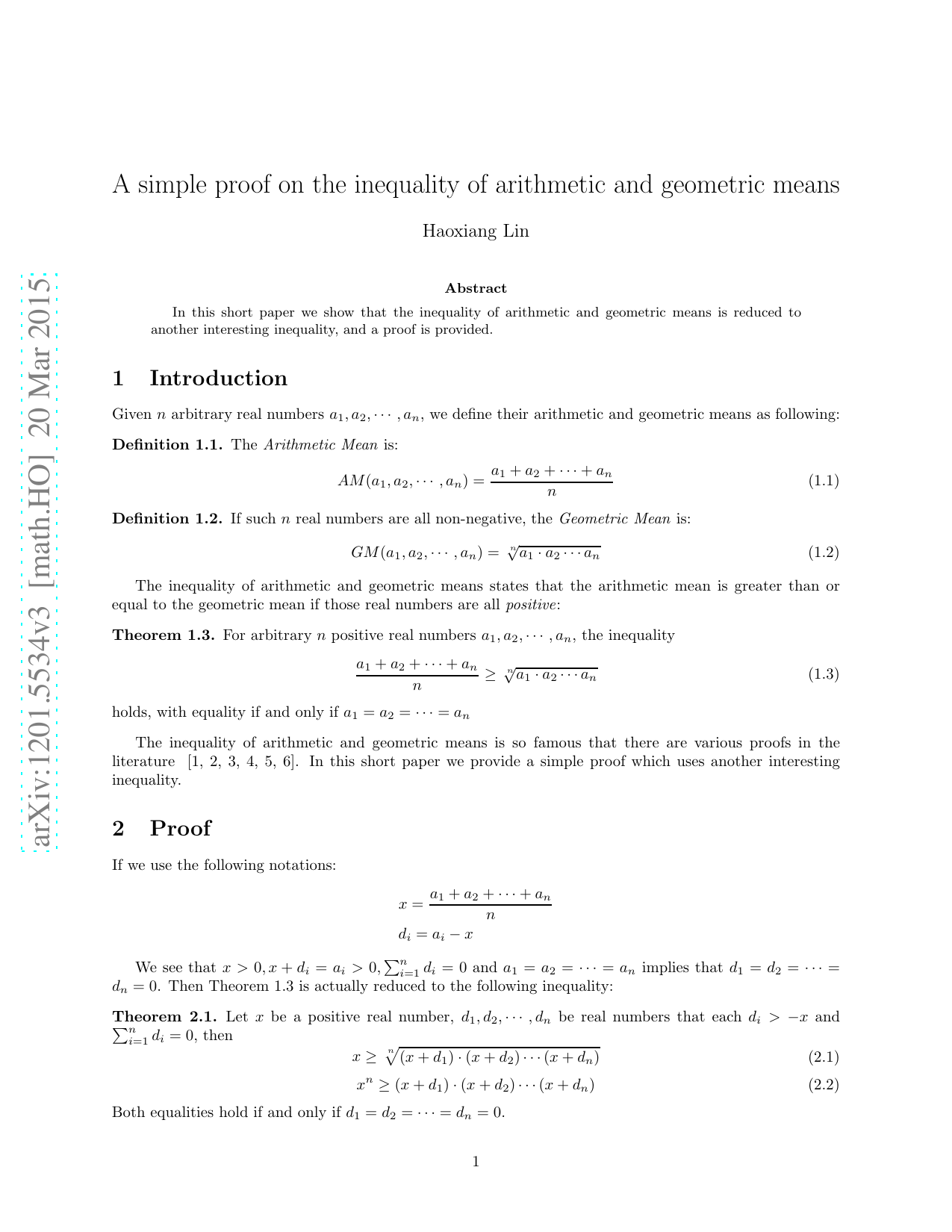
In this short paper we show that the inequality of arithmetic and geometric means is reduced to another interesting inequality, and a proof is provided.
Deep Dive into A simple proof on the inequality of arithmetic and geometric means.
In this short paper we show that the inequality of arithmetic and geometric means is reduced to another interesting inequality, and a proof is provided.
Given n arbitrary real numbers a 1 , a 2 , • • • , a n , we define their arithmetic and geometric means as following:
Definition 1.1. The Arithmetic Mean is:
Definition 1.2. If such n real numbers are all non-negative, the Geometric Mean is:
The inequality of arithmetic and geometric means states that the arithmetic mean is greater than or equal to the geometric mean if those real numbers are all positive: Theorem 1.3. For arbitrary n positive real numbers a 1 , a 2 , • • • , a n , the inequality
holds, with equality if and only if
The inequality of arithmetic and geometric means is so famous that there are various proofs in the literature [1,2,3,4,5,6]. In this short paper we provide a simple proof which uses another interesting inequality.
If we use the following notations:
Both equalities hold if and only if
Proof. Since x and x + d i are positive real numbers, (2.1) is equivalent to (2.2). We prove the second inequality using induction on n.
When n = 1 and 2, it is easy to verify the correctness.
Suppose that when n = k(≥ 2), the inequality is true. That is
are not all zero. Then there must be one d u > 0, one d v < 0, and u = v since n > 2. Without loss of generality, assume that d k+1 > 0 and
) also meet the prerequisites of the inequality, therefore
And we get
Now we complete the proof, and the equality holds if and only if
This content is AI-processed based on ArXiv data.