A tunable macroscopic quantum system based on two fractional vortices
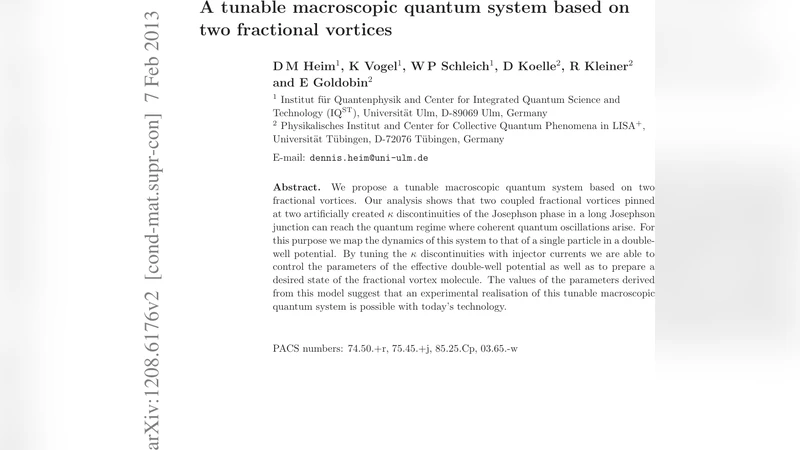
We propose a tunable macroscopic quantum system based on two fractional vortices. Our analysis shows that two coupled fractional vortices pinned at two artificially created \kappa\ discontinuities of the Josephson phase in a long Josephson junction can reach the quantum regime where coherent quantum oscillations arise. For this purpose we map the dynamics of this system to that of a single particle in a double-well potential. By tuning the \kappa\ discontinuities with injector currents we are able to control the parameters of the effective double-well potential as well as to prepare a desired state of the fractional vortex molecule. The values of the parameters derived from this model suggest that an experimental realisation of this tunable macroscopic quantum system is possible with today’s technology.
💡 Research Summary
The paper proposes a novel macroscopic quantum system built from two fractional vortices pinned at engineered κ‑discontinuities in a long Josephson junction (LJJ). Fractional vortices are topological excitations that carry a phase jump of κ (0 < κ < 2π) rather than the full 2π of a conventional fluxon. By fabricating two such discontinuities a distance d apart and using injector electrodes to impose the desired κ values, each discontinuity traps a fractional vortex, forming a “fractional‑vortex molecule.”
The authors develop an effective one‑dimensional model in which the collective coordinate φ, representing the phase difference between the two vortices, obeys the dynamics of a particle of effective mass m_eff moving in a double‑well potential V(φ). The two minima correspond to the vortices being aligned (φ ≈ 0) or anti‑aligned (φ ≈ π). Crucially, the shape of V(φ) – barrier height ΔU, well depth, and curvature – depends on κ and the separation d. By varying the injector current Iinj one can tune κ continuously, thereby reshaping the double‑well in situ.
Quantum‑mechanical analysis proceeds by solving the Schrödinger equation for the effective particle. For realistic parameters (critical current density Jc ≈ 10 A cm⁻², Josephson penetration depth λJ ≈ 30 µm, d ≈ 2 λJ, κ ≈ π) the authors find a barrier ΔU ≈ 0.5 K·kB and an intra‑well oscillation frequency ω0 ≈ 5 GHz. The resulting tunneling splitting corresponds to a tunneling rate Γ ≈ 10⁶ s⁻¹, well within the detection capabilities of modern dilution refrigerators (base temperature < 10 mK) and microwave spectroscopy setups.
A key advantage of this architecture is the ability to prepare a desired quantum state on demand. By momentarily driving κ far from its operating point, the system can be forced into a specific well; returning κ to the target value then isolates the system in the chosen state. Subsequent coherent oscillations between the two wells – macroscopic quantum tunneling – can be observed, or the barrier can be lowered again to accelerate tunneling for calibration purposes.
The paper also discusses practical implementation issues. Injector electrodes must deliver low‑noise currents; the authors suggest using filtered, battery‑powered sources and cryogenic attenuators to suppress phase noise that would otherwise limit coherence times. Fabrication tolerances for the κ‑discontinuities are compatible with existing Nb‑AlOx‑Nb junction technology, and the required geometry (two discontinuities separated by a few λJ) can be realized with standard electron‑beam lithography.
In summary, the work demonstrates theoretically that a pair of coupled fractional vortices can be mapped onto a tunable double‑well potential, enabling controllable macroscopic quantum oscillations. The ability to adjust κ electrically provides a versatile knob for exploring the crossover between classical and quantum regimes, preparing specific quantum states, and potentially integrating such elements into larger superconducting quantum circuits for qubit design, quantum sensing, or fundamental studies of macroscopic quantum coherence.